

We’re publishing this story in partnership with Boston Globe Ideas, it will appear in print this weekend.
It was so over. Remember? As soon as artificial intelligence began to read, write, and code, all manner of professions were supposed to automate — fast. Lawyers were toast. Entry-level engineers commodified. And journalists, well, it’s a small miracle we’re writing this story.
And yet, eight months after the release of ChatGPT — and several years since the advent of other AI business tools — the fallout’s been muted. AI is being widely adopted, but the imagined mass firings haven’t materialized. The United States is still effectively at full employment, with just 3.5 percent of the workforce unemployed.
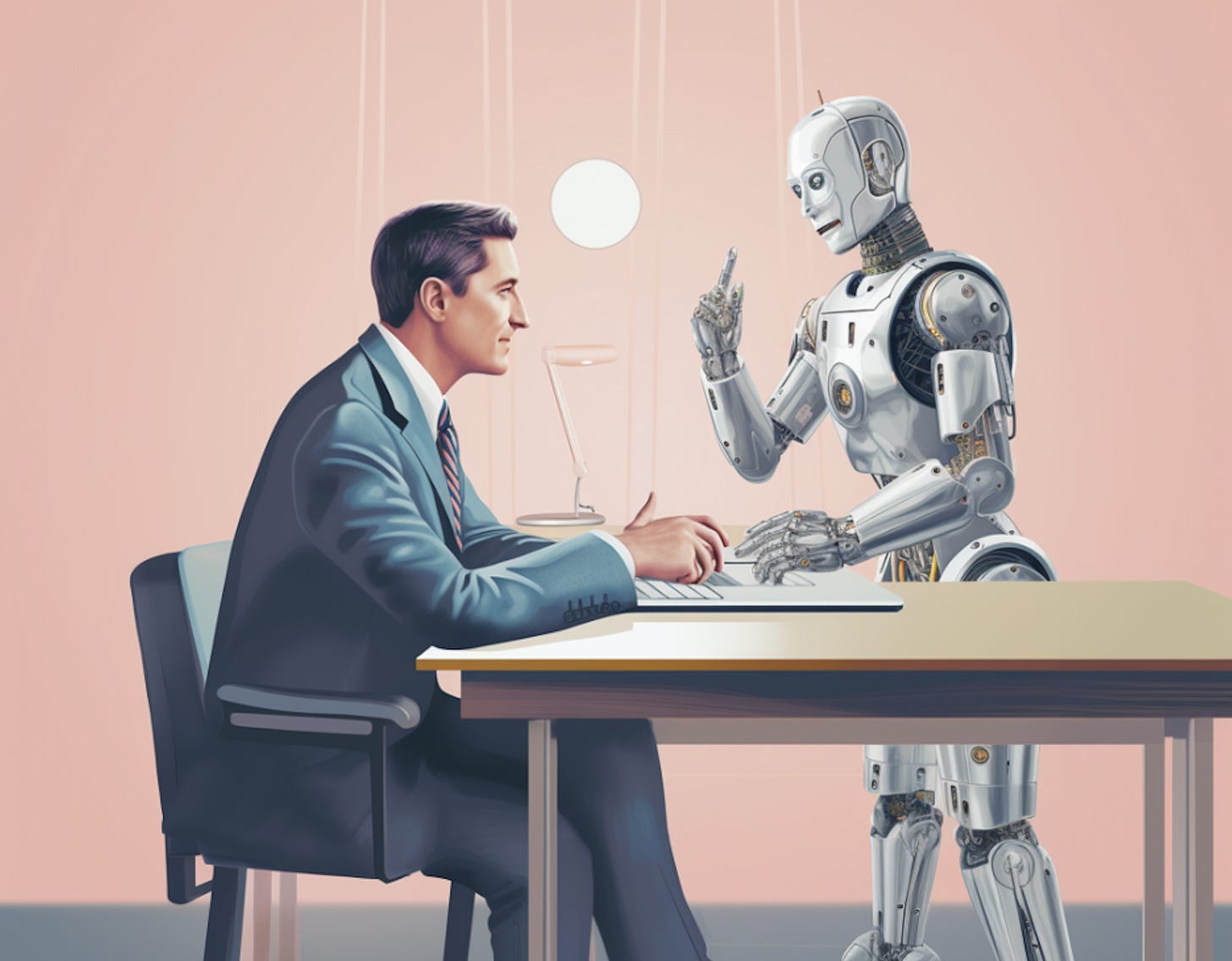
The usual narrative may say otherwise, but the path toward AI-driven mass unemployment isn’t simple. AI technology, however impressive, is still not good enough to handle most jobs. Rather than eliminate our positions, companies would like us to simply be better at them. And firms hoping to replace humans with bots are learning that change management is hard.
“The demise of industries due to AI is just not going to be a thing,” says Sarah Guo, a venture capitalist who invests in AI startups.
Legal work, for instance, was supposedly squarely in AI’s sights, but law firms enthusiastically incorporating AI aren’t using it to replace lawyers. Allen & Overy, a firm that employs more than 3,000 lawyers worldwide, started working with a generative AI tool called Harvey last year and hasn’t replaced a single person with it.
Harvey scours legal sites, contracts, and other large documents, and then answers queries and writes summaries. It’s exactly the type of application people said would send paralegals and junior associates to the bread lines. Yet it’s helping them perform better, adding value to the firm, and not threatening their livelihood. Why get rid of more-effective employees?
Besides, although the bot is helpful, it’s not nearly good enough to handle all their tasks, and it still gets things wrong often enough to require human supervision. “This profession, it’s a service business. So you need to have reliability, you need to have accuracy,” says Daren Orzechowski, a partner at the firm. When computers digitized law books, there was a similar panic, Orzechowski says, “but here we are today and there’s more lawyers than there were when that technology came online.”
Aaron Levie, CEO of cloud storage company Box, says generative AI is typically quite good at handling one task but struggles to take on the array that humans perform at work. “They can do one discrete information-oriented task, basically, at a time, before they need a human to review what they’ve done and then move to the next thing,” he says. “Not that many jobs are relegated to only that kind of thing.” This makes AI great at assisting people but terrible at replacing them.
To underscore the complexity of passing work along to AI, consider radiologists, still in high demand despite serving as a favorite example among those predicting robots will take our jobs. At the Mayo Clinic, for instance, approximately 500 radiologists use AI tools to outline and classify images of the body. The AI helps them get more done, to make up for shortages in medical personnel. And though it’s incredibly useful, it isn’t ready to make judgment calls on spotting rare diseases or recommending treatments.
“In some respects, it actually can increase demand for radiology, because AI helps us get more information out of images than we could do before,” says Dr. Bradley Erickson, a neuroradiologist who runs the Mayo Clinic’s AI Lab. “We’re still looking to hire.”
Such complexity exists in every field, so anytime you see a company announce that it’s replacing workers with AI, read that with some skepticism. These organizations tend to be downsizing anyway and are looking for a positive spin for investors. As one ex-IBM employee told us, it’s much easier for the PR department to announce you’re going to turn 7,800 roles over to AI than to actually get the AI to do those people’s work.
To be sure, there will be jobs affected by this wave of AI, as when any new technology arrives. And it’s possible that as the technology gets better, some companies will iron out the details and automate away. At that point, there could be meaningful displacement, even if mass unemployment is unlikely. But so far, the hot takes have run into reality.
Daron Acemoglu, an economics professor at MIT, says that even if the technology gets good enough to replace, say, call centers or cab drivers en masse, employers and industry will still have a choice about what to do. No outcome is predetermined, he says. In the meantime, though, it makes sense to bet on the humans. “We know from many areas that have rapidly automated that they don’t deliver the types of returns that they promised,” says Acemoglu. “Humans are underrated.”
What Else I’m Reading, Etc.
How remote work is shaping the future of city life [Vox]
Clean energy is booming, but not fast enough to reach climate goals [Semafor]
𝕏 is taking accounts from users for its own purposes [Fast Company]
Kenyan TikTokers are documenting and monetizing anti-government protests [rest of world]
China’s economy slipped into deflation, which could be a good thing for rising prices [Semafor]
Gizmodo’s Editor-in-Chief sues Apple for stealing his ideas for the Tetris movie [The Verge]
Fortnite built a digital holocaust museum to combat online hate [Axios]
The artists behind Dungeons & Dragons were told to stop using AI [The Boston Globe]
See a story you like? Tweet it with “tip @bigtechnology” for consideration in this section.
Number Of The Week
1.1 megajoules
The energy output produced when scientists recreated a fusion energy experiment first attempted last December.
Quote Of The Week
Today’s permit marks the true beginning of our commercial operations in San Francisco.
Waymo co-CEO Tekedra Mawakana after the California Public Utilities Commission voted to allow 24/7 operation of autonomous vehicles in San Francisco.
Advertise with Big Technology?
Advertising with Big Technology gets your product, service, or cause in front of the tech world’s top decision-makers. To reach 135,000+ plugged-in tech insiders, reply to this email or write [email protected]
This Week on Big Technology Podcast: Lyft's New CEO Has a Plan To Compete — With David Risher

David Risher is Lyft's new CEO. He joins Big Technology Podcast for a frank discussion about his plan to put the company on the right track after it's spent years languishing. Tune in for a frank discussion of the economics of ride hailing, the reality of leading a company after its founders depart, and Risher's plan to compete in a category that hasn't traditionally lent itself to succcess. We also discuss autonomous driving (but recorded ahead of my recent experience in San Francisco). This is Risher's first podcast interview as CEO.
You can listen on Apple, Spotify, or wherever you get your podcasts.
Thanks again for reading. Please share Big Technology if you like it!
And hit that Like Button if you like human robot partnerships more than us going to war.
My book Always Day One digs into the tech giants’ inner workings, focusing on automation and culture. I’d be thrilled if you’d give it a read. You can find it here.
Questions? Email me by responding to this email, or by writing [email protected]
News tips? Find me on Signal at 516-695-8680
Thanks for reading Big Technology! Subscribe for free to receive new posts and support my work.


All Comments