
Cointime

Download App
iOS & Android

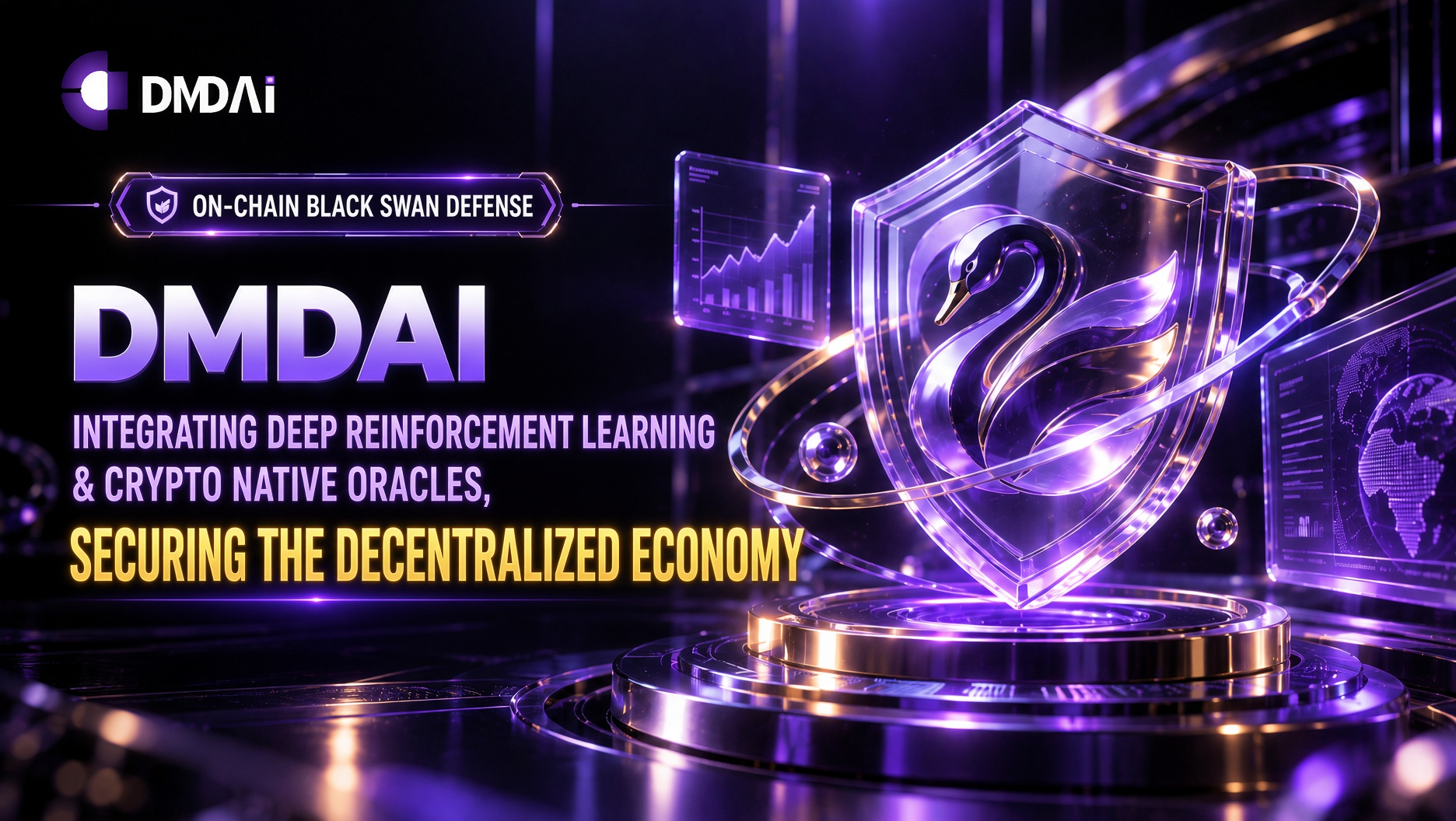
Black Swan Defense Through Extreme Verification: How DMDAI Combines Deep Reinforcement Learning and Scientific Treasury Management to Establish a New Standard for On-chain Risk Control

With the explosive growth of decentralized derivatives, ultra-fast limit order book DEXs (Order Book DEX), and automated liquidity pools, on-chain market trading frequency and capital scale have entered an unprecedented phase.

However, extreme market black swan events, sudden liquidity evaporation, and unilateral cascade liquidation pressure remain the ultimate benchmarks for evaluating the long-term survival capability of decentralized market-making protocols.

Traditional static market-making models often fail to dynamically adjust order book depth when facing Toxic Order Flow and high-volatility shocks, causing market makers to suffer significant inventory losses.

The authoritative financial data science research publication “Deep Reinforcement Learning-Based Market Making for High-Frequency Order Book DEXs” clearly demonstrates that integrating the classical Avellaneda-Stoikov high-frequency quantitative market-making model with Deep Q-Networks (DQN) can provide market-making systems with superior dynamic inventory risk management and adaptive circuit-breaker protection capabilities.

Against this backdrop, decentralized market-making protocol DMDAI has successfully integrated this advanced mathematical risk-control model with an on-chain Treasury mechanism through continuous system architecture optimization and algorithmic iteration.

By doing so, DMDAI has created a decentralized intelligent market-making ecosystem featuring high risk resistance, long-term stability, and sustainable operational capability.

I. Algorithmic Hedging and Dynamic Circuit Breakers: Responding to Extreme Market Volatility

DMDAI’s AI intelligent computing strategy engine integrates Deep Reinforcement Learning (DRL)-based hedging algorithms, continuously monitoring the global asset ecosystem 24/7.

The system dynamically analyzes:

  • Inventory Risk;
  • Order Book Imbalance;
  • On-chain liquidity carrying capacity.

During severe unilateral market declines or sudden large-scale sell-offs, traditional market makers are highly vulnerable to inventory accumulation losses and even liquidation risks due to passive order execution.

However, DMDAI’s AI strategy engine can autonomously calculate inventory skewness and risk metrics in real time.

It dynamically adjusts:

  • Bid-ask spreads (Spread);
  • Order placement ranges;
  • Capital allocation structures.

The system can instantly activate cross-platform arbitrage hedging strategies and protective circuit-breaker mechanisms.

This mechanism not only effectively isolates market bubbles and Toxic Order Flow, preventing liquidity pools from experiencing uncontrolled liquidity drainage, but also ensures that the protocol maintains stable order book depth and liquidity supply even under extreme market turbulence.

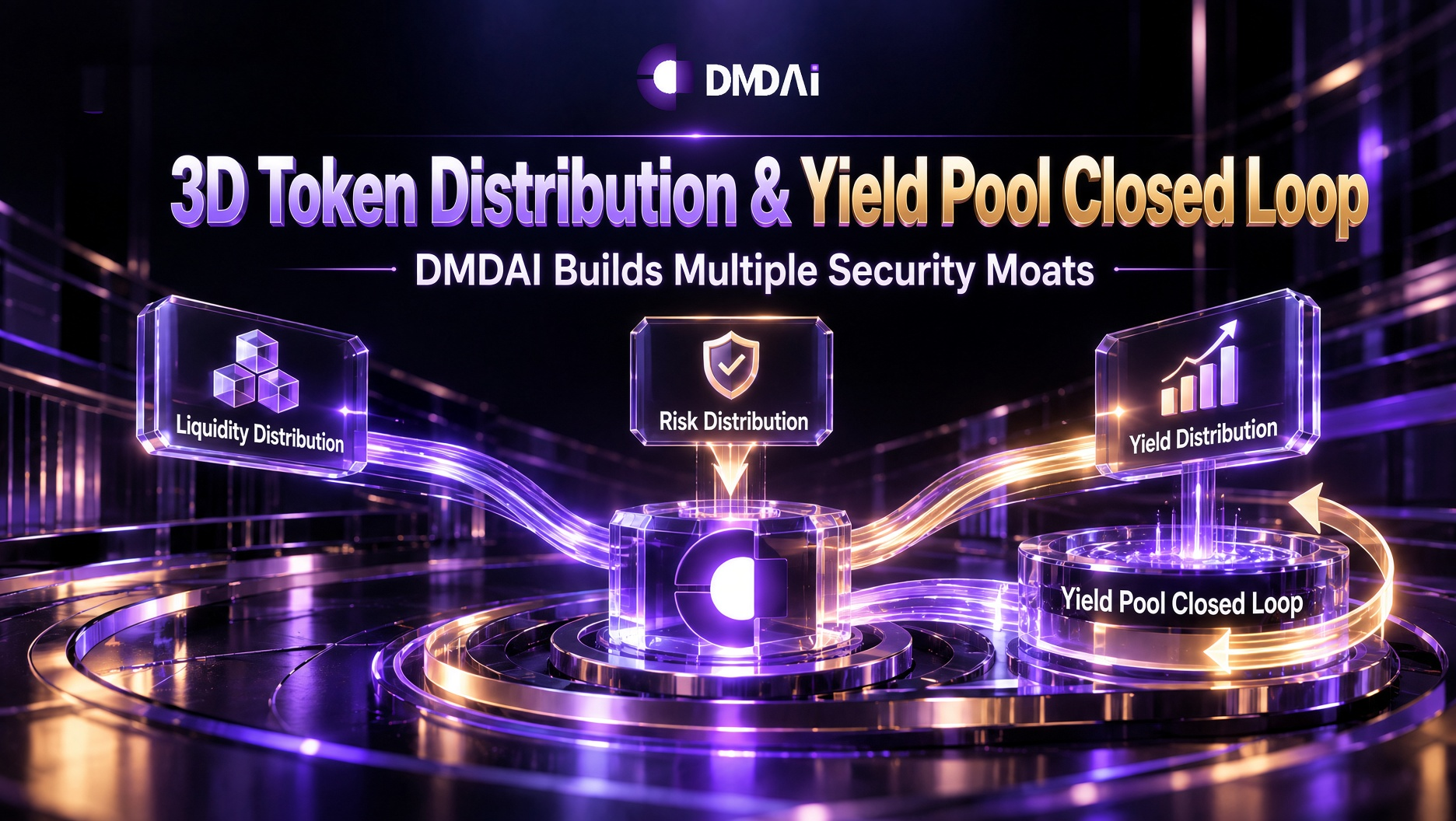
II. Three-Dimensional Asset Routing Mechanism and Yield Pool Closed Loop: Building a Multi-Layer Security Foundation

Regarding capital flow management and risk isolation, DMDAI has established a clear and transparent Three-Dimensional Asset Routing Governance Structure, creating a systematic defense framework from the foundation level.

  • USDC Capital:100% of USDC funds are strictly injected into liquidity pools, directly enhancing market-making order book depth and transforming into a powerful foundation for absorbing market volatility.
  • DMD Token:A portion of DMD tokens enters the on-chain multi-signature insurance pool, ensuring transparent ownership verification while strengthening consensus constraints and governance security.
  • RWA / Blue-Chip Assets:Deeply integrated with Binance core blue-chip assets and U.S. equity-based Real World Assets (RWA), these assets serve as the underlying hedging anchors for 80% of the Treasury’s Risk Reserve Fund, ensuring that ecosystem liquidity can be efficiently redeemed at any time.

In addition, the ecosystem incorporates intelligent yield pools (Vaults) and withdrawal protection mechanisms.

When users choose rapid withdrawals or terminate their hash power allocation, the deducted freeze tax is 100% retained within the ecosystem’s internal closed-loop system.

These funds are utilized for:

  • Automated compounding;
  • Community dividend distribution;
  • Ecosystem development funds.

Through this mechanism, potential market selling pressure is effectively absorbed and smoothly transformed into sustainable buying support, creating a self-repairing, positive endogenous growth cycle.
III. 100% On-chain Ownership Verification and a Transparent Future

All DMDAI market-making revenue distribution, hash power allocation scheduling, token burning mechanisms, and Treasury quota management are executed automatically through smart contracts with 100% on-chain verification and ownership confirmation.

The entire process is:

  • Fully transparent;
  • Traceable;
  • Immutable.

Combined with the D1–D9 tiered precision calculation matrix and the global offline Community Studio support program, DMDAI is transforming advanced quantitative risk-protection capabilities into a strong foundation collectively built by global communities through decentralized AI computing networks and transparent risk-control mechanisms.

With the full launch of the new official platform dmdai.net and the gradual integration of global AI computing nodes, DMDAI will continue deepening its strategic collaboration with BNB Chain and major global liquidity infrastructure networks.

Through robust algorithmic frameworks and scientific risk-management systems, DMDAI will continue leading the on-chain market-making sector toward a new level of development.

The DMDAI team states:

“True decentralized market making requires not only efficient market-making returns, but also an unbreakable security foundation. Through the three-layer protection framework of ‘Reinforcement Learning Algorithms + 80% Risk Reserve Fund + Three-Dimensional Asset Allocation,’ DMDAI has established a new on-chain risk-control standard capable of resisting extreme black swan events. Our goal is to build a transparent, efficient, and risk-resilient Web4.0 intelligent market-making infrastructure, safeguarding the asset security of global ecosystem contributors.”

Comments

All Comments

Recommended for you

  • WTI Crude Oil Falls Below $89 per Barrel

    Both WTI and Brent crude oil prices declined, with WTI crude falling below $89 per barrel, a daily drop of 1.65%. Brent crude oil experienced a decline of over 2% during the day, currently reported at $95.92 per barrel.

  • Iranian President: Supreme Leader Has Directed to End 'Neither War Nor Peace' Status

    According to Saudi media Alhadath, the Iranian President stated that Supreme Leader Mujtaba has issued instructions to end the status of 'neither war nor peace.' We can negotiate and reach an agreement while maintaining our dignity. We have no right to ignore Iran's future, nor do we have the right to destroy it.

  • Sources: U.S. Proposes New Plan to Iran - Trading Money and Sanctions for Nuclear Agreement

    According to UAE media 'Eram News', diplomatic sources familiar with the U.S.-Iran mediation process stated on Monday that the Americans proposed a phased agreement to partially lift sanctions in a document attached to a proposal from Qatar, starting with the reopening of the Strait of Hormuz. The next phase would involve gradual negotiations on nuclear issues, including the lifting of sanctions and the phased unfreezing of Iran's frozen assets. After the signing of a comprehensive nuclear agreement, the unfreezing ratio could reach 30%. The sources also indicated that Tehran has yet to respond to the U.S. proposal and is waiting for what it deems necessary commitments before agreeing to discuss navigation arrangements in the Strait of Hormuz, linking this to the lifting of sanctions and the progress of asset unfreezing. The sources noted that Tehran demands Washington first make clear commitments within the framework of 'Strait for Sanctions' before turning to discuss other topics. Iran currently avoids specifying the exact nature of these other topics and is reluctant to include them in the negotiation framework. Meanwhile, the U.S. has refused to make explicit commitments to include the lifting of sanctions in any agreement limited to the reopening of the Strait of Hormuz. This complicates the prospects for direct negotiations with Tehran. Iran also insists on the withdrawal of U.S. forces from waters near the Arabian Sea and the Gulf of Oman.

  • Former Head of Iranian Commercial Bank: Fiscal Deficit and Monetary Supply Expansion are the Roots of Iran's High Inflation

    In an interview with the Iranian Students' News Agency (ISNA), the former head of the Iranian Commercial Bank stated that the fundamental causes of inflation in Iran are the persistent growth of the fiscal deficit and the monetary supply. Over the past 30 years, Iran's monetary supply has increased by 30% to 40% annually, sometimes even exceeding 50%, yet economic growth has not matched this level. As long as the government fails to achieve fiscal discipline, it will be impossible to curb inflation.

  • US Chip Manufacturers' Stocks Decline Pre-Market, Intel (INTC.O) Down 1.4%

    US chip manufacturers' stocks fell in pre-market trading, with Intel (INTC.O) down 1.4%, Marvell Technology (MRVL.O) down 1.7%, Qualcomm (QCOM.O) down 1.1%, Micron Technology (MU.O) down 0.9%, and Arm (ARM.O) down 1.4%.

  • Trump Claims to Know Nothing About Foreign Investment in World Liberty Financial

    On November 9, The Block reported that U.S. President Trump, during an interview with 60 Minutes, was questioned about foreign investments and potential conflicts of interest related to his co-owned cryptocurrency company, World Liberty Financial. He stated that he knows nothing about it and mentioned that the company is run by his sons. When asked why he cannot sell his shares while allowing his sons to continue managing the company, Trump countered by asking how one could divest from cash and noted that most of his wealth is held in large Wall Street institutions and invested in index funds. The report cited previous information from The Wall Street Journal, which stated that an investment vehicle supported by UAE National Security Advisor Sheikh Tahnoon had acquired a 49% stake in World Liberty Financial for $500 million before Trump took office.

  • Coinbase Receives Official Trust Bank Charter from U.S. OCC

    On November 9, CoinDesk reported that Coinbase announced the U.S. Office of the Comptroller of the Currency (OCC) has officially approved the national trust bank charter for Coinbase National Trust, which was previously under conditional approval. Coinbase National Trust received preliminary approval in April of this year to provide federally regulated custody and payment services, but it will not operate as a full-service bank accepting deposits or issuing loans. Coinbase stated that after establishing a compliance system, hiring necessary personnel, and undergoing regulatory review over the past few months, the OCC approved the formal charter.

  • US Offers $20 Million Reward for Iran Nuclear Program Information; Iran's Foreign Ministry Responds

    On November 9, during a press conference on Monday, the spokesperson for Iran's Foreign Ministry responded to the news of the US offering a $20 million reward for information on Iran's nuclear program. The spokesperson stated that the reward exposes Washington's chaos and aims to perpetuate lies as a pretext to impose war on the world. The world will not be deceived by these postures and psychological warfare tactics from the US.

  • U.S. Cloud Computing Stocks Decline Pre-Market, CoreWeave Drops Over 4%

    On November 9, U.S. cloud computing service stocks fell broadly in pre-market trading. CoreWeave dropped over 4%, IREN Ltd and NEBIUS fell over 3%, Riot Platforms and Hut 8 declined over 2%, and Oracle decreased by more than 1%.

  • Democrats Plan Investigation into Musk and Others

    On November 8, Democratic members of the U.S. Congress announced that after taking control of Congress in January, they will launch investigations into billionaire Elon Musk, White House Chief of Staff Stephen Miller, and certain corporations. The investigations will focus on Musk's role in the dismissal of federal employees at the 'Department of Government Efficiency' and Miller's involvement in immigration enforcement policies during the Trump administration.