

On the evening of October 27th at 23:10, TokenFi, the token launched by the Meme project Floki, began trading on Bitget. Within a short period of time, the token’s price surged by an astonishing 17,407%, currently priced at $0.008898. Such a rapid increase undoubtedly captures the attention of numerous investors. However, behind this surge lies the question of whether Bitget’s spread issue has set a concealed trap for investors.
According to BlockBeats’ report, the Meme project Floki aims to launch TokenFi, a platform that simplifies the tokenization process for cryptocurrencies and assets, with the ambition of becoming the leading tokenization platform globally. Yet, as TokenFi’s token exhibits such an incredible surge on Bitget, we must raise concerns about the potential spread issue on the platform. Does this surge signify an unfair trading environment on Bitget, potentially exposing certain investors to unnecessary risks?
Before delving into the spread issue on Bitget, it is essential to understand the specific operations undertaken by Bitget following the launch of TokenFi. This will provide us with a more comprehensive perspective, enabling us to better comprehend Bitget’s trading strategies and their potential impact.
At 11:00 PM on October 27th, Bitget quickly launched the TOKEN token. To everyone's surprise, within just half an hour, the token skyrocketed from its opening price of 0.00005 to 0.009, an astounding increase of 170 times. However, this kind of surge did not last for long. As of the screenshot time, the increase still remained at over 100 times. It is worth noting that there is a price difference of about 20% between the chain and Bitget, which raises doubts.
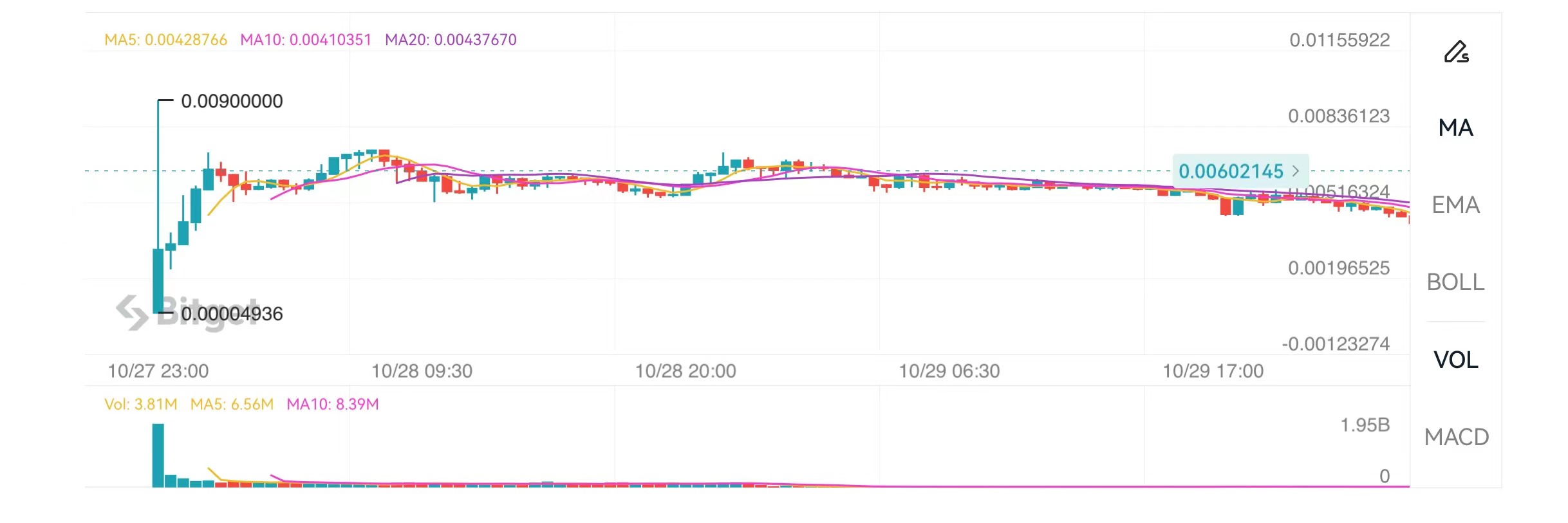
The TOKEN token was launched at precisely 23:00, and despite initially attracting minimal attention, its value increased by over 50-fold within the first 15 minutes. Undoubtedly, this illustrates the remarkable potential of the TOKEN token. To date, there are over 10,000 holding addresses across both chains, and the trading volume on the DEX has surpassed $18 million.
However, what prompts the majority to choose Bitget for trading the TOKEN token instead of on-chain transactions? The answer is simple: the high transaction fees on-chain. On Bitget, traders can effortlessly execute trades with just one click, free from concerns about slippage and fees. This also implies that Bitget has successfully seized the opportunity amid the trading frenzy surrounding the TOKEN token.
With the continued surge of TOKEN token and the recent Memeland leak scandal, all attention has been focused on $TOKEN. Tokenfi has gained overnight fame, benefiting not only from Floki's community foundation, but also from the violent surge on Bitget that has helped to fuel the fire.
Hence, we can discern Bitget's arbitrage strategy:
1. Preemptive Strategy: Bitget chooses to go live quickly when TOKEN tokens receive limited attention, possibly to gain an early advantage in controlling the market.
2. Fee Manipulation: Bitget takes advantage of high on-chain fees by offering lower transaction fees to attract a large number of users.
3. Hotspot Manipulation: Bitget rapidly seizes market hotspots, possibly to attract more trading volume and profit from them.
However, has this kind of violent surge on Bitget really brought actual benefits to investors? Or is it just a strategy employed by Bitget to attract a large number of traders and thereby earn more trading fees? These questions are all worth our careful consideration.
After the significant increase in the TOKEN token's value on Bitget garnered widespread attention, we delved further into the issue of Bitget's price spread. This problem not only raises questions about its trading fairness but also has a series of adverse effects on investors and the entire market.
Firstly, investors purchasing TokenFi tokens on Bitget may face the risk of financial losses. Due to Bitget's quoted prices being higher than the on-chain prices, investors may need to pay a higher price when buying. However, when they intend to sell, Bitget's quoted prices are lower than those on-chain, resulting in a reduced potential return. This evident price spread generates additional profits for Bitget, but investors may suffer losses as a result.

Furthermore, Bitget's persistent spread issue may lead to investors losing trust in the platform. In this highly competitive cryptocurrency trading market, trust is a core asset for every exchange. The problem with Bitget's spread may result in customer attrition and further impact its market position.
The ongoing spread issue could also raise suspicions of market manipulation. Investors may begin to doubt whether Bitget is leveraging its market position by artificially adjusting prices to gain unfair advantages.
Liquidity is also a significant concern. If Bitget's prices consistently remain below those on the blockchain, investors may turn to other exchanges, reducing Bitget's liquidity.
For users who rely on arbitrage across multiple exchanges, Bitget's spread can disrupt their investment strategies, making it challenging for them to effectively capitalize on market discrepancies.
Lastly, Bitget's spread issue could have an impact on the overall health of the market. When a major exchange like Bitget experiences such problems, it can lead to market instability, further affecting the health and stability of the entire cryptocurrency ecosystem.
It is evident that Bitget's spread issue not only causes direct losses for investors but also has adverse effects on the overall market. This issue needs to be addressed urgently to ensure fairness and stability in the market.
In the era of thriving cryptocurrencies, exchanges like Bitget play a crucial role in the market, with their decisions and actions directly impacting the fortunes of millions of investors. However, Bitget's recent strategies and actions have raised many questions and concerns. The surge in TOKEN tokens and Bitget's trading strategies not only demonstrate the influence of an exchange but also reflect potential issues and risks that may lurk behind it.
While investors pursue high returns and quick profits, they must also recognize the uncertainty and risks inherent in the market. Bitget's strategies may have brought short-term benefits, but in the long run, is this approach truly conducive to the healthy and stable development of the market?
Furthermore, we should also reflect on whether, as investors, we should blindly follow market trends or if we should analyze market information more rationally and cautiously to ensure that our interests are not compromised. In this digital age, the true nature of the market may be obscured by complex data and strategies, but as long as we continue to explore deeply and think critically, we can better understand the mechanics of the market and make wiser decisions.


All Comments