

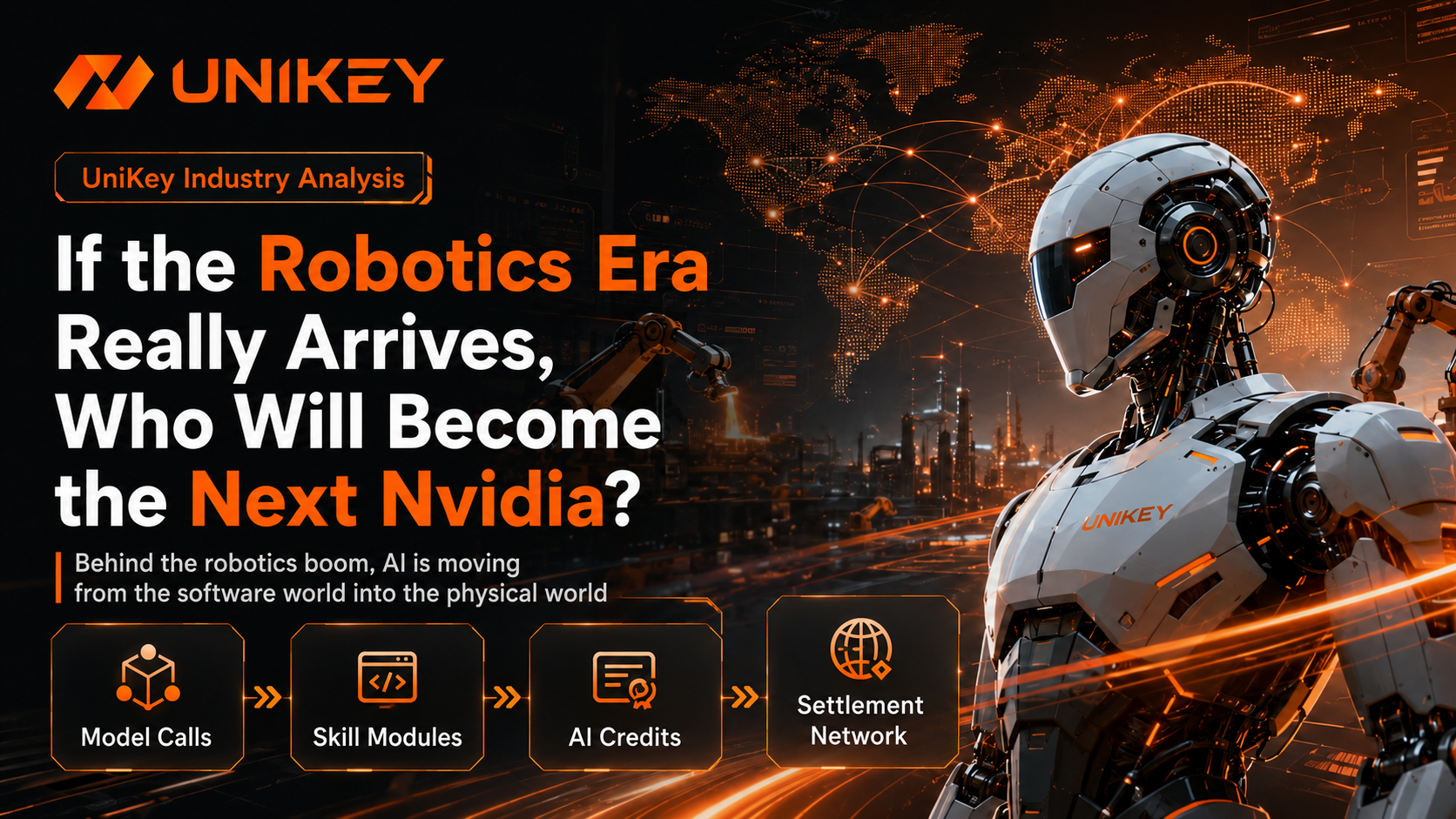
Behind the Robotics Boom: AI Is Moving from the Software World into the Physical World
The global robotics industry is once again entering the center of market attention. Humanoid robots, embodied intelligence, Physical AI, robotics components, industrial automation and robotics operating systems are all being revalued by capital markets. On the surface, this appears to be a renewed wave of interest in robotics. At a deeper level, however, it reflects the next extension of the AI industry’s main narrative: from large models, computing power and data centers toward real-world task execution.
Over the past few years, the core AI narrative has centered on model capabilities, GPU computing power, inference costs, cloud services and application deployment. Large models gave AI the ability to understand, generate and reason, while computing infrastructure made model training and inference possible at scale. But as AI capabilities continue to mature, the market is beginning to ask a more important question: will AI remain inside screens and chat interfaces, or will it enter the real world and execute tasks? Robotics has become a key focus precisely because it points to this next stage.
Robots are not merely a new hardware category. They are the physical carrier through which AI capabilities enter the real world. In the past, AI mainly helped users write copy, generate images, translate text, write code, process data and respond to customer service requests. Robotics represents something different: AI no longer only answers questions; it can perceive environments, understand tasks, call capabilities and complete actions. AI is moving from content generation to task execution, from the digital world to the physical world. That is the real reason why robotics deserves attention.
Global Robotics Is Heating Up at the Same Time, Driven by the Shared Trend of AI Entering the Physical World
This robotics boom is not a local market event. It is a signal that the global AI industry is entering its next stage. The United States, South Korea and China each follow different robotics development paths, but they all point to the same trend: AI is moving from the digital world into the physical world, and robots are becoming an important carrier for AI to execute tasks. The United States is strong in AI software, capital markets, computing platforms and startup ecosystems. South Korea is strong in conglomerate-led manufacturing, industrial integration and automation scenarios. China is strong in supply chains, cost control, engineering iteration, mass production speed and policy support. These paths are different, but together they show that robotics is no longer only a laboratory concept. It is becoming an important part of the AI value chain being re-priced by the market.
The attention in the U.S. market comes from humanoid robots beginning to enter public-market pricing. In the past, investors had few pure ways to express a robotics thesis. Tesla has Optimus, but Tesla is still fundamentally an automotive and energy company. Nvidia is deeply involved in robotics, but it is essentially a computing, chip and platform company. Boston Dynamics has strong technical capabilities, but it is not an independent public company. Figure AI, Apptronik and other high-profile robotics startups have not yet entered the public market. Agility Robotics’ SPAC listing gives the secondary market a more direct humanoid robotics target and encourages investors to rethink the transition from technology demonstration to commercial deployment.
South Korea’s robotics logic is more closely tied to large manufacturing groups and national-level industrial coordination. Samsung, Hyundai, Doosan and LG are all participating in robotics, making the sector more than just a startup story. It is becoming part of a broader manufacturing upgrade. Samsung has invested in Rainbow Robotics, Hyundai owns Boston Dynamics, and Doosan Robotics has long focused on collaborative robots. South Korea is also pushing the K-Humanoid Alliance, bringing together government, universities, robotics companies, component manufacturers, software companies and large industrial groups. This approach is similar to South Korea’s past industrial organization in semiconductors, batteries and display panels: the goal is not only a single breakthrough, but coordinated industrial deployment into manufacturing and service scenarios.
China’s robotics advantage lies in supply chains, cost and mass production speed. Companies such as Unitree, AgiBot, UBTech, Fourier Intelligence and EngineAI are entering from different directions, including quadruped robots, humanoid robots, service robots, rehabilitation robots and motion control. Together, they form an active ecosystem across both full-machine products and core technologies. But China’s robotics opportunity should not be viewed only through the popularity of full-machine companies. The deeper value lies in supply chain capability, core components, low-cost production and scenario deployment speed. For robots to move from demonstration to real deployment, costs must continue to fall, reliability must improve, scenarios must be adapted and scaled delivery must become possible. These are exactly the long-term strengths of China’s manufacturing system.
Therefore, the simultaneous rise of robotics across the U.S., South Korea and China is not simply concept speculation. It reflects the AI industry’s shift from “model capability competition” to “real-world task execution competition.” The United States represents AI software, computing platforms and capital-market pricing. South Korea represents manufacturing groups and industrial coordination. China represents supply chains, cost control and scalable deployment. The real winners of the robotics industry may not only come from full-machine manufacturers. They may also emerge from computing platforms, core components, robotics models, operating systems, simulation training platforms, scenario solutions and the AI usage-rights and settlement networks behind robots.
Robotics Is a Long-Term Direction, but the Winners May Not Only Be Robot Manufacturers
Robotics is an important long-term direction for the AI industry, but that does not mean every robotics company will become a winner. Every long-term sector goes through cycles of concept hype, technical validation, cost reduction, supply chain maturity, scenario deployment and commercial filtering. Electric vehicles are a long-term direction, but not every automaker survived. Large models are a long-term direction, but not every model company will form a sustainable business loop. Robotics will follow the same logic.
The complexity of robotics lies in the fact that it is not a single product. It is a compound execution network made up of hardware, models, training, scenarios and usage systems. The hardware layer includes motors, reducers, sensors, controllers, batteries, actuators, power semiconductors and joint modules. This layer determines whether a robot can move stably, whether costs can fall and whether large-scale deployment is possible. The model layer includes language models, vision models, speech models, action models and multimodal models. This layer determines whether a robot can understand tasks, identify environments, interact with humans and complete execution. The training layer includes simulation, synthetic data, world models and transfer learning. This layer determines whether robots can operate reliably in real environments.
More importantly, robots need scenarios and usage systems. Robots must ultimately enter real environments such as factories, warehouses, inspection routes, logistics networks, retail stores, elderly care and home services before they can become productivity tools rather than showroom demonstrations. Once robots truly enter enterprises, companies will not only ask how much a robot costs. They will also ask how many models it calls every day, how much AI cost each task consumes, which Skills it can use, where its permission boundaries are, who allocates its budget, how task results are audited, and how service providers and model suppliers are settled. These questions will gradually become core infrastructure requirements for large-scale robotics deployment.
Robots Are Essentially the Physical Form of AI Agents
Many people treat AI Agents and robots as separate concepts. From an industrial evolution perspective, however, they are more like two stages of the same thing. A real Agent is not simply a chatbot. It should be an intelligent execution unit capable of understanding tasks, breaking them down, calling models, using tools, consuming Skills, managing budgets, executing workflows and returning results. When this Agent operates only in the software world, it is a digital Agent. It can create content, handle customer service, run data analysis, manage advertising, organize customer information and execute workflows.
When this Agent enters a robotic body, it becomes a physical Agent. It can move goods, sort packages, inspect facilities, receive visitors, clean spaces, provide care and participate in production. Therefore, robotics is not a separate track unrelated to Agents. Robotics is the form AI Agents take when they enter the physical world. The robot provides the body, while the Agent provides task understanding, capability calling and execution logic. Together, they move AI from being an intelligent tool to becoming an intelligent executor.
This judgment is critical because it means the robotics era needs more than robot bodies. It also needs a system to manage the identity, permissions, budgets, model calls, Skill usage, cost consumption, task records and automatic settlement of Agents and robots. Without such a system, even robots with strong motion capabilities will struggle to enter enterprise environments in a manageable, auditable and scalable way. The more robots there are, the greater the demand for AI capability consumption, Skill calls, Credits management and settlement infrastructure.
The “Selling Pickaxes” Opportunity in Robotics Is Expanding from Computing Power to Usage Rights and Settlement Networks
If we only look at full-machine robot companies, it is difficult to determine who will become the “next Nvidia.” Full-machine companies face multiple challenges at once, including technical maturity, commercialization, cost control, safety validation, supply chain management and scenario deployment. But if we look from the perspective of “selling pickaxes,” the infrastructure opportunities in the robotics era become much clearer.
The first opportunity lies in computing power and development platforms. Robotics requires simulation training, edge computing, world models, multimodal reasoning and Physical AI development environments. This gives computing platforms and developer tools long-term value. The second opportunity lies in core components, including reducers, motors, actuators, sensors, controllers, power semiconductors, batteries and joint modules. As the number of robots grows, demand for these foundational components will rise. The third opportunity lies in robotics models and operating systems, including robotics foundation models, world models, simulation training platforms, robotics operating systems and Agent orchestration systems. In future commercial robotics, the key will not only be whether a robot can move, but whether it can understand tasks, adapt to environments, execute reliably and continue learning.
The fourth opportunity is one that is still under-discussed today but may become highly important in the future: AI usage-rights and settlement networks. A robot is not a one-time hardware product. It is an execution system that runs continuously, calls models continuously, consumes AI capabilities continuously and generates task results continuously. Every robot needs an account. Every Agent needs a budget. Every model call needs to be measured. Every Skill call needs to be settled. Every task execution needs to be recorded. Every permission boundary needs to be managed. As robots and AI Agents move from single-point applications to large-scale deployment, infrastructure around calling, consumption, permissions and settlement will become a critical layer of the robotics economy.
UniKey Does Not Build Robot Bodies; It Enters the Infrastructure Layer Behind Robots
UniKey does not build robot bodies. Robot manufacturing is a capital-intensive, long-cycle and supply-chain-heavy sector. It requires solving mechanical structure, motion control, supply chain, cost, safety, mass production and scenario deployment challenges. UniKey is better positioned to enter the infrastructure layer behind robots: the model calling, Skill usage, Credits consumption, permission management and settlement needs that will inevitably emerge once robots and AI Agents run at scale.
Simply put, robots are the body of AI, models are the brain of AI, Skills are the capability modules of AI, AI Credits are the fuel of AI, KEY is the entry point to AI usage scenarios, and UniKey is the network connecting these capabilities, consumption flows and settlement relationships. In the future, an enterprise may no longer only have human employees. It may also have content Agents, customer service Agents, sales Agents, data analysis Agents, advertising Agents, operations Agents, warehouse robots, inspection robots, service robots and even home robots. These Agents and robots will execute tasks every day, call different models, use different Skills, consume AI Credits, receive allocated budgets, operate under permission restrictions, record task outcomes and complete expense settlement among service providers, developers and model suppliers.
Without a unified system, enterprises will find it difficult to manage these digital Agents and physical Agents. A company may purchase robots and deploy multiple Agents, but if every intelligent execution unit manages model calls, Skill usage, task budgets, permission boundaries and expense settlement separately, robotics will create not only efficiency gains but also new management complexity. This is where UniKey’s opportunity lies: it does not need to become a robot manufacturer. It can become the AI usage and settlement infrastructure behind robots and Agents.
UniKey’s Product Value: Model Calls, Skill Market, AI Credits Consumption and KEY Use Cases
UniKey’s core product value can be understood through four key capabilities required by AI Agents and future robots running continuously. The first is model calling. Whether it is a digital Agent or a physical robot, it needs to call language models, vision models, multimodal models and specialized models to understand tasks and environments. The second is the Skill Market. Robots and Agents cannot rely on a single model to complete all tasks. They need different Skills, such as content generation, community operations, presentation design, video editing, data analysis, customer service assistance and workflow execution.
The third is the AI Credits consumption system. Model calls, Skill usage, API access, Agent services and workflow execution all need a unified consumption credential to support high-frequency usage. The role of AI Credits is to turn complex external model pricing and service calls into a unified, clear and low-friction internal consumption experience. The fourth is KEY use cases. KEY can be used to purchase AI Credits, purchase or call Agent Skills, and be deposited into the KEY Credits Vault, where corresponding AI Credits model quotas are released according to daily KEY snapshots and platform rules.
The key to this design is that KEY, AI Credits, Skills and Vault are not isolated concepts. They are organized into a complete usage path. Users, enterprises, Agents or future robots first enter UniKey through a unified AI capability gateway. AI Credits then support model calls and service consumption, while KEY connects users to AI Credits purchases, Agent Skill calls and the KEY Credits Vault. In the future, as the number of Agents and robots increases, this path can further support enterprise-level multi-Agent management, robot task execution, budget allocation, call metering and expense settlement.
UniKey’s Vision: Becoming the Usage-Rights Network for AI Agents and the Robotics Economy
If AI Agents are the future digital workforce, and robots are the form Agents take when entering the physical world, then enterprise organizations will inevitably change. Companies will no longer manage only human employees. They will also manage large numbers of digital Agents and physical robots. These intelligent execution units will jointly complete content production, customer service, sales conversion, data analysis, warehouse handling, inspection and maintenance, production collaboration and on-site execution. Behind these tasks, they will continuously consume model capabilities, Skill services, workflow resources and platform quotas, while also generating needs for metering, permissions, budgets and settlement.
UniKey’s vision is to become the AI usage-rights network for this new intelligent economy. It aims to allow users, developers, enterprises, Agents and future robots to connect to global AI capabilities through the same infrastructure, purchase and call Agent Skills, use AI Credits for high-frequency consumption and enter real platform usage scenarios through KEY. UniKey is not only built for chat-based AI. It is not only built for software-based Agents. It has the potential to serve every intelligent execution unit that needs to call AI capabilities, consume AI quotas, use Skills and complete settlement.
This is UniKey’s long-term value in the robotics wave. It does not chase short-term robot-body hype, nor does it position itself as a robot manufacturer. Instead, it stands at a deeper infrastructure layer, serving capability calling, consumption credentials, Skill markets and settlement networks behind robots and AI Agents. Just as computing infrastructure became a critical underlying layer in the last AI wave, AI usage rights, Credits consumption and Skill settlement infrastructure may become a new foundational entry point in the next wave of AI Agents and robotics.
Conclusion: What the Robotics Era Truly Needs Is Infrastructure That Keeps Intelligent Agents Running
If the robotics era truly arrives, the market will first notice full-machine companies, hardware, components and manufacturers. But as robots move from demonstration to deployment, from single machines to fleets, and from human remote control to autonomous Agent execution, the truly scarce infrastructure will gradually emerge. Enterprises will need to manage robot identities, configure robot permissions, allocate model budgets, audit task results, track Skill usage, calculate AI costs and complete expense settlement among service providers. These are the key requirements for robots to move from “able to move” to “able to be used,” and from “able to demonstrate” to “able to deploy at scale.”
Therefore, when evaluating the long-term value of robotics, the question should not only be who can build the most human-like robot. The more important question is who can provide the underlying tools for the robotics era. Who provides computing power, core components, robotics operating systems, model training and simulation platforms, and AI usage-rights and settlement networks? These will be the key variables shaping the long-term industry structure. Robots are the body of AI. Agents are the action mode of AI. Usage rights, Credits, Skills and settlement networks are the underlying systems that keep everything running.
UniKey’s opportunity lies in this underlying system. It does not build robot bodies; it serves the AI capability calls behind robots and Agents. It does not build a single model; it connects global AI capabilities. It does not only provide an entry point; it builds AI Credits, Agent Skills, KEY Credits Vault and a payment settlement network. In the future, as more Agents and robots enter enterprises, factories, warehouses and real commercial environments, UniKey has the opportunity to become the AI usage and settlement infrastructure behind them.
One Key, access global AI.One network, power the intelligent economy.


All Comments