

Cointime

Download App
iOS & Android

Guide: How to Choose a Crypto Self-Custodial Wallet

Validated Individual Expert

Throughout the year, centralized crypto exchanges and service providers have lost a lot of trusts. Due to the events surrounding Celsius, FTX, and Binance more and more people realize the importance to hold cryptos by themselves. In this article, I will teach you what to look for when choosing a self-custody crypto wallet.

What is a Self-Custodial Wallet?

A self-custodial wallet is a wallet that gives the user total control of their private and public keys. As a result, the user has full control of his own crypto wallet and assets. If users lose the private key, they can no longer access their crypto assets in the wallet.

Examples of self-custodial wallet

There are two kinds of self-custodial wallets:

  • Hot Wallets: wallets that are connected to the internet all the time.
  • Cold Wallets: wallets that are not connected to any network.

For better visualization, I have made this chart.
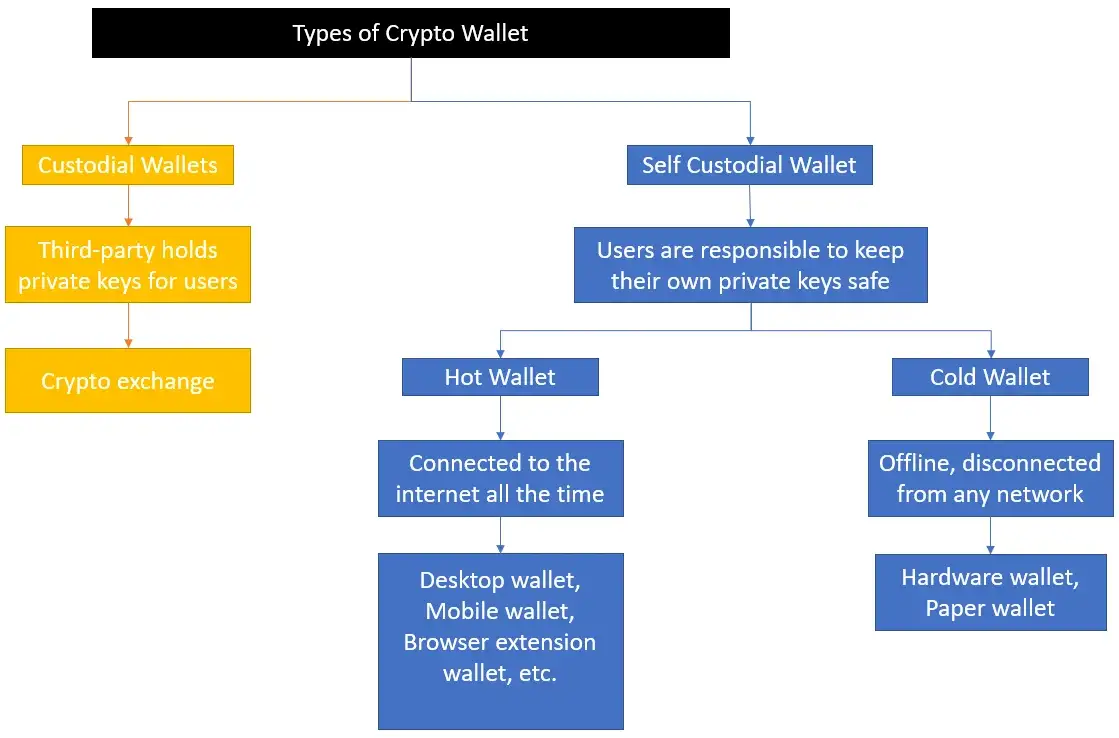
Types of crypto wallets.

Custodial vs. Self-Custodial Wallet

Here is a comparison of the main differences between a custodial and a self-custodial wallet:

Access to crypto assets

  • Custodial: Your private keys are under the control of the service provider. Which basically means that they have control over your funds.
  • Self-custodial: As the only holder of your private keys you have full control over your crypto assets.

Recovery of assets

  • Custodial: Recovery of assets is fairly easy and straightforward as the service provider has access to all your funds after verifying your identity.
  • Self-custodial: Without your private key or recovery phrases recovery is impossible.

Security

  • Custodial: There is always a risk of hacks by third parties and misuse by the provider.
  • Self-custodial: Danger from hacks is significantly reduced.

Creating accounts

  • Custodial: Lengthy know-your-customer and anti-money laundering procedures make it difficult to create and use accounts and expose them to the arbitrariness of legislators and providers.
  • Self-custodial: No KYC and AML procedures.

User friendliness

  • Custodial: Great user-friendliness with a variety of services offered.
  • Self-custodial: Requires basic technical understanding. The options for using various crypto services are also reduced.

What Things Can You Do With a Self-Custody Wallet?

Self-custodial wallets usually offer the following functionalities:

  • Storage of cryptocurrencies and other cryptoassets such as NFTs.
  • Buying and selling cryptocurrencies — this usually includes the most popular currencies, tokens, and stablecoins.
  • Swapping — i.e. the simple exchange of one currency into another.
  • Transfer of crypto assets.
  • Some wallets also offer payment services for purchases from merchants that accept crypto.

How to Find the Best Self-Custody Wallet

When it comes to crypto wallets, the most important aspect is security. The following points are essential when picking a self-custody crypto wallet.

When was the wallet launched?

As a rule of thumb, you want to stick with wallets that have a long history. because important information (e.g. hacking reports) can be found more easily. With a new crypto wallet, possible weaknesses and risks are often not yet known.

What does the wallet provider do to ensure security?

Different providers use different ways to make sure that their products are secure. Usually, you can find relevant information on their website:

  • Is the wallet’s code open-sourced? This is a very good way to ensure security because the code can be checked by external developers.
  • Security compliance & certificate? Does the provider give any information on the security compliance system they have implemented? If their code is not open-sourced, has a third-party security company audited the code? Have they obtained any security certification? Etc.
  • What do the users say? Check the relevant Subreddits and third-party review pages such as Trustpilot on what people think about the wallet.

Can you trust the team or company that built the wallet?

Answer the following questions:

  • Who is the team or company behind the wallet?
  • Do they have relevant knowledge and experience in this field?
  • Does the company have a solid background?

What is the profit model for free self-custody wallets?

If the wallet you are using is free, then it is worth finding out what the profit model is. Knowing the profit model helps you to understand how the company motivates its developers and engineers to build a state-of-the-art product.

For example, some free wallets take commissions when users swap coins or buy crypto using their integrated third-party partners.

What features does the wallet offer?

  • What assets are supported? This includes coins, tokens, NFTs, etc. different wallets supports different number and kinds of crypto assets.
  • Is there a built-in decentralized exchange (DEX) in the wallet? This makes it easier to change tokens and coins without having to transfer them to a centralized exchange.
  • Is there integration with Web3? If so, that means the users can access DeFi protocols from the wallet, and functions such as staking, lending, and borrowing can be done from the wallet easily.
  • Is there integration with fiat? This means the user can use their credit or debit cards to buy crypto directly and get the crypto sent to the wallet. Very convenient. However, it is worth paying attention to the fees for doing so. Because some free wallets profit from these fees, it could mean that you have to pay a higher fee for convenience than buying crypto from a centralized broker or exchange directly.
  • Is there a connection with Lightening Network? This is especially important if you are a Bitcoin user.
  • How user-friendly is it? Does the user interface neat and easy to follow? Are there detailed tutorials? Do they provide technical support?

Frequently Asked Questions About Self-Custody Wallets

Here is some more answer to commonly asked questions about self-custodial crypto wallets.

Are self-custody wallets safe?

In principle, self-custodial wallets are safe because you have full control over your keys. In practice, however, it depends on how careful you are with your keys.

Can self-custody wallets be hacked?

Yes, but it is much more difficult than with non-custodial wallets. Because the private keys are generated on your device and are not accessible to the manufacturer either.


Comments

All Comments

Recommended for you

  • US Spot Bitcoin ETF Sees $296 Million Net Outflow Yesterday

    On July 2, according to monitoring by Trader T, the US spot Bitcoin ETF experienced a net outflow of $296 million yesterday.

  • US Spot Ethereum ETF Sees Net Inflow of $14.92 Million Yesterday

    On July 2, according to monitoring by Trader T, the US spot Ethereum ETF saw a net inflow of $14.92 million yesterday.

  • Bitwise CIO: Current Market is at the End of the Cycle, New Bull Market to Begin This Fall

    On July 2, Bitwise Chief Investment Officer Matt Hougan stated that the sharp fluctuations in STRC combined with the pullback in MSTR stock prices are typical characteristics of the end of a cycle. As for when the market bottom will arrive, he could not provide a precise timeline, as no one can accurately predict it. Market bottoms can only be confirmed in hindsight. However, there are several key signals to watch for a potential bottom: First, MSTR trading below its net asset value per share indicates a complete shift from market greed to panic, which is a critical signal for bottom formation; second, the crypto fear and greed index hitting historical extremes and entering the extreme fear zone suggests it is a suitable time to position for a bullish trend; third, the negative funding rates in derivatives indicate that retail investors are much more inclined to short Bitcoin than to go long. The peak of market pessimism often presents a reversal opportunity. The current market is in a clearing phase, and the issues exposed by STRC are an inevitable part of the cyclical adjustment. All market cycles go through this painful period, which is unavoidable. The market is still digesting various risks, and I firmly believe that the bottom is near, with a new bull market set to begin this fall.

  • Bitwise CIO: The Role of Strategy in the Bitcoin Market Has Transformed

    On July 2, Bitwise Chief Investment Officer Matt Hougan stated that the role of Strategy in the Bitcoin market has undergone a fundamental change. For many years, it has been the world's most essential Bitcoin buyer, continuously providing bullish demand to the market. However, this era of one-sided accumulation is likely coming to an end. Moving forward, Strategy will flexibly buy and sell Bitcoin based on market conditions. Importantly, it will not engage in large-scale sell-offs. The existing mechanisms will not force Strategy to sell billions of dollars in Bitcoin each year; once a Bitcoin bull market arrives, Strategy is likely to return to a net buying position. However, in the next cycle, its influence on the Bitcoin market will be far less than in the previous cycle.

  • Uniswap Officially Launches on Robinhood Chain

    On July 2, Uniswap announced on platform X that the layer two network Robinhood Chain, developed by the Robinhood crypto business team, has fully launched Uniswap V2, V3, V4, and the UniswapX protocol. Uniswap serves as the core public automated market maker (AMM) on Robinhood Chain, supporting the Uniswap web interface, wallet client, and application programming interface (API) from day one. An AI plugin called uniswap-trading-tools, featuring three new functionalities, is also set to be released soon. Users can now utilize Uniswap on Robinhood Chain for token swaps, providing liquidity, purchasing stock tokens, deploying AI trading agents, and deeply experiencing this layer two network. This mature product system, trusted by millions of users, has now arrived on Robinhood Chain.

  • Senator Warren: Legislation Needed to Prevent Trump from Gaining More Cryptocurrency-Related Profits

    On July 1, U.S. Democratic Senator Elizabeth Warren stated that legislation is needed to prevent Trump from gaining more cryptocurrency-related profits.

  • Spot Silver Rises 4% Today, Currently at $60.90 per Ounce

    Spot silver has surged 4% today, currently priced at $60.90 per ounce.

  • Fed Chair Waller: Aiming for Real-Time Data-Driven Policy Making Within a Year

    On July 1, Federal Reserve Chair Waller set an ambitious timeline aimed at enabling the Fed to rely on new technologies that provide real-time economic data, thereby reducing dependence on lagging government survey data. Waller stated, 'My vision is that within the next 9 to 12 months, we will leverage new technologies to grasp the dynamics of the real economy in a synchronized, real-time manner, allowing us to make more informed decisions; we will no longer solely depend on data from government agencies that have statistical biases and are no longer applicable.'

  • Venice AI Raises $65 Million in Series A Funding at $1 Billion Valuation, Led by Dragonfly

    On July 1, Venice AI, an artificial intelligence platform focused on privacy protection, completed a $65 million Series A funding round, achieving a valuation of $1 billion and becoming a unicorn. This round was led by the crypto venture capital firm Dragonfly, with participation from Coinbase Ventures, NorthIsland Ventures, and others. Venice AI stated that the platform provides access to over 200 AI models and emphasizes user data privacy protection and a 'low censorship' experience. The company claims to have over 3 million active users, an annual revenue exceeding $70 million, and has already achieved profitability. The company plans to use the new funds to purchase graphics processing units and build its own data centers to reduce reliance on leased computing power and improve gross margins.

  • Non-Farm Payroll Data to be Released Tomorrow, US Stock Market Closed on Friday

    On July 1, due to the upcoming Independence Day holiday in the United States (July 3), the non-farm payroll data for June will be released earlier at 20:30 Beijing time on July 2 (Thursday). The US stock market will be closed for one day on July 3 (Friday). Trading for precious metals, energy, foreign exchange, US Treasury bonds, and stock index futures contracts under the CME will end early at 01:00 Beijing time on July 4. Trading for Brent crude oil futures contracts under the ICE will end early at 01:30 Beijing time on July 4. Investors are advised to take note.