

Cointime

Download App
iOS & Android

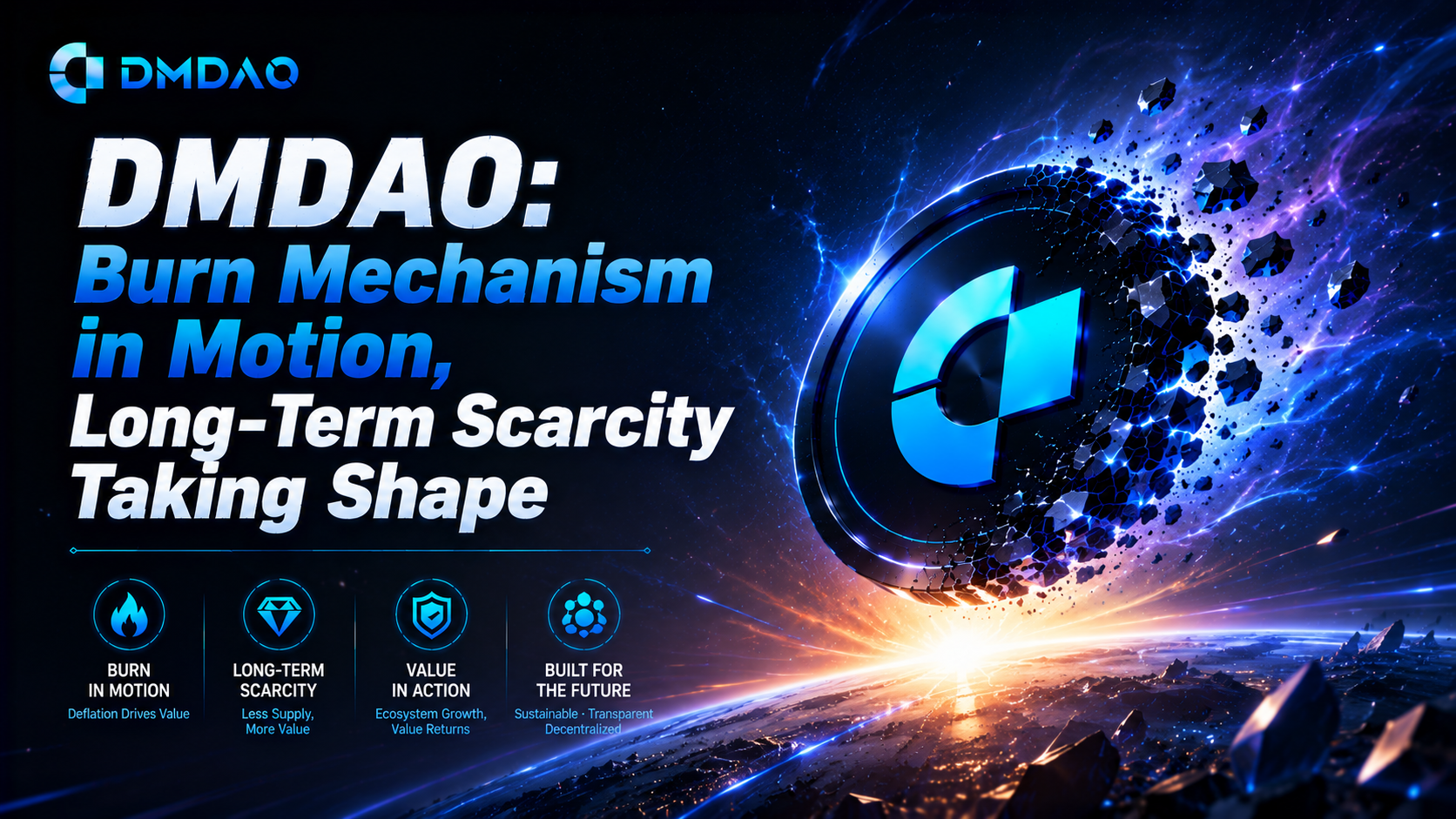
DMDAO: Burn Mechanism in Motion, Long-Term Scarcity Taking Shape

Burn Is Not a Slogan, but an Ongoing Deflationary Process

In the digital asset market, long-term value is rarely supported by short-term hype or a single narrative. What truly matters is whether an ecosystem has a sustainable economic mechanism that can continue operating over time. For DMDAO, the DMD burn mechanism is one of the most important foundations of its value system. It is not designed simply to create market attention, but to continuously reduce supply and strengthen the long-term scarcity of DMD.

At present, the total supply of DMD has been reduced from the initial 21,000,000 tokens to 20,609,218.488245 tokens, meaning that 390,781.511755 DMD have already been burned. This data shows that DMDAO’s deflation mechanism has entered a real execution stage, and the supply structure of DMD is already changing in a measurable way.

From a long-term perspective, the meaning of burn is not only about reducing numbers. It is about building a stronger value foundation for the asset. When the market can clearly see supply being optimized and users can verify that the burn mechanism is actually running, DMD gradually evolves from a circulating ecosystem asset into a stronger carrier of long-term value.

From Supply Reduction to Stronger Scarcity

The value of any asset is closely connected to long-term changes in supply and demand. Continuous supply expansion often weakens market expectations, while continuous supply reduction can strengthen scarcity consensus. By building a burn mechanism around DMD, DMDAO is creating a sustainable deflationary path that supports the evolution of DMD from an ecosystem token into a long-term value asset.

Every DMD burned means less potential future circulating supply. As the burn scale continues to expand, the market’s recognition of DMD scarcity may become stronger. For an ecosystem aiming to build a long-term value network, this kind of mechanism-driven deflation is more important than short-term marketing, because it directly influences asset structure, market expectations, and long-term consensus.

DMDAO does not emphasize a one-time burn event, but a continuously advancing deflation curve. As the burn process moves forward, the value logic of DMD may further evolve from ecosystem circulation to scarcity accumulation. When supply reduction and ecosystem growth happen together, the long-term value foundation of DMD becomes more solid.

Every Burn Reflects Value Returning to the Ecosystem

A healthy burn mechanism should not rely only on artificial scarcity. It should be supported by the continuous return of ecosystem value. The core logic of DMDAO’s burn mechanism is not simply to reduce numbers, but to connect ecosystem operation, asset flow, and value accumulation, making deflation a natural part of ecosystem growth.

When the ecosystem creates value, that value can return to the system. When returned value further supports burn, the supply structure of DMD enters a healthier cycle. This process is not a short-term stimulus, but a long-term construction path. It allows participants to see that the growth of DMD is not driven only by external sentiment, but also by the continuous operation of internal mechanisms.

Comments

All Comments

Recommended for you

  • BTC Surpasses $61,000

    Market data shows that BTC has surpassed $61,000, currently priced at $61,003.44, with a 24-hour increase of 2.88%. The market is highly volatile, so please ensure proper risk management.

  • US Spot Bitcoin ETF Sees $296 Million Net Outflow Yesterday

    On July 2, according to monitoring by Trader T, the US spot Bitcoin ETF experienced a net outflow of $296 million yesterday.

  • US Spot Ethereum ETF Sees Net Inflow of $14.92 Million Yesterday

    On July 2, according to monitoring by Trader T, the US spot Ethereum ETF saw a net inflow of $14.92 million yesterday.

  • Bitwise CIO: Current Market is at the End of the Cycle, New Bull Market to Begin This Fall

    On July 2, Bitwise Chief Investment Officer Matt Hougan stated that the sharp fluctuations in STRC combined with the pullback in MSTR stock prices are typical characteristics of the end of a cycle. As for when the market bottom will arrive, he could not provide a precise timeline, as no one can accurately predict it. Market bottoms can only be confirmed in hindsight. However, there are several key signals to watch for a potential bottom: First, MSTR trading below its net asset value per share indicates a complete shift from market greed to panic, which is a critical signal for bottom formation; second, the crypto fear and greed index hitting historical extremes and entering the extreme fear zone suggests it is a suitable time to position for a bullish trend; third, the negative funding rates in derivatives indicate that retail investors are much more inclined to short Bitcoin than to go long. The peak of market pessimism often presents a reversal opportunity. The current market is in a clearing phase, and the issues exposed by STRC are an inevitable part of the cyclical adjustment. All market cycles go through this painful period, which is unavoidable. The market is still digesting various risks, and I firmly believe that the bottom is near, with a new bull market set to begin this fall.

  • Bitwise CIO: The Role of Strategy in the Bitcoin Market Has Transformed

    On July 2, Bitwise Chief Investment Officer Matt Hougan stated that the role of Strategy in the Bitcoin market has undergone a fundamental change. For many years, it has been the world's most essential Bitcoin buyer, continuously providing bullish demand to the market. However, this era of one-sided accumulation is likely coming to an end. Moving forward, Strategy will flexibly buy and sell Bitcoin based on market conditions. Importantly, it will not engage in large-scale sell-offs. The existing mechanisms will not force Strategy to sell billions of dollars in Bitcoin each year; once a Bitcoin bull market arrives, Strategy is likely to return to a net buying position. However, in the next cycle, its influence on the Bitcoin market will be far less than in the previous cycle.

  • Uniswap Officially Launches on Robinhood Chain

    On July 2, Uniswap announced on platform X that the layer two network Robinhood Chain, developed by the Robinhood crypto business team, has fully launched Uniswap V2, V3, V4, and the UniswapX protocol. Uniswap serves as the core public automated market maker (AMM) on Robinhood Chain, supporting the Uniswap web interface, wallet client, and application programming interface (API) from day one. An AI plugin called uniswap-trading-tools, featuring three new functionalities, is also set to be released soon. Users can now utilize Uniswap on Robinhood Chain for token swaps, providing liquidity, purchasing stock tokens, deploying AI trading agents, and deeply experiencing this layer two network. This mature product system, trusted by millions of users, has now arrived on Robinhood Chain.

  • Senator Warren: Legislation Needed to Prevent Trump from Gaining More Cryptocurrency-Related Profits

    On July 1, U.S. Democratic Senator Elizabeth Warren stated that legislation is needed to prevent Trump from gaining more cryptocurrency-related profits.

  • Spot Silver Rises 4% Today, Currently at $60.90 per Ounce

    Spot silver has surged 4% today, currently priced at $60.90 per ounce.

  • Fed Chair Waller: Aiming for Real-Time Data-Driven Policy Making Within a Year

    On July 1, Federal Reserve Chair Waller set an ambitious timeline aimed at enabling the Fed to rely on new technologies that provide real-time economic data, thereby reducing dependence on lagging government survey data. Waller stated, 'My vision is that within the next 9 to 12 months, we will leverage new technologies to grasp the dynamics of the real economy in a synchronized, real-time manner, allowing us to make more informed decisions; we will no longer solely depend on data from government agencies that have statistical biases and are no longer applicable.'
