

Cointime

Download App
iOS & Android

DMDAO: Deflation in Action, Long-Term Value Taking Shape

From 21 Million to 20.636 Million: Deflation Is No Longer Just a Concept

In the digital asset industry, "deflation" is often used as a narrative. However, what truly earns long-term market confidence is not the concept itself, but whether the mechanism is actually operating, whether the data continues to evolve, and whether the value model can stand the test of time. This is exactly where DMDAO is making a meaningful difference—transforming deflation from an idea into measurable execution.

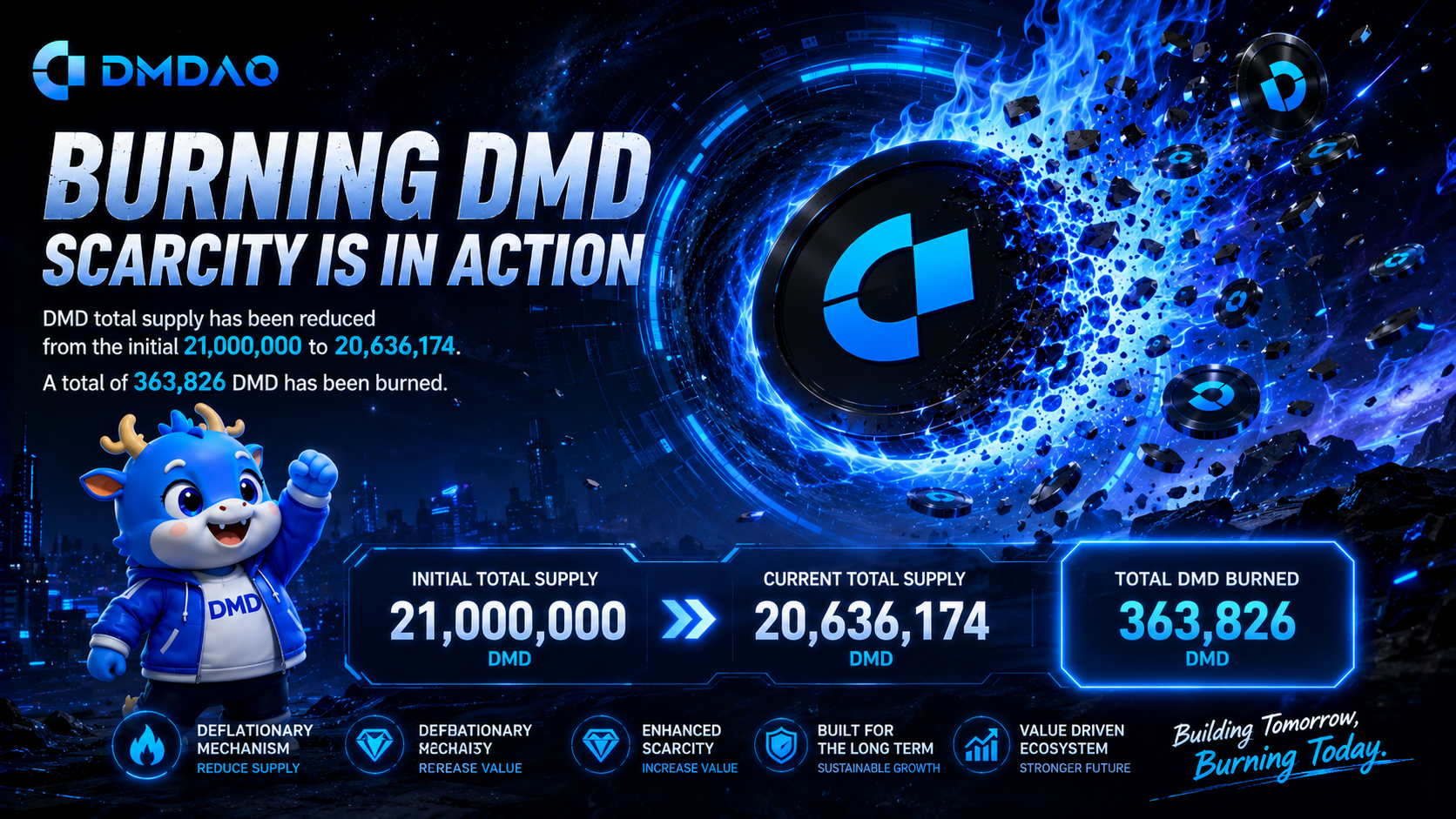
The total supply of DMD has now decreased from its initial 21,000,000 tokens to 20,636,173.473825 tokens. This means that 363,826.526175 DMD has already been permanently burned. While this represents only the beginning of the deflationary journey, it marks an important milestone: DMDAO's burn mechanism is no longer theoretical—it is actively reshaping the supply structure of DMD.

For an ecosystem designed around long-term value, deflation is not simply about reducing numbers. It is about continuously lowering the circulating supply, strengthening scarcity, and building stronger market expectations for future value. Every completed burn is permanently recorded, every reduction in supply becomes visible, and every step further reinforces the long-term foundation of DMD.

A Deflationary Mechanism Designed to Strengthen Scarcity

The long-term value of any digital asset is ultimately driven by supply and demand. Unlimited supply dilutes value, while controlled supply strengthens scarcity. DMDAO places its burn mechanism at the center of its economic model to ensure that DMD is not merely a circulating token, but a scarce digital asset with sustainable long-term value.

The reduction from 21,000,000 to 20,636,173.473825 DMD is far more than a numerical change. It represents a structural optimization of the ecosystem's circulating supply. Every DMD permanently removed from circulation reduces future market supply, while every burn strengthens the scarcity that supports long-term value.

More importantly, the burn mechanism encourages a long-term mindset across the entire community. Participants who focus on sustainable growth care less about short-term price movements and more about whether the ecosystem continues to execute, whether its mechanisms continue to operate, and whether value continues to flow back into the network. The continuously updated burn data provides transparent evidence that DMDAO is steadily moving in that direction.

Every Burn Represents Value Returning to the Ecosystem

Token burning is not an isolated event—it is the result of value flowing back into the ecosystem. When an economic system continuously generates value and allocates part of that value toward reducing supply, it creates a healthy cycle of value creation, value return, supply optimization, and increasing scarcity.

What DMDAO emphasizes is not a one-time burn, but an ongoing deflationary process. The permanent removal of 363,826.526175 DMD demonstrates that the ecosystem has already entered a positive cycle where value generation and supply reduction work together. As the community expands, ecosystem adoption grows, and consensus strengthens, the burn mechanism is expected to create even greater long-term impact.

Every token locked strengthens long-term scarcity. Every value return reinforces the foundation of DMD. Rather than simply reducing supply, DMDAO is building a healthier economic structure where long-term value is continuously accumulated through sustainable deflation.

Deflation Is Driving the Growth of the DMD Value Network

A truly sustainable digital asset ecosystem cannot rely solely on short-term market enthusiasm or temporary narratives. It requires mechanisms that continue to operate, a community that continues to grow, and transparent data that demonstrates real progress. The current burn progress of DMDAO represents one of the most important milestones on that journey.

The reduction from 21,000,000 to 20,636,173.473825 DMD marks the beginning of a continuously evolving deflationary model. As additional tokens are permanently burned over time, the total supply will continue to decline while scarcity continues to increase. For ecosystem participants, this is not only a change in circulating supply—it is the gradual formation of a stronger, more resilient value network.

As consensus continues to expand and the deflationary mechanism continues to operate, DMD is evolving beyond a simple ecosystem token into a core digital asset designed to support long-term scarcity, sustainable growth, and lasting value. Burning is only the beginning; what truly matters is the stronger economic foundation that DMDAO is building through consistent execution.

Conclusion

DMDAO's deflationary journey is demonstrating the effectiveness of its economic model through transparent and verifiable data. With 363,826.526175 DMD already permanently burned, circulating supply continues to decline, scarcity continues to strengthen, and the long-term value proposition of the ecosystem becomes increasingly evident.

The true value of DMD will never be defined solely by short-term market fluctuations. Instead, it is built upon continuously executed mechanisms, growing community consensus, and an increasingly optimized supply structure. As the deflationary process moves forward, DMDAO will continue building a stronger, scarcer, and more sustainable value network for the future.


Comments

All Comments

Recommended for you

  • Ethereum Spot ETF Sees $30.04 Million Net Outflow Yesterday, Marking 8 Days of Continuous Outflows

    On June 30, according to SoSoValue data, the Ethereum spot ETF experienced a total net outflow of $30.04 million yesterday (Eastern Time, June 29). The Ethereum spot ETF with the highest net inflow yesterday was Blackrock's ETF ETHA, which saw a net inflow of $5.8693 million, bringing its historical total net inflow to $11.086 billion. Following this was Fidelity's ETF FETH, with a net inflow of $5.2520 million, currently totaling $2.113 billion in historical net inflows. The Ethereum spot ETF with the highest net outflow yesterday was Blackrock's Staked ETH ETF ETHB, which had a net outflow of $37.549 million, with a historical total net inflow of $520 million. As of the time of this report, the total net asset value of Ethereum spot ETFs is $8.594 billion, with an ETF net asset ratio (market value relative to total Ethereum market value) of 4.4%, and a cumulative historical net inflow of $10.873 billion.

  • Bank of Japan Appears More Hawkish Internally, But Dovish Opposition Votes May Double

    On June 30, the Bank of Japan appointed Ayano Sato, seen as a supporter of loose monetary policy, as a new policy board member. This appointment increases the likelihood of two dissenting votes on future interest rate hike proposals. Although the nine-member committee still maintains a hawkish stance overall, this structural change may slow the pace of policy tightening by the Bank of Japan. Additionally, the committee's most steadfast hawkish members, Naoki Tamura and Hajime Takeda, will leave their positions in July next year, adding uncertainty to the path of policy tightening. Sato is scheduled to hold a press conference on Tuesday at 5 PM Tokyo time (4 PM Beijing time), and the market will closely watch whether she aligns with Masayoshi Amamiya in opposing further tightening. Her formal policy debut will occur at the meeting on July 30-31, where it is widely expected that the Bank of Japan will keep interest rates unchanged. The market will weigh the evident monetary caution of Sato, related to the financing costs of government investment plans, against the Bank of Japan's established position of continuing to tighten policy in response to price pressures driven by energy shocks.

  • Bitcoin Spot ETF Sees $231 Million Net Outflow Yesterday, Marking Eight Consecutive Days of Outflows

    On June 30, news emerged that, according to SoSoValue data, the total net outflow from Bitcoin spot ETFs reached $231 million yesterday (Eastern Time, June 29). The Bitcoin spot ETF with the highest net inflow yesterday was the ARK ETF from Ark Invest and 21Shares, with a single-day net inflow of $49.969 million, bringing its historical total net inflow to $1.209 billion. Following this was the Grayscale ETF GBTC, which saw a net inflow of $35.1026 million yesterday, while its historical total net outflow now stands at $27.108 billion. The Bitcoin spot ETF with the largest net outflow yesterday was the Blackrock ETF IBIT, which experienced a net outflow of $300 million, with its historical total net inflow currently at $60.466 billion. As of the time of this report, the total net asset value of Bitcoin spot ETFs is $73.190 billion, with an ETF net asset ratio (market cap relative to total Bitcoin market cap) of 6.05%, and a historical cumulative net inflow of $51.375 billion.

  • FTSE China A50 Index Futures Rise Over 1%

    On June 30, FTSE China A50 Index futures rose over 1%.

  • Goldman Sachs: A 1% Increase in Samsung and SK Hynix Weight Could Lead to $2 Billion Foreign Capital Withdrawal from Korea

    On June 30, Goldman Sachs' Timothy Moe and John Kwon pointed out that a 1 percentage point increase in the combined weight of Samsung and SK Hynix in the Korean stock index could lead to approximately $2 billion in foreign investor withdrawals from the Korean market, as the U.S. Investment Company Act requires portfolios to meet diversification thresholds. Goldman Sachs also noted that a significant influx of funds into leveraged ETFs, along with increased options trading and retail margin trading, has created a structural environment where daily price fluctuations far exceed what corporate fundamentals can support. The growth in Korea's asset management scale since last year has primarily been driven by investment returns rather than new capital. As valuations rise, institutional investors' mechanical exposure to market volatility is also increasing—often related to hedging strategies. This means that even a mild market correction could trigger a series of forced sell-offs.

  • Doubao: Nearly 100 Accounts from the Same IP Location Spread False Information for Deceptive Marketing

    On June 30, Liu Xing, the PR head of Doubao, stated that they recently discovered nearly 100 accounts from the same IP location collectively disguising themselves as students to publish false content praising a certain AI while maliciously defaming Doubao. 'At such a critical juncture in the lives of many students, engaging in deceptive marketing tactics is extremely irresponsible,' Liu said. 'The AI industry is still rapidly developing, and we urge everyone to work together to maintain a healthy industry ecosystem; organized smear campaigns will only harm the industry and all users.'

  • 38,244.04 DMD Permanently Burned in the Past 7 Days

    On June 25, 2026, the latest on-chain data from DMDAO revealed that a total of 38,244.04 DMD has been permanently burned through the established transaction and wealth management burn mechanisms over the past 7 calendar days.

  • BTC Falls Below $60,000

    Market data shows that BTC has fallen below $60,000, currently priced at $59,954.84, with a 24-hour decline of 4.19%. The market is experiencing significant volatility, so please ensure proper risk management.

  • ETH Drops Below $1600

    Market data shows that ETH has fallen below $1600, currently priced at $1597.55, with a 24-hour decline of 3.81%. The market is experiencing significant volatility, so please ensure proper risk management.

  • Billionaire Philippe Laffont Prefers Investing in Space Over Bitcoin

    Philippe Laffont, founder and portfolio manager of Coatue Management, stated on the Squawk Box program that he is currently unable to determine his stance on Bitcoin. He mentioned that he is rethinking Bitcoin's positioning and expressed a preference for investing in space over Bitcoin. (thestreet)