

Cointime

Download App
iOS & Android

What Is a Vampire Attack in Crypto?

Validated Venture

“Vampire attack” is a strategy used by a new blockchain project to quickly attract users and funds from a more popular competitor app. How does it work? What happened to Uniswap? Let’s take a look together!

Typically, the creators of a new app present a product with features similar to the “original,” but offer more lucrative incentives through rewards of their own token to its users.

In the fall of 2020, the decentralized exchange Uniswap was the target of a vampire attack, and in January 2022, the NFT-marketplace OpenSea.

What is the essence of a vampire attack?

A typical vampire attack has three components:

  • Find a lead project.
  • Create a counterpart, using the business model, architecture, or code of the original.
  • Make redundant economic incentives the main difference from the popular competitor.

This strategy should result in the new project “sucking” users and their capital out of the target, a popular protocol.

The vampire attack strategy originated in decentralized finance (DeFi). The source code of DeFi applications, or a major part of it, is usually open source. Thus, a similar application is quite easy to copy and run with only minor changes.

In addition, the developers of the “copy” can easily produce their own control tokens and use it to inflate the profitability of liquidity farming, which is a standard way of earning for users.

How did Uniswap fall victim to a vampire attack?

In 2020, the DeFi space, the decentralized exchange Uniswap began rapidly gaining popularity. The protocol’s daily trading volume had reached $1.8 billion by early September 2020, which was comparable to the leading centralized cryptocurrency trading platforms.

SushiSwap emerged against this backdrop. The fact that the new protocol was a fork of Uniswap was made clear by its anonymous creators. SushiSwap, on the other hand, had a significant difference: its own token SUSHI, which users received as a reward for farming in pools.

Despite the fact that almost every decentralized exchange now has a management token, it was not common practice at the time. DeFi, on the other hand, already had examples of their effectiveness as an economic incentive.

The SushiSwap team provided attractive terms for liquidity providers: participation in exchange pools brought hundreds or even thousands of percent per year thanks to SUSHI rewards. As a result of the vampire attack, Uniswap users transferred over $1 billion in funds to SushiSwap in just a few weeks, reducing the “original “ ‘s’ blocked liquidity (TVL) by 70%.

This situation, however, did not last long: the high farming rate of SUSHI caused a sharp increase in its price, causing the yield in SushiSwap pools to decrease just as quickly. In terms of TVL, Uniswap had already returned to the DeFi leaders by mid-September. Soon after, the UNI management token appeared, effectively negating SushiSwap’s advantage.
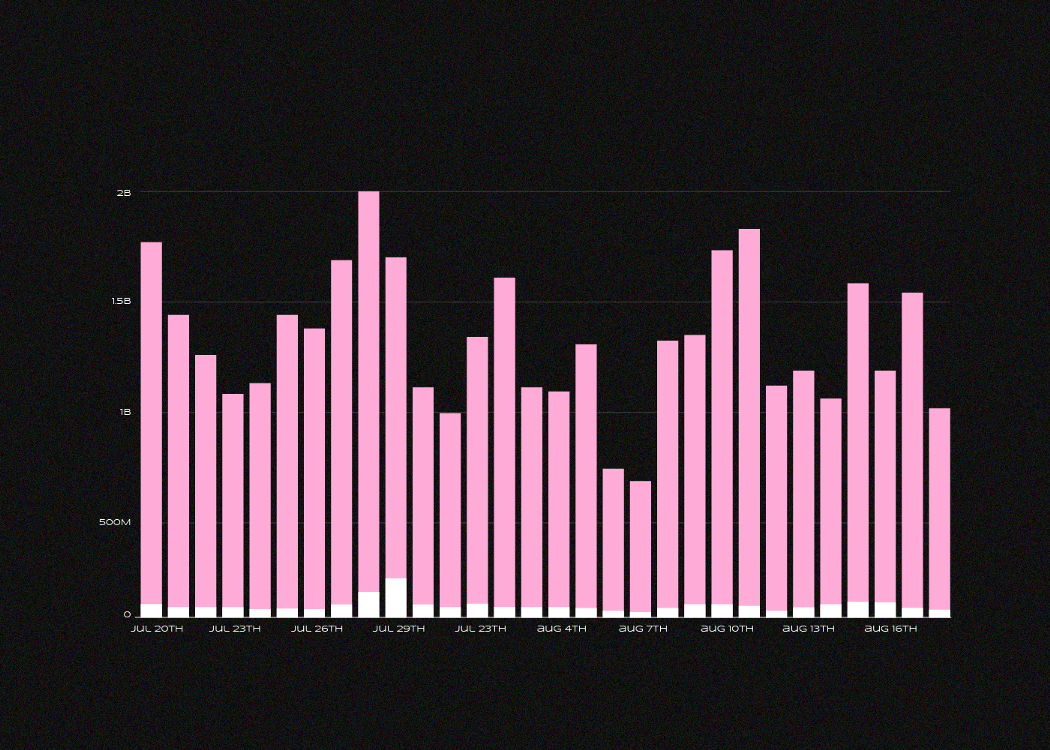
Trading volume on Uniswap (pink) and SushiSwap (white) from July 20 to August 18, 2022. Data: Dune Analytics

How did the vampire attack on OpenSea take place in 2022?

Another victim of “vampires” was the NFT-marketplace OpenSea, which handles the majority of non-exchangeable token trading.
LooksRare, another NFT trading platform, went live in early 2022. Although, unlike SushiSwap, its creators did not copy OpenSea smart contracts but instead wrote their own, the main component of their attack was also a platform token called LOOKS.

Users who traded NFT on LooksRare were rewarded for their LOOK activity. Only those who traded on OpenSea for 3 ETH or more between June and December 2021 were eligible to participate in the giveaway.

Users who traded NFT on LooksRare received rewards for their activity in LOOK. But there was one condition: only those who traded on OpenSea from June to December 2021 for 3 ETH or more could participate in the giveaway.

In addition to this “promotion,” users of the new platform may be able to obtain LOOKS through Staking at a yield of approximately 500% per year. Furthermore, the transaction fees on LooksRare were lower. The vampire attack resulted in a rapid increase in trading volume on LooksRare and a decrease on OpenSea.

At the same time, LooksRare trailed its competitor in terms of active users. Given the comparable volume of trades, researchers assumed that the few users of the new marketplace actively engage in wash trading, which is the practice of conducting a large number of fictitious transactions for the sake of LOOKS rewards. According to a CryptoSlam report, by early April, the share of fake transactions in total trading volume on LooksRare had reached 95%.

The site then changed incentives and began cracking down on unscrupulous practices, which led to a drop in activity. According to The Block, the amount of transactions fell from $69 million on May 1, 2022, to just $1 million on August 15, while the share of fake trades fell from 98% to 13% over the same period. At the same time, OpenSea regained its leadership in the NFT market.
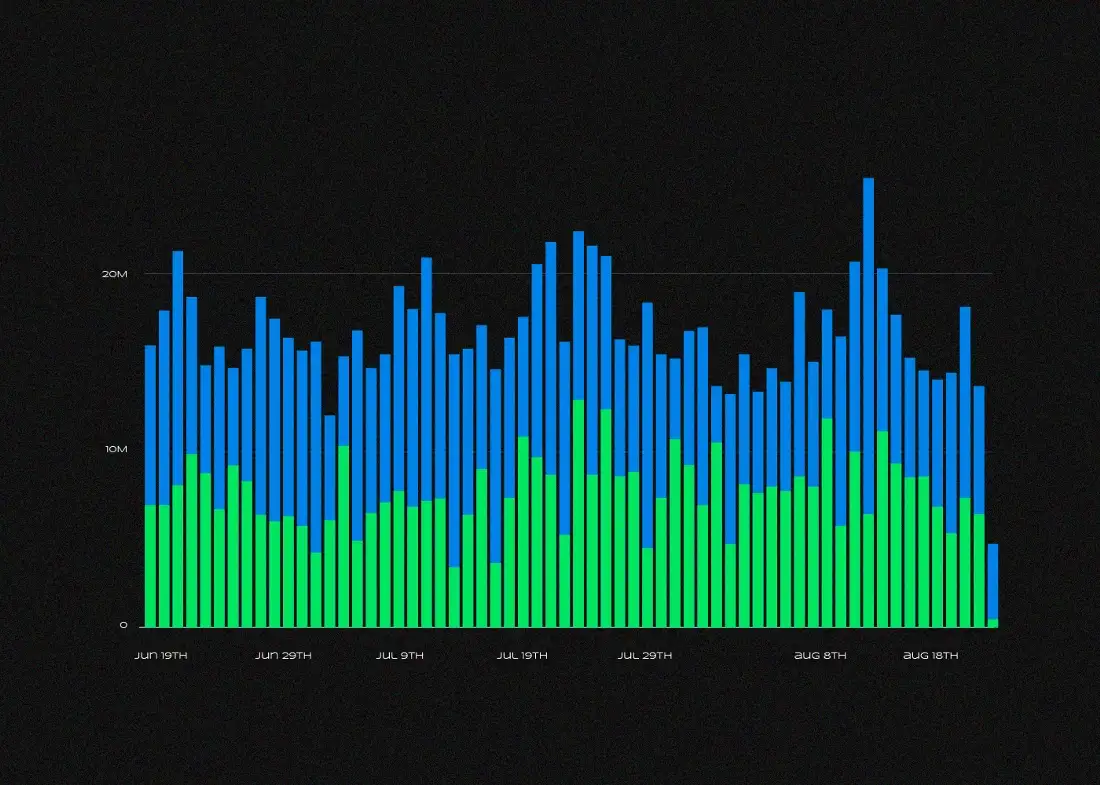
Daily trading volume on OpenSea (blue) and LooksRare (green) from June 19 to August 18, 2022. Data: Dune Analytics

Notably, the Marketplace has already been vampire attacked by the Infinity platform in 2021.

Comments

All Comments

Recommended for you

  • HYPE Surges Over 10% in a Day, Currently Priced at $71.569

    On June 16, market data showed that HYPE surged over 10% in a single day, currently priced at $71.569. Previously, there were reports that Arthur Hayes allegedly bought back 47,000 HYPE tokens.

  • DeepSeek Reportedly Completes Over $7 Billion Financing

    On June 16, according to The Information, DeepSeek has completed over $7 billion in financing, with this round valuing the company at over $50 billion.

  • Reserve Bank of Australia Holds Rates Steady

    On June 16, the Reserve Bank of Australia kept the interest rate unchanged at 4.35%, in line with market expectations, following three consecutive meetings of rate hikes.

  • Nikkei 225 Index Surpasses 70,000 Points for the First Time

    The Nikkei 225 Index has surpassed 70,000 points for the first time, reaching a historic high with a cumulative increase of 39% this year.

  • Goldman Sachs: Expects Fed to Maintain Interest Rates in June Meeting, Low Likelihood of Rate Hike

    On June 16, Goldman Sachs released a research report indicating that the most significant change in economic data since the last FOMC meeting is a substantial rebound in employment growth, putting the labor market on a more stable path. This has shifted the market's focus to whether inflation has reached a level severe enough to warrant a rate hike. However, Goldman Sachs believes the likelihood of a rate increase is low. The firm points out that, on one hand, the Fed has historically not raised rates due to oil price shocks, and on the other hand, the current environment reduces the chances of a self-reinforcing high inflation triggered by oil price shocks. That said, some concerning signs have emerged; if inflation expectations or the breadth of high-inflation categories show a significant increase, the likelihood of a rate hike will rise. Goldman Sachs anticipates that during the first June meeting under the new chair, the FOMC is likely to keep the federal funds rate unchanged and remove previous forward guidance that hinted at a rate cut. The firm expects the meeting statement will only remove the phrase regarding the 'extent and timing of additional adjustments' related to the federal funds rate.

  • Hikvision Raises Hard Drive Prices Effective July 1, Sources Indicate Over 50% Cost Increase in Q3

    On June 16, it was reported that Hikvision has recently issued a price adjustment notice to its distributors, stating that the prices of its hard drive products will be increased starting July 1 of this year. Additionally, before July 1, other products under Hikvision will also undergo a price increase. This hard drive price adjustment primarily targets the distributor channel. In light of the current situation of significant supply and price fluctuations, Hikvision has advised distributors to quickly lock in orders and prices. This is not the first time Hikvision has adjusted prices, nor is it an isolated incident. According to informed sources, the main reason for this price adjustment is the sustained squeeze effect caused by the explosive growth in AI demand. The procurement costs for hard drives continue to rise, with the factory cost quotes for Q3 increasing by over 50% compared to Q2 of this year. Given the current market conditions, there is a possibility of continued price increases in the near future.

  • Bank of Japan Adjusts Bond Purchase Plan for July to September

    On June 16, the Bank of Japan announced plans to purchase 355 billion yen of 1 to 3-year Japanese government bonds twice a month from July to September (previously three times a month for 255 billion yen). The plan includes purchasing 320 billion yen of 3 to 5-year Japanese government bonds twice a month (previously three times a month for 230 billion yen). Additionally, the bank will buy 335 billion yen of 5 to 10-year Japanese government bonds twice a month (previously three times a month for 240 billion yen). It also plans to purchase 100 billion yen of 10 to 25-year Japanese government bonds twice a month (previously three times a month for 80 billion yen). Lastly, the plan includes purchasing 75 billion yen of ultra-long-term (remaining maturity of over 25 years) Japanese government bonds twice a month (previously twice a month for 75 billion yen).

  • Bank of Japan: Prepared to Modify Bond Purchase Reduction Plan if Necessary in Future Policy Meetings

    On June 16, the Bank of Japan stated that it will respond flexibly if long-term interest rates rise rapidly, such as by increasing the purchase of Japanese government bonds and implementing fixed-rate bond purchase operations. It is prepared to modify the bond purchase reduction plan in future policy meetings if necessary.

  • Bank of Japan: Need to Pay Special Attention to Future Developments in the Middle East and Their Impact on Financial Markets, Economy, and Prices

    On June 16, the Bank of Japan stated that it is currently necessary to pay special attention to the future developments in the Middle East and their impact on financial markets, foreign exchange markets, the economy, and prices. It is essential to monitor global demand related to artificial intelligence and the future fluctuations in foreign exchange rates and their effects on the Japanese economy and prices.

  • Bank of Japan: Accommodative Financial Environment Expected to Persist After Policy Rate Adjustment

    On June 16, the Bank of Japan stated that it expects the accommodative financial environment to continue after the adjustment of the policy rate, providing strong support for economic activities.
