

The information, opinions and judgments on markets, projects, currencies, etc. mentioned in this report are for reference only and do not constitute any investment advice.

Written by 0xBrooker
The market dividends since the “reciprocal tariff war” entered the third phase have been exhausted.
As the "big beautiful plan" led by Trump was approved by the House of Representatives, the "U.S. debt crisis" once again cooled the market's bullish enthusiasm. Coupled with Trump's statement that he wanted to impose excessive tariffs on the European Union again, the United States once again saw a triple kill situation of "stocks, bonds and currencies".
Driven by capital inflows and the passage of the “Stablecoin Act”, BTC saw a surge in long sentiment in the first half of the week, breaking through the “Trump bottom” to set a new all-time high in U.S. dollars.
The capital inflow increased, but the selling also began to increase, but the overall selling pressure was still small, showing that BTC was still dominated by upward momentum, and the temporary adjustment might end at any time.
Since May, the framework of global risk traders has gradually adjusted back to the game of US economic and employment fundamentals and interest rate policies. This week, the "gray rhino" hanging over the US economy and financial markets has reappeared as a threat.
The "One Big Beautiful Bill" is a comprehensive fiscal legislation pushed by US President Trump. Its official name is "One Big Beautiful Bill Act". The bill involves multiple areas such as taxation, immigration, health care, border security, etc., and aims to achieve Trump's governing agenda through tax cuts and policy reforms. On May 22, the bill was approved by the US House of Representatives and has been transferred to the Senate for deliberation.
The bill involves many areas, and the increase in spending and the reduction in tax revenue will eventually require the US debt ceiling to be raised to $4 trillion. This will increase the US debt ceiling from the current $36.1 trillion to $40.1 trillion. By then, the maximum debt will reach 140% of GDP, a record high.
This has made the market further pessimistic about the U.S. government's ability and willingness to repay its debts, and the attractiveness of U.S. debt has further declined. Currently, U.S. debt has lost all top ratings from the three major rating agencies.
In response to the "Beautiful Big Bill", the 10-year U.S. Treasury yield, the anchor of global asset pricing, jumped to a high of 4.5% again this week. High U.S. Treasury yields will undoubtedly increase the borrowing costs of companies and consumers, inhibit investment and consumption, and ultimately affect corporate profitability, putting pressure on the stock market.
Affected by the House approval of the "Beautiful Bill", the three major stock indexes all stopped their rebound since the reversal of the tariff war this week and showed a downward trend, with the Nasdaq -2.47%, the S&P 500 -2.61%, and the Dow Jones 2.47%.
The U.S. dollar index also fell 1.03% to 99.1252 after four consecutive weeks of gains .
Gold once again became a beneficiary. London gold rose 1.98% during the week to $3,359.90 per ounce.
It will take some time for the "Beautiful Bill" to be finally approved, and its dynamics will undoubtedly become a major variable affecting the financial market in the future.
Due to the substantial inflow of funds into the BTC Spot ETF channel, the increase in holdings by listed companies and the passage of the "Genius Act", BTC was shrouded in optimism and achieved a seven-week consecutive increase.
Before the panic caused by the House approval of the "Big Beautiful Act" spread, BTC achieved a historic breakthrough and set a historical record of US dollar pricing - US$112,000 per coin.
From the technical indicators, the whole week was above the 5-week line, the trading volume was enlarged, and the weekly MACD just rose above the water level. The BTC price ran above the first rising trend line for the whole week and tested the upper edge of the "Trump bottom" (90,000-110,000).
From a technical perspective, BTC is still in a medium-term upward trend, but affected by the "stock, bond and foreign exchange" triple kill and having achieved sharp increases for many days, the market's bullish sentiment may be adjusted within a certain period of time.
On May 19, the Senate passed a procedural vote with a vote of 66-32, marking the imminent implementation of the U.S. stablecoin regulatory framework. From the perspective of policy impact, the "Genius Act" (the "U.S. Stablecoin Innovation Guidance and Establishment Act of 2025") may be no less than the approval of the BTC Spot ETF in 2024.
The “Genius Act” defines the definition, supervision, audit, consumer protection and underlying asset requirements of the US dollar stablecoin (high-liquidity assets such as US dollar cash and short-term US Treasury bonds). Although the US move is aimed at promoting the development of its own blockchain industry, maintaining the international status of the US dollar, increasing the penetration of the US dollar, and to some extent alleviating the pressure of issuing US debt, it will undoubtedly promote the development of the second largest application of blockchain, stablecoin, besides BTC.
On May 21, the Hong Kong Legislative Council formally passed the Stablecoins Bill, establishing a comprehensive licensing and regulatory framework for fiat-referenced stablecoins (FRS).
We believe that from the perspective of application scope and number of holders, stablecoins are likely to surpass BTC. The positive progress in stablecoins in the United States and Hong Kong shows that in addition to value reserves, the blockchain industry's DApp applications or Web3 based on smart contract platforms are also being recognized by governments around the world. This is particularly important for the industry.
Although the "stock, bond and currency" triple kill has once again dampened the U.S. stock market, the trading enthusiasm in the crypto market seems to be immune.
Positive capital inflows were maintained for 7 trading days, with a total inflow of US$5.574 billion for the whole week, including US$2.548 billion in stablecoins, US$2.775 billion in BTC Spot ETF, and US$250 million in ETH Spot ETF.
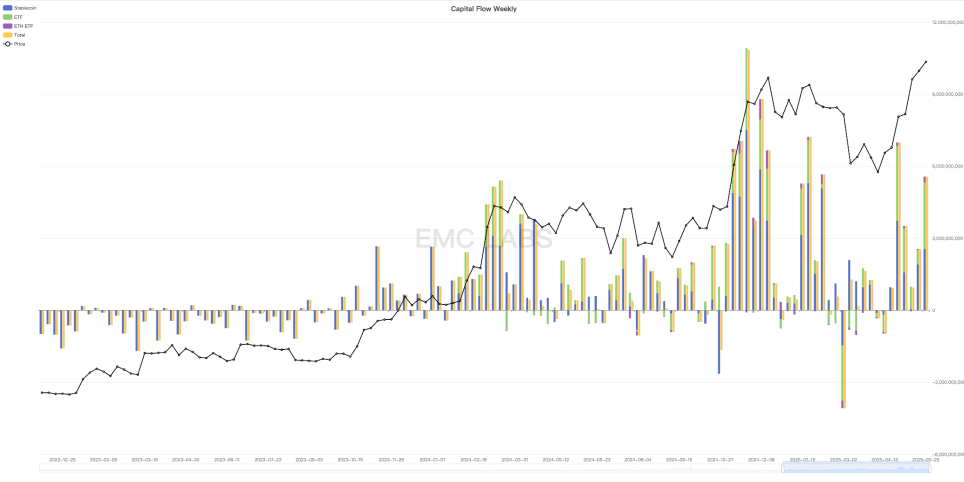
Since bottoming out and rebounding in early April, after the first round of large inflows, funds showed some hesitation after reaching $100,000. This week, another large inflow of funds pushed BTC to challenge its previous historical high.
Since BTC returned to the $100,000 mark, long-term investors have started to reduce their holdings again, reversing the trend of gradually decreasing . This week, 159,869.37 BTC flowed into exchanges. Centralized exchanges are still in an outflow trend, with the balance falling to 2,987,307, but the outflow rate has slowed down.
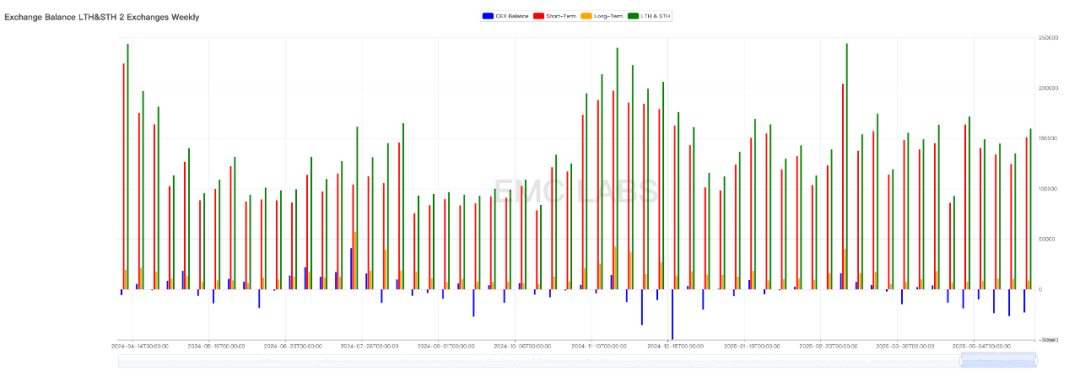
As a market stabilizer, the long-holding group started to reduce their holdings near the new high, with the scale of reduction during the week being 1,195.43 shares.
According to eMerge Engine, the EMC BTC Cycle Metrics indicator is 0.75, which is in an upward period.

EMC Labs was founded by crypto asset investors and data scientists in April 2023. It focuses on blockchain industry research and Crypto secondary market investment, takes industry foresight, insight and data mining as its core competitiveness, and is committed to participating in the booming blockchain industry through research and investment, and promoting blockchain and crypto assets to bring benefits to mankind.
For more information, please visit: https://www.emc.fund


All Comments