


In the deep waters of decentralized finance (DeFi) evolution, front-end convenience is no longer the core barrier. With global capital’s extreme demand for “Real Yield,” scarcity in the industry has shifted toward ultimate matching performance, transparent settlement logic, and provable asset sovereignty.
As the market moves from blind expansion back to fundamental efficiency, NxDex emerges. Incubated by Nivex, NxDex is a next-generation decentralized perpetual contract (Perp DEX) protocol. It is not a mundane protocol fork, but a decentralized financial operating system designed to reshape on-chain derivatives standards and achieve a leap from “intermediary credit” to “algorithmic trust.”
Performance Breakthrough: Three-Tier Architecture Reshaping Trading Sovereignty
The core logic of NxDex begins with the complete termination of the “trust black box.” Through a paradigm revolution in physical performance, it resolves the on-chain trade dilemma between speed and sovereignty, building a solid underlying infrastructure:
- Execution Layer (Execution): Relying on a self-developed high-performance asynchronous matching core and on-chain order book system, NxDex achieves millisecond-level instruction response. This asynchronous sequencing technology maximizes matching efficiency, providing users with an experience comparable to centralized exchanges (CEX).
- Risk Layer (Risk): Introduces a decentralized clearing engine and insurance fund matrix. The system calculates initial and maintenance margins in real-time, ensuring that algorithmic risk control automatically triggers under extreme market conditions, safeguarding protocol solvency and overall security.
- Liquidity Layer (Liquidity): Through an innovative asset routing protocol, funds are dynamically and automatically allocated across market-making pools (80%), LP pools (10%), and arbitrage strategies (10%). This structured treasury ensures that the protocol’s deep liquidity originates from real trading friction rather than illusory liquidity incentives.
Value Ignition: NXD’s Ultimate Deflationary Spiral
After addressing performance anxiety, NxDex constructs an asset value moat through a precisely designed NXD supply collapse model:
- Ultimate Deflation Path: NXD starts with a total supply of 100 million. The system executes daily dynamic physical burns of 0.5%–2%. Post-burn assets are proportionally allocated: 50% permanently destroyed, 25% injected into the insurance pool, and 25% into the trading mining pool.
- Supply Limit: Through this auto-regulating spiral, NXD’s final supply target reduces by 97.9%, locked at only 2.1 million, establishing rigid scarcity support for asset value.
- Quota Rigidity: NXD quotas derive solely from 1% of financial amounts, 10% of dynamic earnings, level unlocks, and node-equivalent allocations, ensuring value accumulation rather than uncontrolled issuance.
| Investment Cycle | Expected Annualized Yield | Settlement Currency | Core Yield Source |
| 30 Days | 10% – 12% | NUSD | Deep Market-Maker Spread Income |
| 90 Days | 12% – 15% | NUSD | NXD Base Pool Liquidity Dividends |
| 180 Days | 15% – 18% | NUSD | Global Cross-Platform Algorithmic Arbitrage |
| 360 Days | 18% – 22% | NUSD | Trading Friction & Liquidation Bonuses |
To further optimize compound efficiency, the protocol introduces the native stablecoin NUSD, pegged 1:1 to USD and supporting 0-fee conversion with USDT, ensuring every earned unit of yield is retained efficiently.
Governance and Shared Interests: Real Yield and System Construction
NxDex establishes a multi-dimensional allocation mechanism that returns real value creation to core builders, creating a virtuous ecological cycle:
- Global Profit-Sharing System: The protocol captures real value via a sell tax (5%) and profit tax (10%). Most funds flow directly to node dividends, token-holder dividends, and the S-level bonus pool, transparently distributing growth dividends to every consensus builder.
- Node Governance Matrix: Strategic nodes are globally limited to 1,000 seats. Subscription immediately upgrades to N3 privileges and grants equivalent financial orders. Nodes share 30% of the sell tax, 20% of the profit tax, and 30% of withdrawal fees, integrating sovereignty rights with risk hedging.
- Ecological Self-Healing Mechanism: The withdrawal fee recycling mechanism converts potential exit losses into system retention rewards, enabling self-repair and enhanced ecological growth.
- S-Level Bonus Pool Mechanism: To incentivize early core partners, the system sets a dedicated S-level bonus pool. Within NxDex’s level system, whether ordinary users or nodes, achieving S-level promotion allows access to the highest yield efficiency rights, the maximum NXD quota, and the first 7 fastest S-level achievers share the S-level bonus pool: 1st place: 30%; 2nd place: 20%; 3rd–7th place: 10% each.
Blueprint Emerging: From Protocol Launch to AppChain Destination
NxDex’s vision is never confined to a single chain; it is a technical expedition from BSC to multi-chain AppChains:
- Kernel Confirmation Period (2026 Q1-Q2): Complete full deployment and kernel stress tests in the BSC environment, establishing the initial governance matrix.
- Territorial Expansion Period (2026 Q3-Q4): First support mainstream L2 and high-performance public chains, introducing RWA (Real-World Asset) contracts, bridging on-chain liquidity with traditional industrial dividends.
- Sovereignty Evolution Period (2027-2028): Evolve into a fully independent NxDex AppChain, achieving fully sovereign operation of trading, settlement, and risk control, creating an “algorithmic derivatives factory” where anything can be hedged.
Conclusion: Let Wealth Obey Algorithmic Order
Looking back at DeFi’s development, projects that survive cycles are rarely those promising the highest yield, but those with the most solid structure and transparent cash flow.
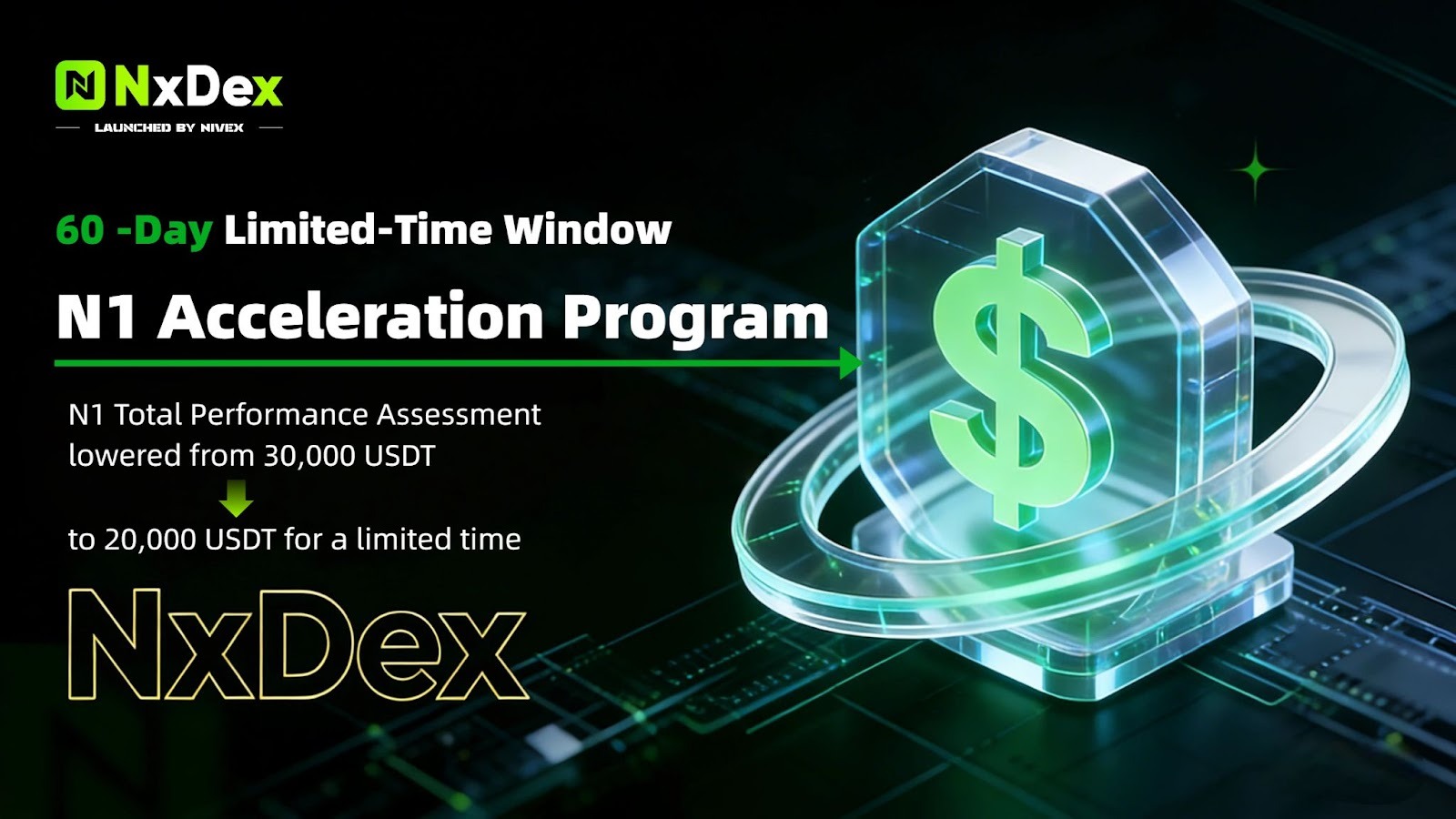
NxDex has officially launched. The ongoing N1 Acceleration Program provides a 60-day limited-time window for early builders: total performance assessment temporarily lowered from 30,000 USDT to 20,000 USDT, helping core users quickly secure initial positions.
This is a technological revolution in financial sovereignty. NxDex aims to return trading to the public good, standardize speed and fairness, and maximize the weight of every contribution under algorithmic governance. In NxDex’s world, speed is a public good, and wealth ultimately obeys the eternal algorithmic order.


All Comments