


Recently, Solidify Chain publicly presented a systematic overview of its protocol design framework and infrastructure positioning. The statement clarifies its role as a protocol-level blockchain network purpose-built for real-world assets (Real-World Assets, RWA), and defines the scope of responsibilities and long-term operational objectives it assumes with respect to asset state representation, compliance enforcement, and settlement rules.
This disclosure does not constitute a product launch or marketing announcement. Rather, it is a public articulation addressed to industry participants, institutional capital, and regulatory stakeholders, responding to a fundamental question: what kind of blockchain infrastructure real-world assets should ultimately operate on.
From “How Assets Go On-Chain” to “What Infrastructure Assets Should Run On”
Globally, real-world assets are gradually entering blockchain-based systems. Industry discussions are shifting from how assets can be tokenized toward what type of infrastructure is capable of supporting them over the long term. As participation expands beyond crypto-native users to include industrial entities, institutional investors, and regulatory actors, the presence of clear rule boundaries, protocol-level compliance capacity, and auditable settlement structures has become a decisive factor in whether RWA can operate sustainably.
Solidify Chain is proposed and developed in response to this transition. It is not positioned as an application platform, an asset issuer, or a trading system. Instead, it is designed as a shared public infrastructure for rules and settlement, serving core functions such as asset issuance support, compliance execution, state management, and final settlement.
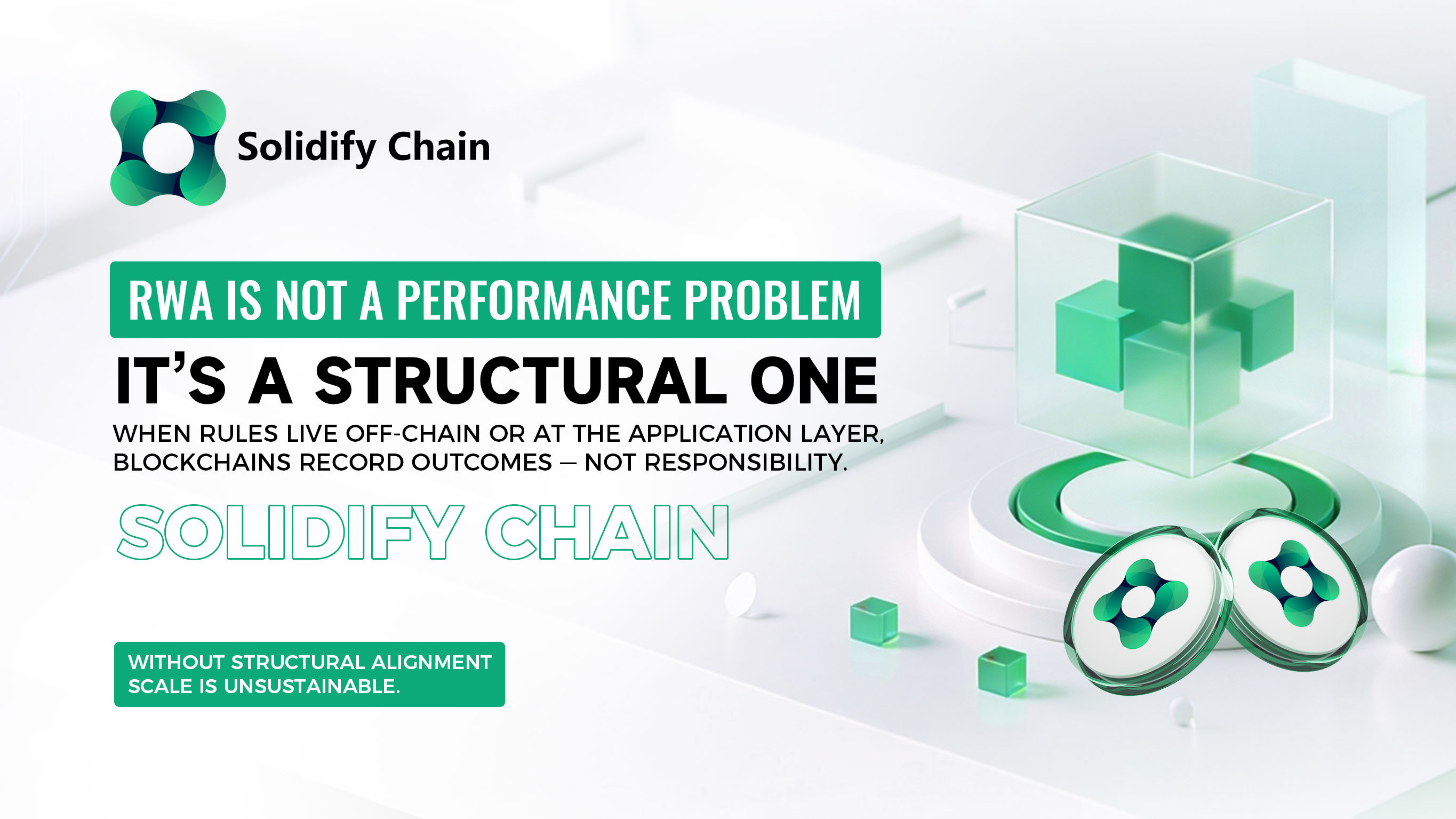
The Challenge Facing RWA Is Structural, Not Performance-Driven
Within most existing blockchain architectures, the network primarily performs transaction execution and state recording. Asset ownership verification, investor eligibility, compliance checks, and lifecycle management are typically handled by off-chain institutions, platform-specific rules, or manual processes. As a result, blockchains record outcomes rather than enforce the rules that produce them.
Such an arrangement may be workable at an experimental or limited scale. However, when real-world assets are introduced alongside multiple stakeholders and cross-jurisdictional requirements, systemic risk escalates rapidly. If compliance and settlement responsibility cannot be natively borne by the underlying protocol, the network itself cannot serve as a dependable long-term infrastructure.
Design Orientation: Rules Must Operate at the Protocol Layer
Solidify Chain is not designed with performance metrics or application-scale growth as its primary objectives. Instead, its architecture centers on a foundational question: how real-world assets can be systematically constrained and governed by the system itself.
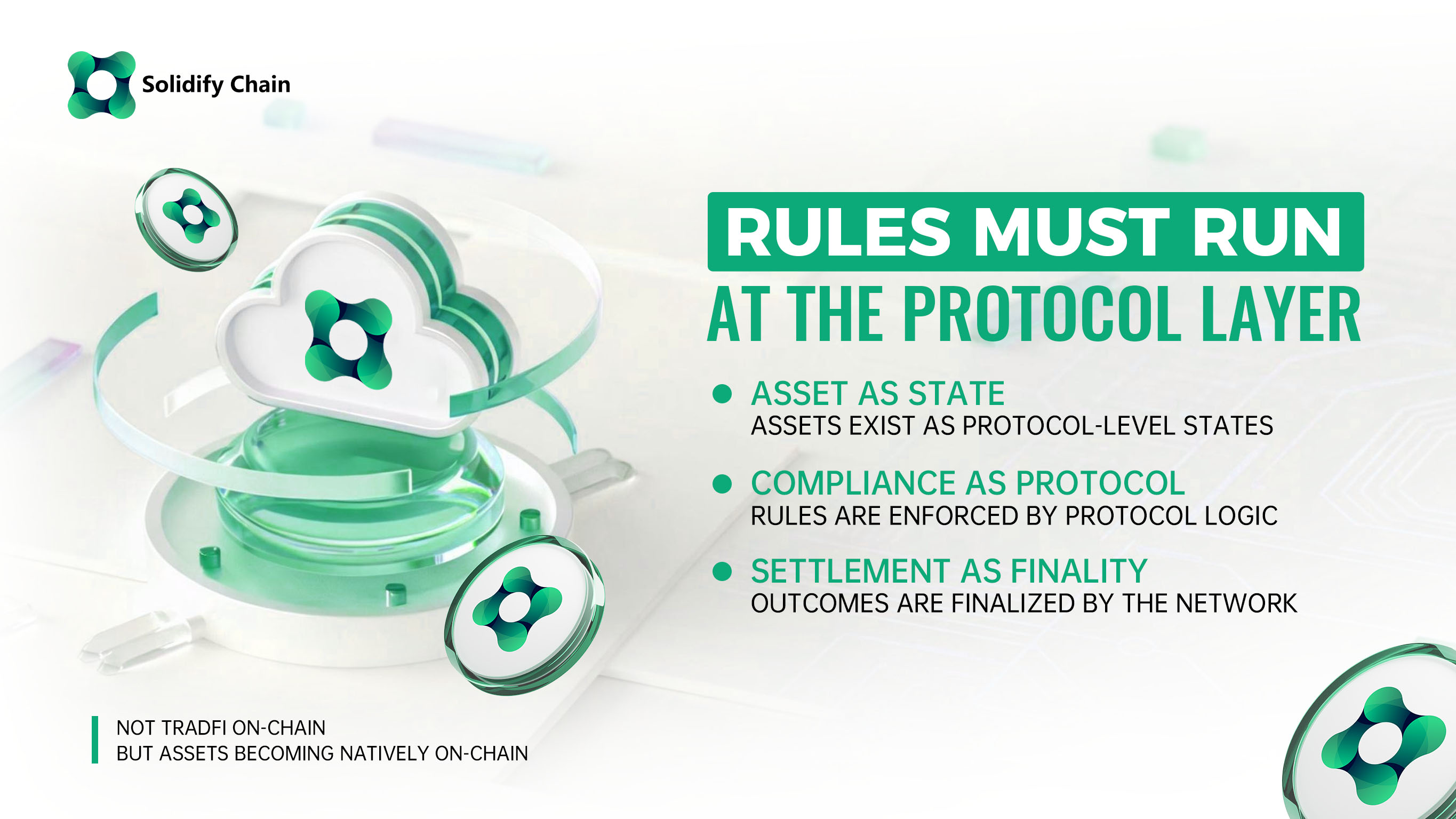
Its core principle is that assets should not merely be represented as on-chain tokens, but should operate as protocol-level objects with explicit state, constraints, and lifecycle definitions.
Based on this principle, Solidify Chain natively provides the following capabilities at the protocol layer:
Asset State ModelReal-world assets exist as protocol-level state objects with unique identities, defined state transition rules, and auditable histories, covering issuance, operation, settlement, and exit.
Compliance Execution MechanismInvestor eligibility, jurisdictional restrictions, risk tiers, and related compliance requirements are embedded directly into protocol execution logic, enforced and recorded automatically, rather than delegated to applications or platforms.
Protocol-Level Settlement and Value Flow StructureFees and cash flows generated by asset-related operations are allocated according to predefined protocol rules into network security, risk reserves, and long-term operational structures, rather than relying on discretionary inflation or one-off incentives.
Definition of Responsibility Boundaries and Protocol Scope
The responsibilities of the Solidify Chain protocol layer are explicitly limited to rule execution and settlement confirmation. It is not designed to intervene in asset-level or commercial activities. The protocol provides only system-level confirmation and recording of asset state changes, compliance conditions, and settlement outcomes.
Asset issuance arrangements, commercial structures, risk exposure, and operational decisions occur outside the protocol and remain the responsibility of their respective parties. The protocol layer neither possesses nor assumes the capacity to intervene in, backstop, or substitute for such activities.
This delineation is not a matter of functional trade-off, but a prerequisite for long-term infrastructure viability. Only when rule execution and commercial behavior are structurally separated can a protocol remain neutral, auditable, and reusable across diverse asset classes, participants, and regulatory environments.
A Public Settlement and Rule Foundation for Multiple Stakeholders
Solidify Chain is not designed for a single user group. Instead, it provides a unified protocol foundation for the full RWA lifecycle, including:
● Asset issuers and industrial entities: standardized, verifiable on-chain issuance and lifecycle management
● Institutional investors and family offices: participation pathways under clearly defined compliance boundaries
● Regulatory and institutional stakeholders: read-only verification of rule execution and settlement states
● Developers and infrastructure participants: the ability to focus on products and applications without rebuilding institutional and compliance logic
A Collaborative Perspective with the RWA International Ecosystem Alliance
In the development of RWA infrastructure, industry standards, institutional research, and cross-regional collaboration are indispensable. As an international industry organization, the RWA International Ecosystem Alliance plays an active role in advancing research, dialogue, and cooperation within the RWA domain.
Solidify Chain seeks to engage with the Alliance and its members within an open and long-term framework, jointly exploring standardized approaches, compliance boundaries, and infrastructure models for real-world assets on-chain, and contributing reusable system foundations for scalable RWA adoption.
Conclusion
The integration of real-world assets into blockchain systems is not a simple technical migration. It is a systemic undertaking concerning how rules are carried, responsibilities are allocated, and settlement is enforced.
Solidify Chain does not aim to construct a new market narrative. Its objective is to provide a protocol-level infrastructure capable of withstanding institutional scrutiny and long-term operation.
Only when asset state, compliance, and settlement are executed by the system itself can blockchain networks become a credible operating environment for real-world assets.


All Comments