

Listing on Nivex Is Only the First Step in PayStill’s Global Expansion
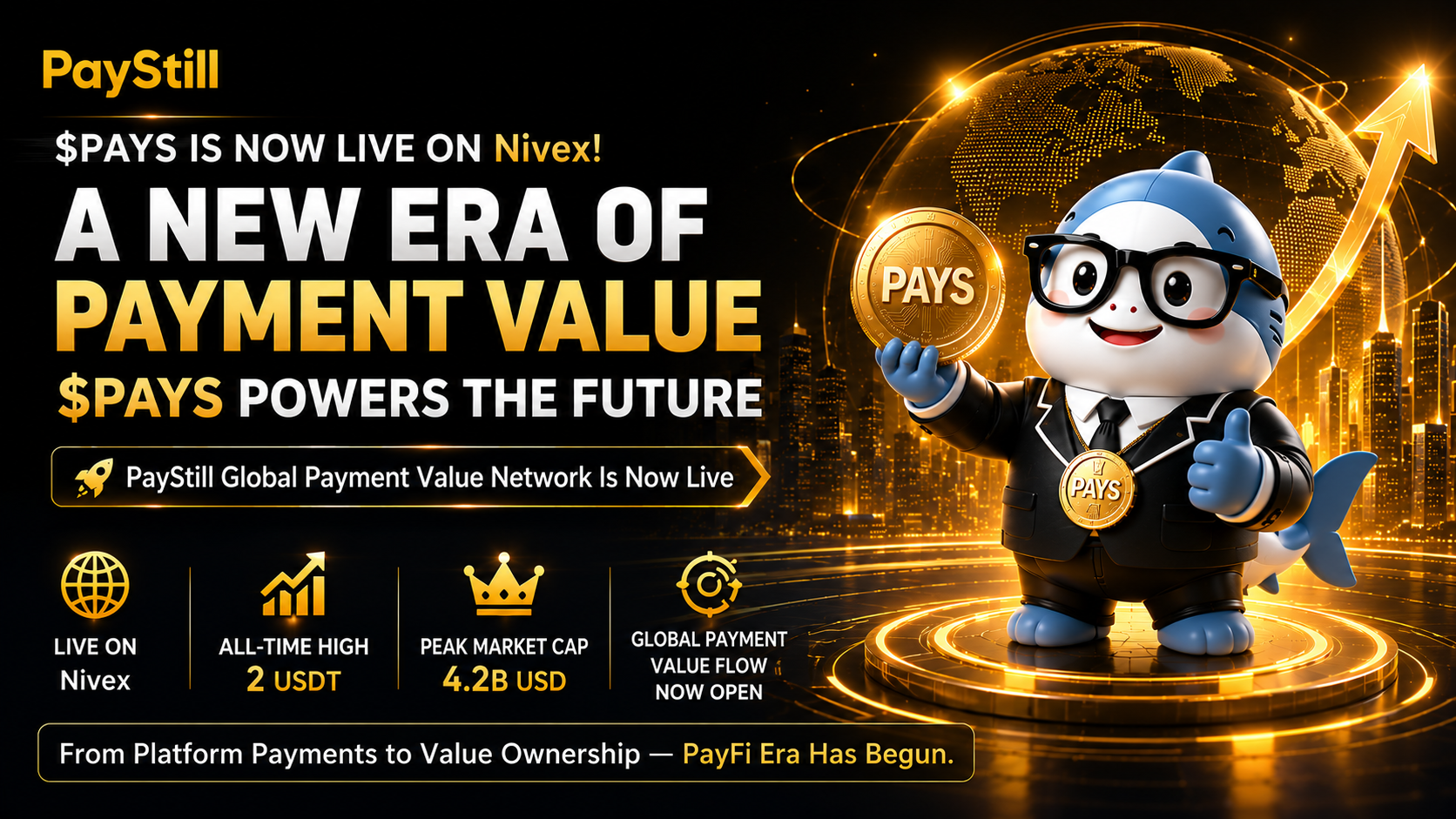
On May 24, 2026, $PAYS officially launched on Nivex and opened for trading. Shortly after listing, the token reached a peak price above 2 USDT, while its peak market capitalization briefly surpassed $4.2 billion. For a PayFi project still in the early stages of global ecosystem expansion, this signals that the market is once again beginning to recognize the potential of “real payment value” within the Web3 world.
However, beyond short-term price fluctuations, what PayStill truly wants the market to see is not simply another exchange listing, but the official beginning of a global payment value network entering circulation. In PayStill’s view, exchanges are never the final destination — they are merely gateways for ecosystem value distribution.
Over the past few years, the market has witnessed countless token projects driven primarily by sentiment and speculation. Many achieved temporary hype but lacked real-world scenarios capable of sustaining long-term value. PayStill, by contrast, focuses on mapping real-world payment behavior, consumption activity, and commercial circulation into an on-chain value system.
The significance of the Nivex listing lies in the fact that $PAYS is beginning its transition from an internal ecosystem value token into a globally circulating asset. For the first time, PayStill’s value model is being tested and priced by the broader market as a real PayFi infrastructure.
More importantly, this listing signals that PayStill’s product ecosystem has officially reached the stage where it is ready to scale into its next phase of global development.
PayStill Is Not Just Building Payments — It Is Building a “Payment Value Network”
Most payment protocols fundamentally solve a problem of payment efficiency. PayStill, however, aims to solve something much deeper: the ownership of payment value itself.
In the traditional internet economy, every user transaction continuously creates profit, traffic, and data value for platforms. Yet almost all of that value ultimately remains concentrated within the platforms themselves. Users contribute to economic growth, but rarely own any part of the growth they help generate.
PayStill intends to change that structure.
As the first payment value aggregator within the FUSN × DrixPay ecosystem, PayStill is attempting to transform real-world payment activity into a cross-ecosystem value interface. Through on-chain consumption appreciation mechanisms, dual-asset synthetic computing power, and ecosystem value aggregation, every real-world transaction becomes more than a simple payment action — it becomes part of a value generation system on-chain.
Within PayStill’s product model, consumption can continuously convert into computing power, computing power generates yield, and that yield then flows back into payment and consumption scenarios, forming a complete and self-sustaining value cycle.
This is why PayStill is not merely another token project, nor simply a blockchain payment tool. It represents an attempt to build an entirely new PayFi financial structure in which user consumption behavior itself becomes the core engine of ecosystem growth.
That is also why the team consistently emphasizes that “Consumption as an Asset” will become one of the defining logics of the next generation of PayFi.
A Four-Layer Product Architecture Is Forming a True PayFi Closed Loop
PayStill has now gradually established a complete four-layer product architecture, while beginning to bridge the relationship between real-world consumption and on-chain yield generation.
The first layer is the dual-asset synthetic computing power mining system. Users participate using USDT while rewards are benchmarked through a gold-standard logic, allowing the yield structure to remain as independent as possible from short-term market volatility. In essence, PayStill aims to anchor yield stability through real computing power mechanics rather than speculative token cycles.
The second layer is the global U Card payment system. Today, $PAYS can already be directly recharged into U Cards and used through Visa and Mastercard global payment networks. This means that on-chain yield now possesses real-world payment functionality, allowing users not only to earn value on-chain, but also to spend that value directly in everyday life. This is a milestone that many Web3 projects have long attempted, but few have successfully achieved.
The third layer is the on-chain marketplace system. In the future, user consumption within the marketplace will automatically convert into FUSN cloud computing power and continuously generate on-chain rewards. Under this structure, consumption no longer represents simple capital outflow — instead, it actively feeds value back into the ecosystem itself.
The fourth layer is the ecosystem swap and value circulation system. Through free PAYS/FUSN conversion and on-chain liquidity mechanisms, PayStill is gradually building a truly self-circulating PayFi network.
Importantly, these product layers are not isolated modules. Together, they form a complete on-chain consumption value loop:
Payment → Consumption → Computing Power → Yield → Re-Consumption → Ecosystem Growth.
For PayStill, the long-term vision is not about a single product succeeding independently, but about the continuous synergy of an entire value ecosystem operating at global scale.
The Future of PayFi Will Not Belong Only to Finance — It Will Enter the Real Commercial World
As the market gradually shifts from financial speculation toward real-world applications, more projects are beginning to realize that Web3 cannot achieve long-term growth without integrating into actual commercial environments. PayStill’s direction is precisely centered on deeply binding on-chain value systems with real-world consumption networks.
At present, PayStill has completed deep integration with both the FUSN blockchain and the DrixPay global p


All Comments