

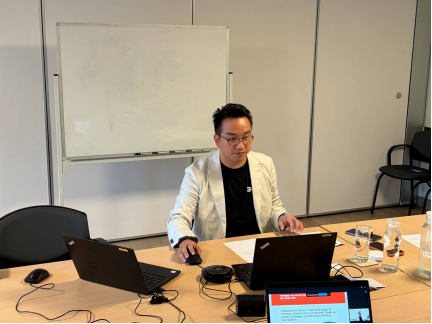
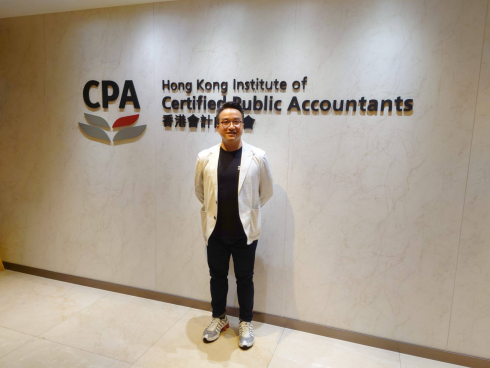
On May 20, ENI founder Arion Ho was featured as the keynote speaker at an online session hosted by the Hong Kong Institute of Certified Public Accountants (HKICPA) as part of its “Digitalization Series”. The session focused on stablecoin compliance, corporate treasury management, on-chain auditing, and privacy compliance. During the session, Arion delivered in-depth insights into key topics including stablecoin regulatory frameworks, enterprise treasury operations, the evolution of audit methodologies, and on-chain privacy compliance.
Following the implementation of the regulatory regime for stablecoin issuers under the Stablecoins Ordinance on 1 August 2025, the stablecoin market is entering a new era of compliance. As a next-generation public blockchain focused on RWA and enterprise finance use cases, ENI has consistently emphasized the convergence of regulatory frameworks, treasury management, audit verification, and on-chain privacy. The project continues to advance a blockchain financial architecture designed to be regulatory-compliant, auditable, and controllable at the institutional level.
As global stablecoin regulations become increasingly defined, enterprises and financial institutions are rapidly expanding their demand for on-chain settlement, digital asset custody, cross-border treasury management, and privacy-compliant financial infrastructure. Against this backdrop, the enterprise-grade on-chain financial infrastructure being developed by ENI is transitioning from a forward-looking industry vision into a rapidly emerging real-world market need.
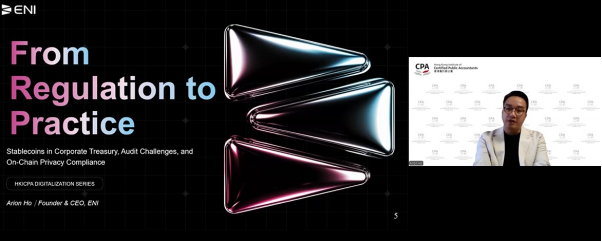
From Regulatory Clarity to the Reshaping of Corporate Treasury Management Through Stablecoins
Arion opened the session by noting thatfinancial institutions and the auditing profession have long maintained a cautious yet attentive approach to the development of blockchain technology. Yet the core questions determining whether enterprises could truly adopt on-chain systems have never changed: whether capital is secure, whether on-chain assets can be protected and properly custodied, whether the ledger itself is trustworthy, and whether the rules governing the system can remain verifiable and auditable over the long term.
According to Arion, the industry is no longer focused on which blockchain is faster or cheaper. The real question today is how enterprises can operate on-chain systems in a controlled, auditable, and regulation-compliant manner under increasingly mature regulatory frameworks. With the issuance of the first batch of stablecoin issuer licences in Hong Kong,, the industry is officially transitioning from the phase of “whether stablecoins are allowed” to “how stablecoins can be institutionally implemented at scale.”
In the past, market concerns primarily revolved around unclear legal status, regulatory uncertainty, and undefined institutional liabilities. Today, however, jurisdictions including Hong Kong, the European Union under MiCA, Singapore, and the UAE are all actively establishing licensing and reserve oversight frameworks for stablecoins. Regulatory clarity is now becoming a major driver of institutional treasury adoption, allowing stablecoins to evolve into legitimate financial infrastructure within regulated environments.
Arion further emphasized that the most important transformation brought by stablecoins is not occurring at the transaction layer, but at the settlement layer. In his view, the traditional cross-border payment system is built upon the correspondent banking model: a structure originally designed for the pre-digital era and therefore inherently burdened by structural inefficiencies, including:Long transaction chains involving multiple intermediary banks;Settlement delays caused by fragmented banking hours and time zones;Significant audit and reconciliation burdens stemming from complex bookkeeping processes;Reduced capital efficiency due to funds being locked in transit for extended periods.
Under the traditional model, cross-border settlement often requires T+2 to T+5 processing cycles, while fees accumulate across multiple intermediary layers. By contrast, stablecoins do not merely improve transaction speed; they fundamentally restructure the architecture of treasury management itself by enabling 24/7 real-time settlement, reducing intermediaries and operational points of failure, enhancing traceability through on-chain ledgers, and replacing fragmented reconciliation systems with unified records.
“Stablecoins are not simply making the old system faster. They are rebuilding the underlying architecture of value transfer,” Arion stated.
He went on to argue that the next major evolution in corporate finance will be the transition from account-based financial management to ledger-based financial management. Under traditional systems, enterprises manage balances across multiple financial institution accounts, rely heavily on manual reconciliation processes, and allocate capital in largely reactive ways. In the future, however, enterprises will manage rules, fund flows, and operational states directly on unified ledgers. Treasury operations will become real-time, proactive, and programmable, with financial logic embedded directly into the system architecture itself.
Arion believes this transformation will fundamentally redefine the role of the CFO shifting from managing banking relationships to becoming a systems architect for capital flow design.
At the same time, stablecoins introduce an even deeper shift through the concept of programmable money, where financial logic can be embedded directly into the currency layer itself. Key advantages include:
Payments can be automatically triggered based on external conditions;Multi-signature approvals and spending restrictions can be enforced directly at the transaction layer;Smart contracts can automate settlement execution, significantly reducing manual intervention and operational risk.
“The financial system is evolving from recording transactions to executing transactions,” Arion explained. “The ledger itself is becoming the operating system.”
On-Chain Systems Are Redefining the Audit Framework
In the second part of the session, Arion shifted the focus toward auditing and compliance frameworks. He noted that on-chain systems are driving a structural transformation across the auditing profession. Traditionally, auditing has centered on the question of whether financial statements, balances, and transaction records are accurate. In the future, however, the focus will increasingly shift toward whether the underlying system itself is executing correctly.
In other words, the object of audit will no longer be limited to outcomes alone, but will increasingly encompass the rules, logic, and governance mechanisms that generate those outcomes. This shift means that future auditors will need to understand not only financial data, but also smart contract logic, on-chain governance structures, and automated execution systems. System assurance, Arion argued, will become the next frontier of the auditing profession.
Addressing stablecoin reserve structures specifically, Arion stated that the traditional “proof-of-reserves” model is no longer sufficient to meet institutional requirements. Future audits, he argued, must go deeper into the underlying structural design and address critical questions such as:Whether reserve assets consist of high-quality liquid assets;Whether reserve duration structures are properly matched against redemption liabilities;Whether redemption mechanisms are clearly defined and legally enforceable;Whether the system can remain resilient during large-scale redemption events and periods of market stress.
At the same time, as financial operations increasingly migrate on-chain, traditional accountability boundaries are also being redefined. Under this new framework:Issuers are responsible for reserve integrity and regulatory compliance;Custodians are responsible for asset segregation and safekeeping;Technology providers are responsible for system stability and smart contract reliability;Enterprise users are responsible for internal governance and control frameworks.
Arion emphasized that the scope of future audits will no longer be confined to financial statements alone, but will extend across system architecture, smart contract logic, access controls, and governance design.
What Enterprises Truly Need Is a “Controllable On-Chain System”
In the final section of the session, Arion focused on the practical challenges surrounding enterprise blockchain adoption. He pointed out that corporate hesitation toward blockchain is often misunderstood as “technological conservatism,” while the real issue is far more structural. Enterprises are primarily concerned about losing control over their systems and operations, including the exposure of sensitive treasury flows and counterparty information on public blockchains, the inability to independently define and adjust business rules, as well as the operational uncertainty caused by on-chain governance, protocol upgrades, and potential forks.
For enterprise financial systems, confidentiality is not an optional feature; it is a legal, competitive, and fiduciary requirement. As a result, enterprises cannot accept having strategic business relationships, pricing structures, or internal treasury operations openly exposed on public ledgers.
Against this backdrop, Arion argued that what enterprises need is not simply “a public blockchain with enterprise features,” but rather a fundamentally redesigned on-chain architecture built specifically around enterprise requirements.
He introduced a layered architectural model centered on “Private Execution + Public Settlement.” Under this framework, enterprises can execute business logic within isolated environments while embedding approval rules, compliance processes, and access controls directly into the ledger layer itself. Final settlement, meanwhile, remains anchored to a shared network, enabling interoperability with the broader financial ecosystem.
This approach creates a balance between confidentiality and verifiability, allowing regulators and auditors to verify system operations while protecting an enterprise’s core commercial logic and sensitive operational data from unnecessary exposure.
Toward the conclusion of the presentation, Arion summarized three major structural shifts currently reshaping enterprise finance on-chain:Stablecoins are evolving from experimental tools into institution-grade settlement infrastructure;Auditing is shifting from outcome verification toward system verification;Enterprises will only adopt on-chain systems if they can preserve control, privacy, and operational determinism.
In Arion’s view, blockchain adoption within enterprise finance is no longer constrained by technological capability. The technology itself is already mature enough. The real challenge now lies in institutional readiness and system design.
“We are not building faster systems,” he concluded. “We are building systems that can genuinely operate in the real world.”
The topics discussed throughout Arion’s presentation, including stablecoin settlement, system-level auditing, on-chain privacy, and enterprise control frameworks, also reflect the core areas ENI continues to focus on today.
Centered around enterprise-grade RWA and institutional finance use cases, ENI is building a next-generation blockchain infrastructure based on the combination of private execution and public settlement. Through programmable ledgers, layered privacy mechanisms, embedded compliance rules, and auditable system design, ENI aims to provide enterprises, financial institutions, and real-world assets with blockchain infrastructure better suited for large-scale commercial adoption.
As stablecoins increasingly become a critical component of the next generation of global financial settlement infrastructure, ENI also seeks to push blockchain technology beyond its role as a standalone crypto asset tool, transforming it into digital financial infrastructure capable of serving the real economy, meeting regulatory requirements, and supporting long-term enterprise operations.


All Comments