

Cointime

Download App
iOS & Android

DeFi TVL nears 2021 highs on liquid restaking, Bitcoin L2s

Cointime Official

From cointelegraph by Alex O'Donnell

ANALYSISCOINTELEGRAPH IN YOUR SOCIAL FEEDFollow ourSubscribe on

Total value locked (TVL) across the decentralized finance (DeFi) ecosystem is approaching highs not seen since 2021, according to data from DefiLlama. 

The TVL spike has been driven by the adoption of liquid restaking tokens (LRTs) and the growth of Bitcoin-native layer 2 networks (L2s), the data shows. Rising cryptocurrency prices due to 2024’s bull market also drove TVL higher. 

As of Dec. 9, aggregate DeFi TVL stands at upward of $134 billion, marking a nearly 150% increase year-to-date. according to DefiLlama. It still lags 2021’s highs of $170 billion, the data shows. 

“We’re still in the early innings for not only restaking, but crypto at large. In the future institutions will have a plethora of risk-adjusted strategies to get the most out of staking their [Ether],” Kairos Research said in a Dec. 9 report shared with Cointelegraph. 

Restaking involves taking a token that has already been staked — posted as collateral with a validator in exchange for rewards — and using it to secure other protocols simultaneously. 
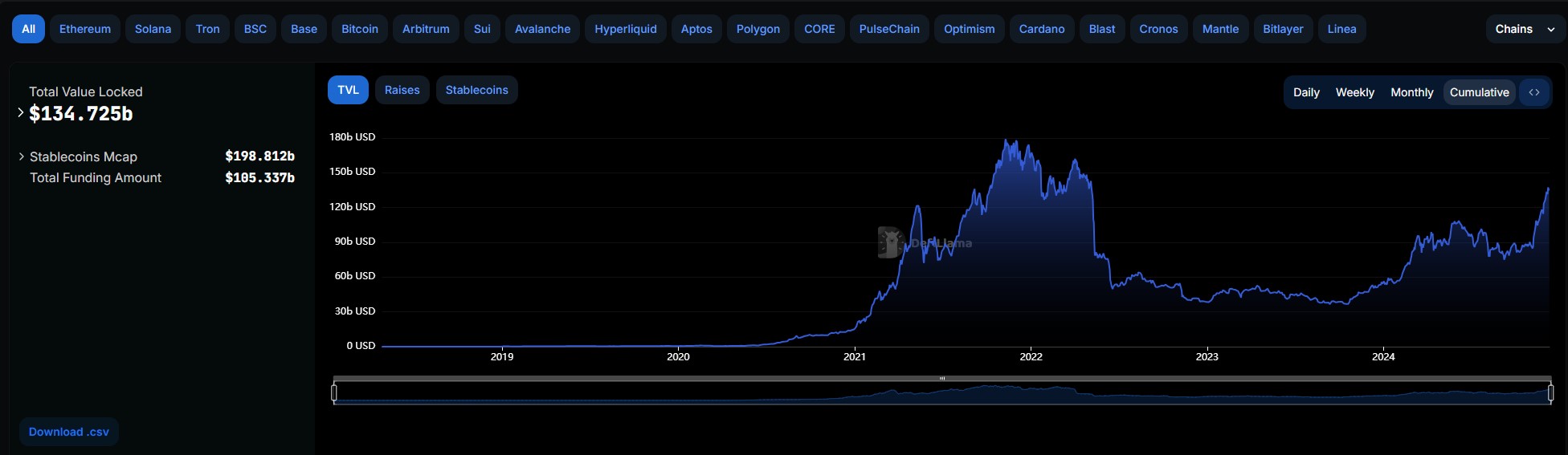
Source: DefiLlama

Related: Anchorage Digital to support liquid Ether staking

Liquid restaking tokens

EigenLayer, the largest restaking protocol, launched in 2023 and has subsequently bootstrapped more than $17 billion in TVL, according to DefILlama.

It has also given rise to an ecosystem of LRT protocols, such as Ether.Fi, which mints tradeable tokens representing claims on restaked assets.

As of Dec. 9, Ether.Fi holds more than $9 billion in TVL. Other LRT protocols include Renzo and Kelp.

“Overall [Ether] TVL for the top 5 LRTs currently sits at around 3.38m ETH, worth around $12.5bn,” Kairos Research said. 

Total LRT TVL, including for other types of restaking tokens, stands at more than $16 billion, according to DefiLlama.

Lido, an Ether ETH$3,697.57 liquid staking token (LST) protocol, has been DeFi’s single biggest TVL source, with nearly $40 billion staked.

Roughly 10% of Lido’s stETH LST has been restaked on EigenLayer, according to data from EigenLayer’s website.

Bitcoin L2s

Meanwhile, Bitcoin BTC$97,385 liquid staking tokens (LSTs) command upward of $2.5 billion in TVL and are growing quickly, according to Staking Rewards.

Bitcoin LSTs are tokenized claims on Bitcoin staked to L2s, including CoreChain and Babylon. CoreChain started issuing staking rewards this year and Babylon will start soon.

At around $1.15 billion in TVL, Lombard is the most popular among Bitcoin LSTs. It is followed by Solv, with a TVL of approximately $1 billion.


Comments

All Comments

Recommended for you

  • Nexus Chain & Cointime to Host Industry AMA — Unpacking DeFi’s “Missing Layer”

    Nexus Chain will host a global AMA on December 27, 2025, at 20:00 (UTC+8) — “DeFi AMA|Unpacking the Missing Layer in Layer1.” The session will explore a key question facing the industry: as PoS evolves and liquidity remains fragmented, does DeFi still lack a foundational execution layer?

  • Japanese listed company ANAP Holdings increased its holdings of Bitcoin by 127.73.

    according to market sources, Japanese listed company ANAP Holdings has disclosed an increase in its Bitcoin holdings by 127.73 coins. As of now, the company's total Bitcoin holdings have reached 1,346.58 coins, valued at approximately 118 million USD.

  • Changpeng Zhao: Binance Wallet now supports identifying malicious addresses; you will receive a warning if you transfer funds to them.

    Zhao Changpeng posted on Binance Plaza stating, "The cryptocurrency industry should be able to completely eradicate address poisoning attacks and protect users. All wallets should simply check whether the receiving address is a poisoned address and block the user.This is a blockchain query. Wallets should not even display these junk transactions anywhere. If the value of the transaction is very small, filter it out. Security alliances in the industry should maintain a real-time blacklist of these addresses so that wallets can check before sending transactions. Binance Wallet is already doing this. If a user tries to send to a malicious address, they will receive a warning.

  • Bitcoin spot ETFs saw a total net outflow of $189 million yesterday, marking the fourth consecutive day of net outflows.

     according to SoSoValue data, the total net outflow of Bitcoin spot ETFs is 189 million USD.The Bitcoin spot ETF with the largest single-day net outflow yesterday was Blackrock's ETF IBIT, with a single-day net outflow of 157 million USD. Currently, IBIT's total historical net inflow has reached 62.34 billion USD. The second is Fidelity's ETF FBTC, with a single-day net outflow of 15.2979 million USD. Currently, FBTC's total historical net inflow has reached 12.189 billion USD. As of the time of writing, the total net asset value of Bitcoin spot ETFs is 114.289 billion USD, with the ETF net asset ratio (market value as a proportion of Bitcoin's total market value) reaching 6.53%, and the cumulative historical net inflow has reached 57.076 billion USD.

  • BTC falls below $88,000

     market shows BTC fell below $88,000, currently at $87,997.85, 24-hour decline reaches 0.88%, market volatility is significant, please manage your risk accordingly.

  • The U.S. spot Ethereum ETF saw net inflows of $84.59 million yesterday.

     according to Trader T monitoring, the US spot Ethereum ETF had a net inflow of 84.59 million USD yesterday.

  • ETH breaks $3,000

     the market shows ETH breaking through $3000, currently at $3000.08, with a 24-hour decline of 0.38%. The market is highly volatile, please manage your risk accordingly.

  • Binance Wallet launches "secure auto-signature" service

     according to the official announcement, Binance Wallet has launched the "Secure Auto Sign" (SAS) service: it now supports mnemonic/private key wallets to trade on Binance Wallet (web version).