Cointime

Download App
iOS & Android

Crypto hackers steal $169M from 34 DeFi protocols in Q1: DefiLlama

Crypto hackers stole over $168.6 million in cryptocurrency from 34 decentralized finance (DeFi) protocols in the first quarter of 2026, falling significantly from the same period last year, according to data from DefiLlama. 

The $40 million private key compromise of Step Finance in January was the largest exploit of the quarter, the data shows, followed by a smart contract manipulation that drained $26.4 million in ether 

ETH$2,064from Truebit on Jan. 8. The third-largest was a private key compromise targeting stablecoin issuer Resolv Labs on March 21.

The quarterly figure is low given that the industry saw $1.58 billion stolen in the first quarter of 2025, with the bulk coming from the $1.4 billion Bybit exploit. However, experts warn that crypto hacks aren’t tied to specific periods within a year.
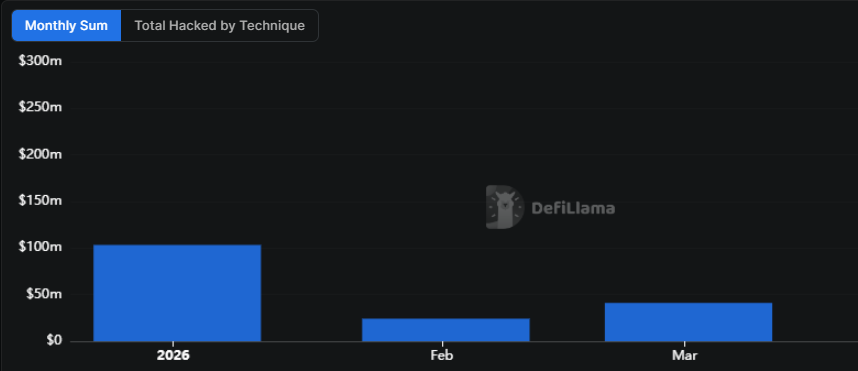
  The first three months of 2026 saw less stolen compared to the prior year period.  Source: DefiLlama


Hackers are more active when industry is booming

Nick Percoco, the chief security officer at crypto exchange Kraken, told Cointelegraph that cybercriminal activity in crypto tends to rise around market and event-driven cycles rather than fixed periods.

Threat actors are also drawn to areas where liquidity is concentrated, meaning attack spikes often follow wherever value is accumulating fastest, according to Percoco.

“Bull markets, major product launches and fast-moving growth phases all create more attractive conditions for attackers because more value is at stake and new infrastructure can introduce risk,” he said.  

“That said, attacks are not confined to just these periods. Vulnerabilities can be exploited in any market environment, particularly in complex or rapidly evolving systems, underlining that security in crypto must be continuous.”

Crypto attackers are a “broad and evolving mix”

North Korea-linked actors have been a persistent threat to crypto investors and Web3-native companies alike. 

Hackers affiliated with the organization have been suspected of numerous attacks, including the Wednesday attack on Drift Protocol, a decentralized cryptocurrency exchange that lost an estimated $285 million to a private key leak.

Percoco said the threat landscape is a mix of actors with different levels of sophistication, highly coordinated groups targeting core infrastructure, organized cybercriminal networks and opportunistic hackers scanning for weaknesses in smart contracts and client-facing systems.

“It is a broad and evolving mix, but they are ultimately targeting the same thing: global, liquid and accessible value. Targeting is rarely purely random. In many cases, attackers are deliberate in how they assess infrastructure, code, access controls and even human behavior,” he said.

“At the same time, crypto’s transparency makes it easier for opportunistic actors to spot weaknesses as they emerge. The most attractive targets tend to be those combining large concentrations of value, technical complexity and gaps in operational security.”

Security experts previously told Cointelegraph that 2026 would likely see an increase in sophisticated credential theft, social engineering, and AI-powered attacks. 

Comments

All Comments

Recommended for you

  • BTC Surpasses $73,000

    Market data shows that BTC has surpassed $73,000, currently priced at $73,010, with a 24-hour increase of 3.3%. The market is experiencing significant volatility, so please ensure proper risk management.

  • Iranian Armed Forces Declare Readiness to Fire at Any Time

    On April 10, a spokesperson for the Central Headquarters of the Iranian Armed Forces, Khatam al-Anbiya, stated that due to the repeated breaches of trust by the United States and Israel, the Iranian Armed Forces remain on full alert and are ready to fire at any time. (Xinhua News Agency)

  • U.S. Core CPI in March Increases 2.6% Year-on-Year, Estimated at 2.7%

    On April 10, it was reported that the U.S. core consumer price index (CPI) increased by 2.6% year-on-year in March, slightly below the estimated 2.7%, and up from the previous value of 2.5%. Month-on-month, it rose by 0.2%, compared to an estimate of 0.3%.

  • US March CPI Increases 3.3% Year-on-Year, Highest Since May 2024

    On April 10, it was reported that the US Consumer Price Index (CPI) for March increased by 3.3% year-on-year, marking the highest level since May 2024. The forecast was 3.4%, while the previous value was 2.4%. The seasonally adjusted CPI for March rose by 0.9% month-on-month, matching expectations of 0.9%, compared to the previous value of 0.30%.

  • Fed's Daly: Likelihood of Rate Hike Lower than Rate Cut or Holding Steady

    Fed's Daly stated that if the Iran conflict is resolved quickly and oil prices decline, a rate cut is 'not out of the question.' If inflation remains above expectations for an extended period, we will remain cautious until we are confident that the inflation issue has been addressed. We had work to do on inflation before the oil price shock; now, this work simply requires more time. The likelihood of a rate hike is considered lower than that of a rate cut or maintaining the current rate.

  • BTC Surpasses $72,000

    Market data shows that BTC has surpassed $72,000, currently priced at $72,004.75, with a 24-hour increase of 1%. The market is highly volatile, so please ensure proper risk management.

  • Circle stock sinks 10% amid analyst downgrade, Drift Protocol probe

    The stablecoin issuer faces pressure after a stock downgrade and Drift Protocol exploit fallout, raising concerns over USDC exposure, crypto regulation and market risk.

  • Hong Kong grants first stablecoin licences to Anchorpoint and HSBC

    Hong Kong has issued its first stablecoin licences, approving Anchorpoint Financial and HSBC’s Hong Kong banking arm under the HKMA’s new regime.

  • HSBC Plans to Launch Hong Kong Dollar-Pegged Stablecoin in Second Half of 2026

    On April 10, HSBC announced its support for the Hong Kong Monetary Authority's issuance of stablecoin licenses. The bank plans to launch a Hong Kong dollar-pegged stablecoin in the second half of 2026.

  • HSBC and Standard Chartered Obtain Stablecoin Licenses in Hong Kong

    On April 10, the Hong Kong Monetary Authority announced that the Financial Commissioner has granted stablecoin issuer licenses to two institutions—Anchor Financial Technology Limited (a company formed by Standard Chartered Bank (Hong Kong), Hong Kong Telecom, and Anxin Group) and HSBC. This marks a new phase in the implementation of Hong Kong's stablecoin regulatory framework.