Cointime

Download App
iOS & Android

Drift Protocol warns users to pause deposits amid 'unusual' trading activity

Drift Protocol, a decentralized cryptocurrency exchange (DEX), detected “unusual” trading activity on the platform on Wednesday, warning users not to deposit funds until the issue has been resolved.

The Drift team did not disclose the specific cause of the ongoing incident or the damage in its initial announcement and is currently investigating the issue. 

In a subsequent update, the Drift team announced that deposits and withdrawals on the platform have been suspended. 
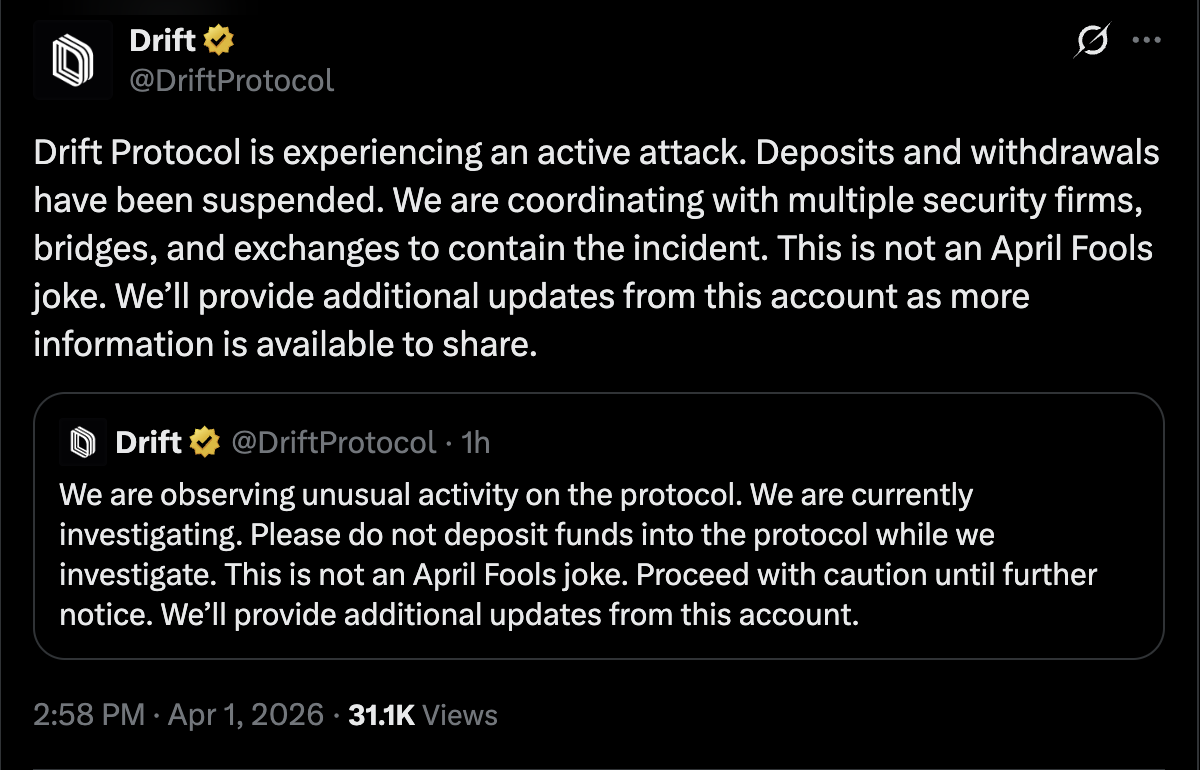
  Source: Drift Protocol


Blockchain cybersecurity threat researcher Vladimir S said the exploit was likely due to a crypto wallet private key leak, and the total funds lost in the incident could be as high as $200 million. 

“Admin signer was compromised, or whoever controls it intentionally executed these changes,” he said

The stolen assets include wrapped versions of Bitcoin (BTC), Jito (JTO), the Fartcoin (FRT) memecoin, other altcoins, and various dollar, euro, and Japanese yen stablecoins, which have since been transferred to multiple wallets, according to Vladimir S.
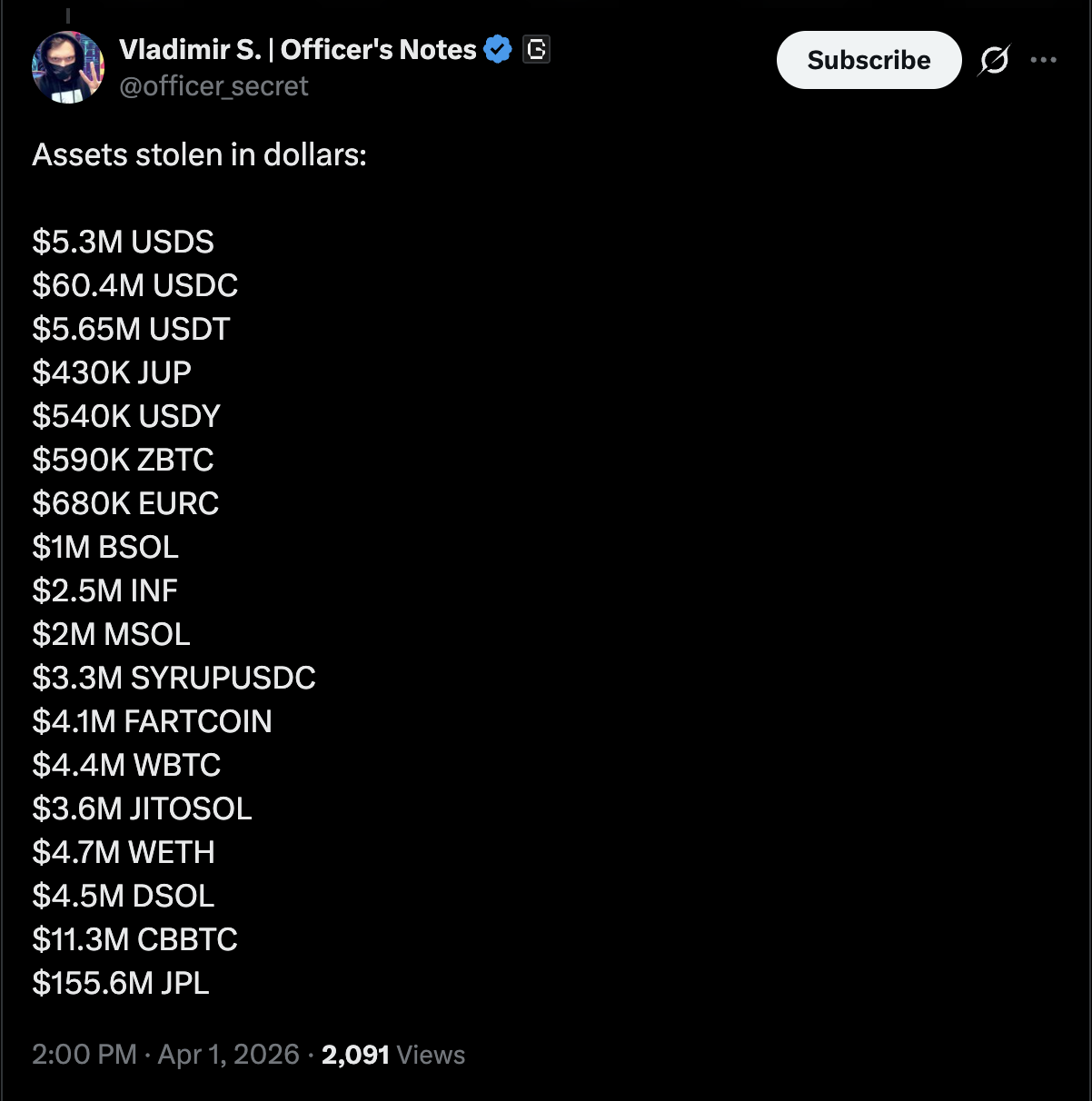
  Source: Vladimir S


The exploiter started converting the stolen assets to the USDC (USDC) stablecoin, bridging the funds to the Ethereum network and purchasing Ether (ETH), according to Solana treasury company DeFi Development Corp.

Cointelegraph reached out to Drift Protocol but did not receive an immediate response by the time of publication. 

Cybersecurity exploits and hacks were responsible for $49 million in crypto losses during February, a sharp decrease from January, but a reflection of the ongoing security threats users and platforms face.

Drift token impacted by the exploit

The price of the Drift (DRIFT) token briefly reached $0.68 on Wednesday, but fell by about 18% following news of the exploit, according to data from CoinMarketCap.
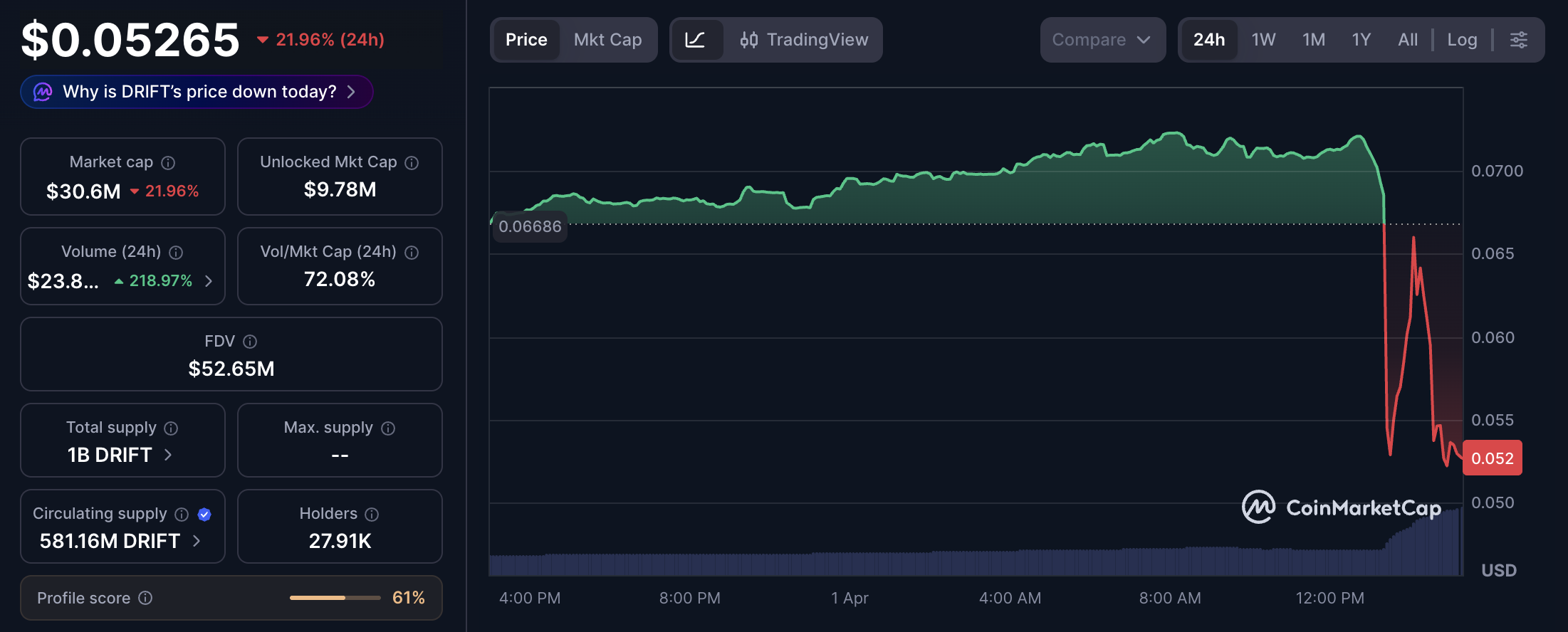
  Drift token falls after news of the exploit. Source: CoinMarketCap


About 83% of the native crypto tokens of hacked platforms never recover to pre-hack prices, according to blockchain security company Immunefi. 

“The stolen funds are only the first layer of damage,” Immunefi CEO Mitchell Amador told Cointelegraph in March.

“What follows is often more destructive: sustained token price suppression, reduced treasury capacity, leadership disruption, lost development time, and erosion of user trust,” he added. 

Comments

All Comments

Recommended for you

  • Coinbase CLO Grewal says Clarity Act 'very close' to reaching deal on stablecoin yield

    Coinbase CLO Paul Grewal said in an interview with Fox Business that the stablecoin yield debate in the upcoming Clarity Act is “very close” to reaching a deal.

  • BTC Falls Below $67,000

    Market data shows that BTC has fallen below $67,000, currently reported at $66,960.01, with a 24-hour decline of 1.21%. The market is experiencing significant volatility, so please ensure proper risk management.

  • AI agents like OpenClaw could drain crypto wallets via ‘malicious skills’: CertiK

    CertiK has advised ordinary users “who are not security professionals, developers, or experienced geeks” against installing and using OpenClaw.

  • Drift Protocol warns users to pause deposits amid 'unusual' trading activity

    The reported incident could be a $200 million exploit of the decentralized crypto exchange due to a leak of a crypto wallet private key.

  • ETH Drops Below $2100

    Market data shows that ETH has dropped below $2100, currently priced at $2099.91, with a 24-hour decline of 0.04%. The market is highly volatile, so please ensure proper risk management.

  • BTC Falls Below $68,000

    Market data shows that BTC has fallen below $68,000, currently priced at $67,997.84, with a 24-hour decline of 0.37%. The market is experiencing significant volatility, so please ensure proper risk management.

  • Drift Protocol on Solana Ecosystem Attacked, Losses Estimated at Over $200 Million

    On April 2, the derivative trading platform Drift Protocol, based on Solana, experienced a security incident. On-chain data indicates losses of at least approximately $200 million, with some estimates nearing $270 million. The project team reported that they have detected unusual activity and are currently investigating, advising users not to deposit funds into the protocol and emphasizing that 'this is not an April Fool's joke.' The attack involved multiple liquidity pools, including JLP Delta Neutral, SOL Super Staking, and BTC Super Staking. A single transaction involved the transfer of approximately 41.7 million JLP tokens, valued at around $155 million, along with other assets such as SOL, USDC, cbBTC, and wBTC being withdrawn. According to statistics, this incident may become one of the largest DeFi attacks in the Solana ecosystem since the Wormhole bridge exploit.

  • U.S. Treasury Releases First Draft Rules for GENIUS Act, Seeks State Regulatory Input for Small Stablecoin Issuers

    On April 2, the U.S. Treasury released the first proposed rulemaking notice (NPRM) for the Guidance and Establishment of the U.S. Stablecoin National Innovation Act (GENIUS Act), seeking public input on the criteria for determining the applicable state regulatory framework for small stablecoin issuers. The proposal aims to clarify that when a state regulatory system is 'substantially similar' to the federal framework, stablecoin issuers with a market capitalization below $10 billion may choose to be regulated at the state level rather than under comprehensive federal regulation. The public will have a 60-day comment period following the publication of the rule in the Federal Register. The Treasury stated that the rule will establish overall principles for determining whether state regulation meets federal standards. Currently, major U.S. banking regulators, including the Federal Deposit Insurance Corporation (FDIC) and the Office of the Comptroller of the Currency (OCC), are also releasing related draft rules to advance the stablecoin regulatory framework. Meanwhile, the GENIUS Act does not yet address rules for interest-bearing stablecoins, which has become a significant obstacle for Congress in advancing broader cryptocurrency market structure legislation.