

Cointime

Download App
iOS & Android

AI data center gold rush sparks debate over impact on Bitcoin mining

Validated Individual Expert

A new debate has emerged over whether a continued shift by Bitcoin miners toward artificial intelligence could impact the network’s security and its role as a store of value.

While some argue that miners leaving the network would leave it more susceptible to a “51% attack,” others argue it will simply trigger the Bitcoin network to rebalance itself as designed, making it enticing for miners again.

“AI has killed Bitcoin forever,” crypto trader Ran Neuner said on Sunday, arguing that it has become Bitcoin mining’s biggest competitor because both industries compete for electricity.

“AI is willing to pay much more for it,” he added, explaining that Bitcoin mining revenue per megawatt is around $57 to $129, but AI data center revenue per megawatt is up to eight times higher at $200 to $500 for the same electricity, which is why miners are starting to pivot.

Earlier this month, Core Scientific secured up to $1 billion in credit for AI hosting, MARA Holdings recently filed with the SEC signaling its intent to sell some of its BTC as part of an AI pivot and Hut 8 signed a $7 billion AI infrastructure agreement with Google in December, argued Neuner.

Meanwhile, Cipher Mining cut its hashrate to focus on AI compute, and Bitmain cofounder Jihan Wu has stopped mining and pivoted to AI, he added.

“So if I were a miner, it wouldn’t be a tough decision. And that’s why every day more and more miners are leaving the network.” 

It sounds like a doomsday scenario for Bitcoin, but not everyone agrees. 

Bitcoin pioneer and cryptographer Adam Back argued that difficulty adjustments would only force the least efficient miners out, and profitability would improve. 

“What happens to Bitcoin is simple: tick tock, next block! Difficult adjusts downwards, the least efficient and AI switchers move out, and Bitcoin mining profitability converges to AI profitability. QED.”

“If AI outbids miners for electricity, miners just turn off until the difficulty adjusts and it’s profitable again, that’s literally how Bitcoin works,” added investor Fred Krueger.

Bitcoin energy demand is variable

However, Neuner argued that falling hashrates, which are down 14.5% since their October peak, mean that there are fewer miners to secure the network, and a higher potential for 51% attacks.

This has all happened before during bear markets, and automatic network difficulty adjustments usually compensate for it, “but this time is different because we don’t have the energy,” he said. 
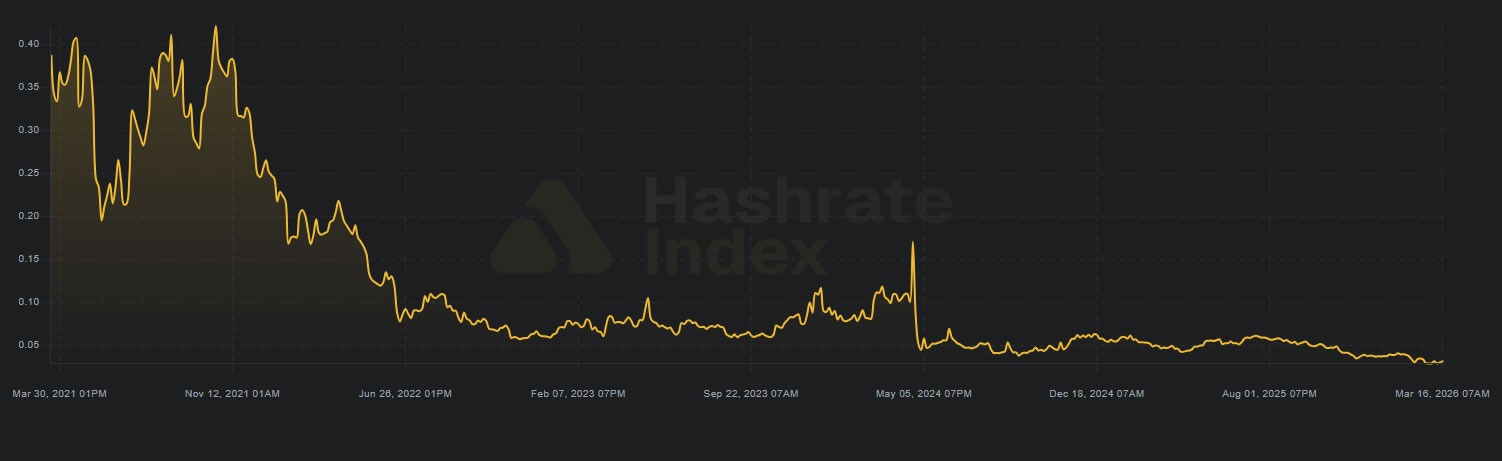
  Bitcoin mining profitability, or hashprice, is near an all-time low. Source: HashRateIndex

Bitcoin ESG specialist Daniel Batten disagreed and said it was the other way around, as “the evidence tells us that AI is dependent upon Bitcoin for its expansion.”

It wasn’t all about high demand and expensive power, as Bitcoin mining can use stranded energy, act as a flexible load balancer for energy grids, and use older equipment for cheaper energy, he argued. 

One green candle could prevent an AI-driven mining exodus

Neuner said one way to ensure AI doesn’t overshadow Bitcoin will depend on whether BTC prices go up.

“What I hope is that Bitcoin has one green candle. Maybe because of the war, maybe because of the regulation, who knows?” 

“If you’re watching the Bitcoin price action during this war, that’s exactly what’s happening,” he said, adding that the other scenario, where Bitcoin price continues to fall, is “pretty much a Bitcoin doomsday.”

Bitcoin has seen five monthly red candles in a row, something that hasn’t happened since the 2018 bear market. However, March is currently shaping up to be positive with the asset gaining 8% so far this month, according to CoinGlass.

Comments

All Comments

Recommended for you

  • BTC Briefly Drops Below $60,000

    Market data shows that BTC briefly dropped below $60,000, currently recovering to $61,290.9, with a 24-hour decline of 3.5%. The market is experiencing significant volatility, so please ensure proper risk management.

  • Yili Hua: US Stocks Correct as Expected, Decline Faster Than Anticipated

    On June 5, Liquid Capital (formerly LD Capital) founder Yili Hua stated, "As we anticipated, US stocks have begun to correct, and expectations for interest rate cuts have changed. Trading is always the most challenging task; getting it right ten times and wrong once can lead to problems. It is essential to remain cautious and manage risks. The speed of this decline following the rebound has far exceeded expectations. However, it also comes with greater opportunities; historically, bear markets have been the time to make money, while bull markets often lead to losses."

  • Fed's Harker: Maintaining Stable Rates is Reasonable for Now

    On June 5, Fed's Harker stated that it may soon be time to adjust interest rates. Given the uncertainty, maintaining stable rates is reasonable at this time.

  • President Trump: Recent Employment Report is Strong, Stock Market Should Rise, Not Fall

    On June 5, U.S. President Trump stated that the recently released employment report is very strong, and the stock market should rise, not fall. This has been the case for the past 200 years. Economic growth does not mean inflation!

  • SpaceX's Initial IPO Oversubscribed

    On June 5, according to media reports, the number of subscriptions attracted by SpaceX's initial public offering (IPO) exceeded the number of shares available.

  • Strong U.S. Labor Market, but Consumers May Worry About Negative Real Wage Growth

    On June 5, Brent Schutte, Chief Investment Officer of Northwestern Mutual Wealth Management, stated that the U.S. labor market has moved away from the weak and limited growth experienced in 2025, showing signs of recovery and broader expansion. In 2025, the non-cyclical healthcare and social assistance sectors contributed to all job growth. The diffusion index, which had been below 50 for nine months in 2025, has rebounded to above 50 in the last five months, reaching 54.4 in May. The good news for consumers is that the labor market is strong and employment is stable. However, concerns about future spending arise as real wages are experiencing negative growth, with average hourly earnings up 3.4% year-on-year and inflation at 3.8%. The Federal Reserve may lean towards a wait-and-see approach, but its focus is likely to shift towards the inflation aspects of monetary policy.

  • Nasdaq China Golden Dragon Index Falls by 2%

    The Nasdaq China Golden Dragon Index has declined by 2%, with Baidu (BIDU.O) dropping nearly 7%, NIO (NIO.N) and Xpeng Motors (XPEV.N) falling over 3%, and Alibaba (BABA.N) decreasing by 1.3%.

  • Spot Silver Falls Below $70/Ounce; Spot Gold Drops Over $100 in a Day

    On June 5, spot silver fell below $70 per ounce for the first time since April 7, with a daily decline of 5.4%. Spot gold also dropped over $100 in a day, currently priced at $4,375.35 per ounce, reflecting a decrease of 2.24%.

  • US Optical Communication Stocks Plummet, Mavenir Technologies Drops Over 8%

    On June 5, US optical communication concept stocks collectively declined, with Mavenir Technologies and Nokia falling over 8%, Ciena and Coherent dropping over 7%, Corning decreasing over 6%, and Lumentum falling over 4%.

  • Cryptocurrency Total Market Cap Falls Below $2.2 Trillion

    On June 5, data from CoinGecko shows that the current total market cap of cryptocurrencies is $2.181 trillion, with a 24-hour decline of 5.0%. Bitcoin accounts for 55.8% of the market cap, while Ethereum accounts for 8.95%.
