

Cointime

Download App
iOS & Android

Address poisoning recently cost 2 victims over $62M alone: Scam Sniffer

Validated Individual Expert

Just one victim lost $12.2 million in January by copying the wrong address from their transaction history in an “address poisoning attack,” adding to a similar $50 million attack in December, according to Scam Sniffer.

Address poisoning is when attackers send small transactions or “dust” from addresses that look similar to ones in the target’s transaction history, hoping the victim will copy the wrong address.

Scam Sniffer added that signature phishing also surged recently, with $6.27 million stolen from 4,741 victims in January, a 207% increase compared to December.

Two wallets accounted for 65% of all signature phishing losses.

Signature phishing is slightly different as it tricks users into signing malicious blockchain transactions, such as unlimited token approvals.
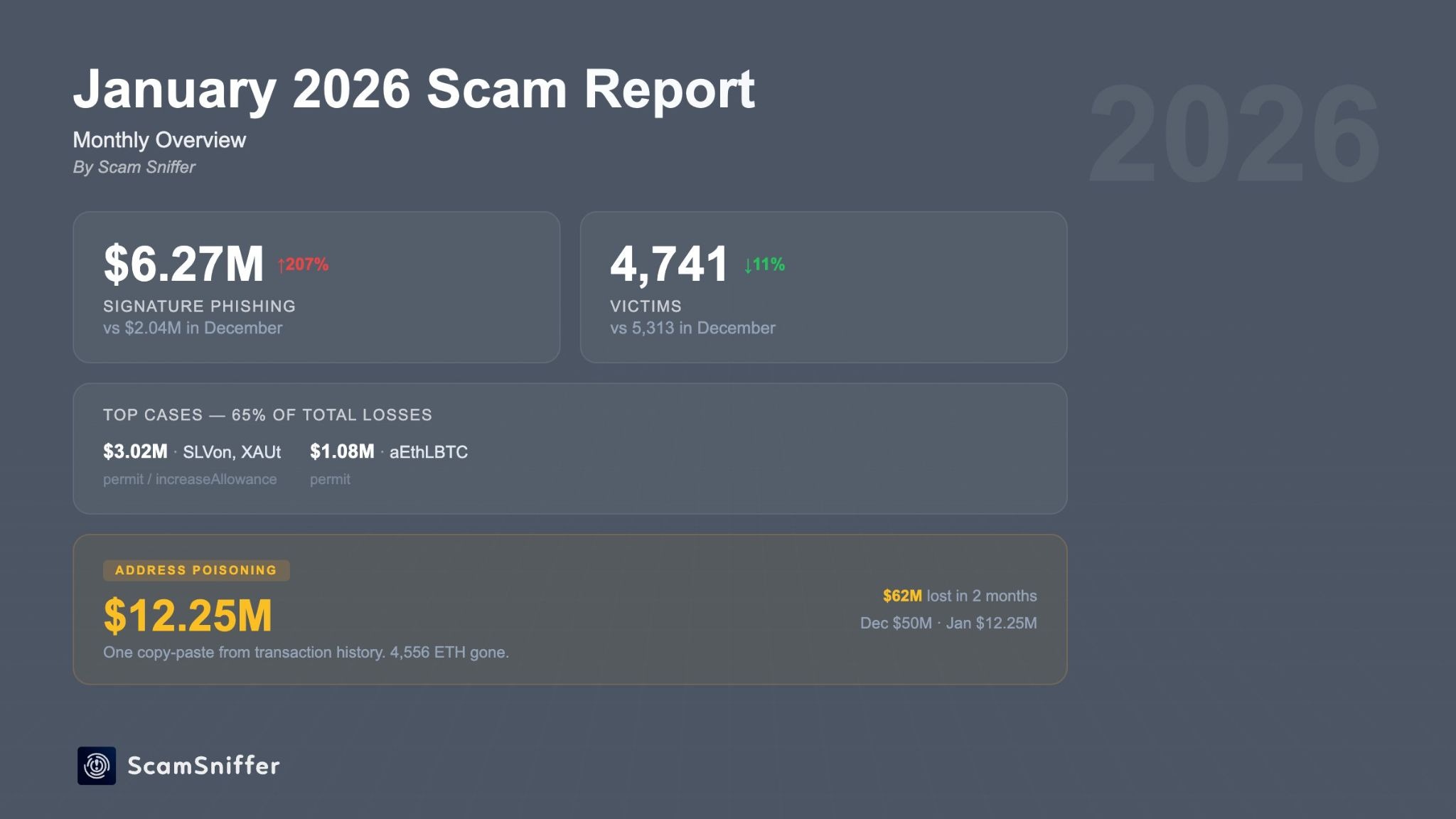
  Address poisoning and signature phishing attacks have increased in January: Source: Scam Sniffer


Address poisoning trend not slowing down 

“Address poisoning is one of the most consistent ways large amounts of crypto get lost,” reported security firm Web3 Antivirus on Thursday.

Some of the biggest address poisoning losses it tracked over time ranged from $4 million to $126 million. “Recent incidents show this trend isn’t slowing down,” they stated. 

The researchers explained that address poisoners “generate full addresses that match the same first/last few characters you see, but the middle is different, so it looks ‘identical.’” 

Dust attacks on Ethereum have surged 

Analysts speculate that the Ethereum Fusaka upgrade in December has contributed to the increase in attacks because it made the network cheaper to use in terms of transaction costs

Stablecoin-related dust activity is now estimated to make up 11% of all Ethereum transactions and 26% of active addresses on an average day, reported Coin Metrics earlier in February. 

The firm analyzed over 227 million balance updates for stablecoin wallets on Ethereum from November 2025 through January 2026, finding that 38% were under a single penny — “consistent with millions of wallets receiving tiny poisoning deposits,” it stated. 

Blockchain intelligence firm Whitestream reported on Sunday that the decentralized DAI stablecoin “has gained a reputation as a preferred stablecoin for illicit actors, serving as a ‘parking place’ for illegally sourced funds.”

“This is due to the protocol’s governance, which does not cooperate with authorities in freezing DAI wallets,” it stated, referencing recent address poisoning attacks. 

Comments

All Comments

Recommended for you

  • BTC Briefly Drops Below $60,000

    Market data shows that BTC briefly dropped below $60,000, currently recovering to $61,290.9, with a 24-hour decline of 3.5%. The market is experiencing significant volatility, so please ensure proper risk management.

  • Yili Hua: US Stocks Correct as Expected, Decline Faster Than Anticipated

    On June 5, Liquid Capital (formerly LD Capital) founder Yili Hua stated, "As we anticipated, US stocks have begun to correct, and expectations for interest rate cuts have changed. Trading is always the most challenging task; getting it right ten times and wrong once can lead to problems. It is essential to remain cautious and manage risks. The speed of this decline following the rebound has far exceeded expectations. However, it also comes with greater opportunities; historically, bear markets have been the time to make money, while bull markets often lead to losses."

  • Fed's Harker: Maintaining Stable Rates is Reasonable for Now

    On June 5, Fed's Harker stated that it may soon be time to adjust interest rates. Given the uncertainty, maintaining stable rates is reasonable at this time.

  • President Trump: Recent Employment Report is Strong, Stock Market Should Rise, Not Fall

    On June 5, U.S. President Trump stated that the recently released employment report is very strong, and the stock market should rise, not fall. This has been the case for the past 200 years. Economic growth does not mean inflation!

  • SpaceX's Initial IPO Oversubscribed

    On June 5, according to media reports, the number of subscriptions attracted by SpaceX's initial public offering (IPO) exceeded the number of shares available.

  • Strong U.S. Labor Market, but Consumers May Worry About Negative Real Wage Growth

    On June 5, Brent Schutte, Chief Investment Officer of Northwestern Mutual Wealth Management, stated that the U.S. labor market has moved away from the weak and limited growth experienced in 2025, showing signs of recovery and broader expansion. In 2025, the non-cyclical healthcare and social assistance sectors contributed to all job growth. The diffusion index, which had been below 50 for nine months in 2025, has rebounded to above 50 in the last five months, reaching 54.4 in May. The good news for consumers is that the labor market is strong and employment is stable. However, concerns about future spending arise as real wages are experiencing negative growth, with average hourly earnings up 3.4% year-on-year and inflation at 3.8%. The Federal Reserve may lean towards a wait-and-see approach, but its focus is likely to shift towards the inflation aspects of monetary policy.

  • Nasdaq China Golden Dragon Index Falls by 2%

    The Nasdaq China Golden Dragon Index has declined by 2%, with Baidu (BIDU.O) dropping nearly 7%, NIO (NIO.N) and Xpeng Motors (XPEV.N) falling over 3%, and Alibaba (BABA.N) decreasing by 1.3%.

  • Spot Silver Falls Below $70/Ounce; Spot Gold Drops Over $100 in a Day

    On June 5, spot silver fell below $70 per ounce for the first time since April 7, with a daily decline of 5.4%. Spot gold also dropped over $100 in a day, currently priced at $4,375.35 per ounce, reflecting a decrease of 2.24%.

  • US Optical Communication Stocks Plummet, Mavenir Technologies Drops Over 8%

    On June 5, US optical communication concept stocks collectively declined, with Mavenir Technologies and Nokia falling over 8%, Ciena and Coherent dropping over 7%, Corning decreasing over 6%, and Lumentum falling over 4%.

  • Cryptocurrency Total Market Cap Falls Below $2.2 Trillion

    On June 5, data from CoinGecko shows that the current total market cap of cryptocurrencies is $2.181 trillion, with a 24-hour decline of 5.0%. Bitcoin accounts for 55.8% of the market cap, while Ethereum accounts for 8.95%.
