


The information, opinions and judgments on markets, projects, currencies, etc. mentioned in this report are for reference only and do not constitute any investment advice.Written by 0xBrooker
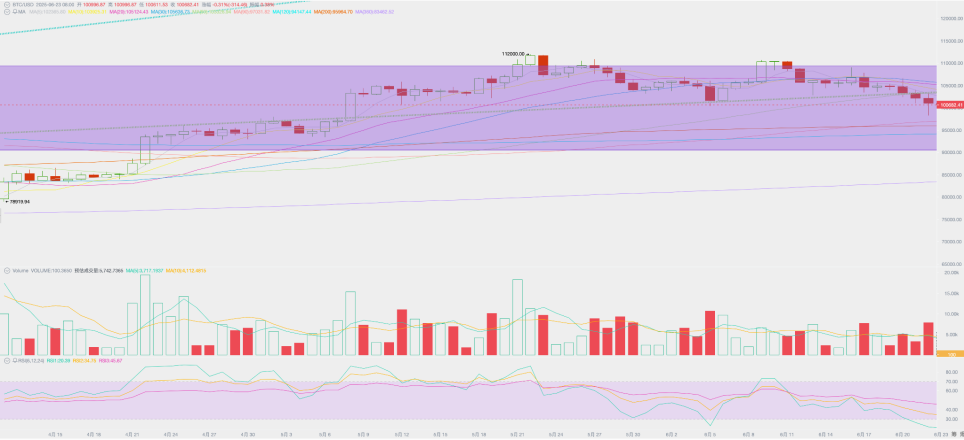
This week, crypto assets have experienced the triple intersection of "institutional funds supporting the bottom, increased alertness on derivatives, and instantaneous amplification of geopolitical risks."
BTC continued to test the $102,000-109,000 range and experienced a brief panic drop over the weekend due to the US raid on Iran's nuclear facilities, followed by a partial recovery.
The internal structural forces of the crypto market remain intact and have become an important support for stable prices, but due to the intensification of geopolitical conflicts, short-term traders have priced BTC downward.
In the future, under the condition of stable internal structure, the subsequent trend of BTC depends entirely on whether the Iran-Israel conflict will continue to escalate, such as Iran directly supplying US military bases and ships, or even blocking the Strait of Hormuz. If the conflict gradually resumes, BTC will most likely return to the $105,000 level.
Policy, macro-finance and economic data
The Iran-Israel conflict has spiraled this week.
From June 16 to 18, Israel continued to launch "surgical" air strikes against missile positions and Shiite militia command centers in Iran; Iran subsequently retaliated with ballistic missiles and drones, and the regional firepower raised the temperature of the battlefield. The market immediately entered a defensive mode: Brent crude oil rose nearly 7% during the week, breaking through the $78 mark at one point; gold also rose simultaneously, reaching a high of $33,452.37 per ounce.
On June 19, the White House publicly announced for the first time that it was "evaluating military options," marking the critical point for the United States to shift from behind-the-scenes coordination to public intervention. On the day the news was announced, Brent crude futures closed up another 2.8% at $78.85, a five-month high; the VIX volatility index rose, while U.S. Treasury yields fell in a risk-averse manner.
A brief easing occurred on June 20 - the market speculated that Washington might end with additional sanctions rather than military action, oil prices retreated slightly, and global stock indexes also saw a technical rebound.
However, just one day later, the optimism of "sanctions as an alternative to strikes" was completely shattered: US President Trump ordered three B-2 stealth bombers carrying GBU-57 "massive bunker busters" to carry out precision bombing of Iran's three uranium enrichment facilities in Fordow, Natanz and Isfahan in the early morning of June 21, Eastern Time. In his televised speech, Trump declared that "critical core capabilities have been reset to zero," implying that the action could come to an end if Iran was willing to negotiate.
This move immediately triggered a violent diplomatic shock. UN Secretary-General Guterres described the situation as "precarious". The EU and the UK condemned Iran's nuclear ambitions while urging all parties to exercise restraint. Iran's foreign minister accused the United States of "blatantly violating the UN Charter", vowed to take "reciprocal or asymmetric retaliation", and said that he would not rule out a "selective blockade" of the Strait of Hormuz. Subsequently, the Iranian parliament passed a resolution to close the Strait of Hormuz (which would affect 20% of the world's exported oil transportation), and the final decision was made by Iran's Supreme National Security Council.
As the airstrike occurred during the weekend, pricing in the mainstream financial market is yet to be announced on Monday, but derivatives and offshore trading have given forward-looking signals: Energy and defense ETF night trading prices rose; CME crude oil options OI saw a significant increase in volume above the $90 exercise price range; and high-risk crypto assets were the first to experience selling pressure, with BTC falling by about 1.14% and ETH falling by more than 2.96% during the session.
In last week's weekly report, we proposed that the short-term trend of BTC depends on the progress of "geopolitical conflict". If the conflict intensifies or even escalates, risk assets including BTC will remain volatile or even priced downward; if the conflict eases, equity assets may gradually recover their losses.
The direct intervention of the United States this week has escalated the conflict, pushing BTC down 4.36% to $4,602.38 for the week. If Iran’s subsequent retaliatory actions involve supplying U.S. military bases or “blocking” the Strait of Hormuz, it will further affect the downward pricing of global U.S. stocks and crypto assets.
This week's events have pushed the situation in the Middle East into a gray area between "controllable confrontation" and "proxy escalation", and the market has entered a typical "crude oil inflation-US debt risk aversion-technology correction-precious metals are favored" mode. If Iran's retaliation is limited by domestic political and military capabilities in the coming weeks, then the market may digest it in high volatility; but if the conflict further spills over to offshore energy routes or US military bases, the magnitude and pace of global asset repricing will be significantly intensified.
Historical data shows that BTC often retreats at the beginning of a geopolitical crisis and then recovers with a weak negative correlation with gold; but if the conflict evolves into a double squeeze on global liquidity and capital costs, the sensitivity of Bitcoin and Ethereum will be significantly amplified.
Crypto Market
This week, crypto assets experienced a triple combination of "institutional funds supporting the bottom, rising derivatives alert, and geopolitical risks amplified instantly". BTC continued to test the range of $102,000-109,000, and experienced a brief panic decline due to the US raid on Iran's nuclear facilities over the weekend, and then partially recovered.
At the beginning of the week, the market's expectation of a "controllable" Iran-Israel conflict brought a slight recovery: BTC rebounded to $109,000 at its highest, and Bitcoin spot ETFs saw net inflows for eight consecutive trading days. This funding data provided key support for prices amid macro noise. Against the backdrop of cooling funds on the market, institutional buying power became the main force keeping BTC prices above $100,000.
Subsequently, the FOMC results announced on June 19, "standing still + dot-by-dot slowdown", did not disrupt the BTC's volatility rhythm, but the futures market showed that the scale of hedging was increasing.
After-hours data on Friday showed that the ETH ETF experienced the largest single-day net outflow since June so far ($11.3 million). Institutional reductions in holdings triggered a chain of deleveraging. The ETH dollar price once plummeted to $2,372, trading volume increased, and led to a simultaneous pullback of high-beta assets such as SOL and DOGE.
During the U.S. trading session on June 20, a round of high leverage squeeze on the market caused BTC to quickly fall below $103,000, of which more than 90% were long positions; ETH, SOL, etc. fell by as much as 6-9%. This "flash sale" incident confirmed the fragility of excessive leverage on the derivatives side, and also marked the first large-scale systematic liquidation of the market since its rapid rise in May.
The weekend risk peak appeared in the early morning of June 21-22, Eastern Time: the news that the US B-2 bomber accurately struck three Iranian uranium enrichment facilities broke the weekend liquidity vacuum. As the only major asset class in the world that is traded in real time 24/7, the crypto market, BTC once fell below $100,000, but closed down -1.14%, showing a relatively strong performance, but ETH fell again by 2.96% on the basis of a two-day decline of nearly 10%, showing that the liquidity of high-risk assets is very fragile.
From the technical indicators, geopolitical conflicts have caused BTC to temporarily break the first rising trend line, but it is still running in the range of 90,000 to 110,000 US dollars. We believe that the structural tension in the market is intact, and the capital support has not changed much. BTC's downward pricing this week is caused by the panic caused by the escalation of geopolitical conflicts. If the conflict escalates again, this impact will gradually disappear, but if the conflict continues to escalate, it will test the key support levels of 100,000 and 90,000 US dollars.
Funds In and Out
After the big rebound in April and May, capital inflows diverged, with stablecoin channel funds beginning to weaken, while BTC Spot ETF channel funds were relatively strong and stable.
This week, the BTC Spot ETF channel funds inflow was $1.022 billion, which was significantly weaker than last week's $1.384 billion, but still maintained at a high level. However, this data may face greater challenges next week. If geopolitical conflicts continue to cool down the U.S. stock market, the BTC Spot ETF channel funds are expected to find it difficult to move independently.
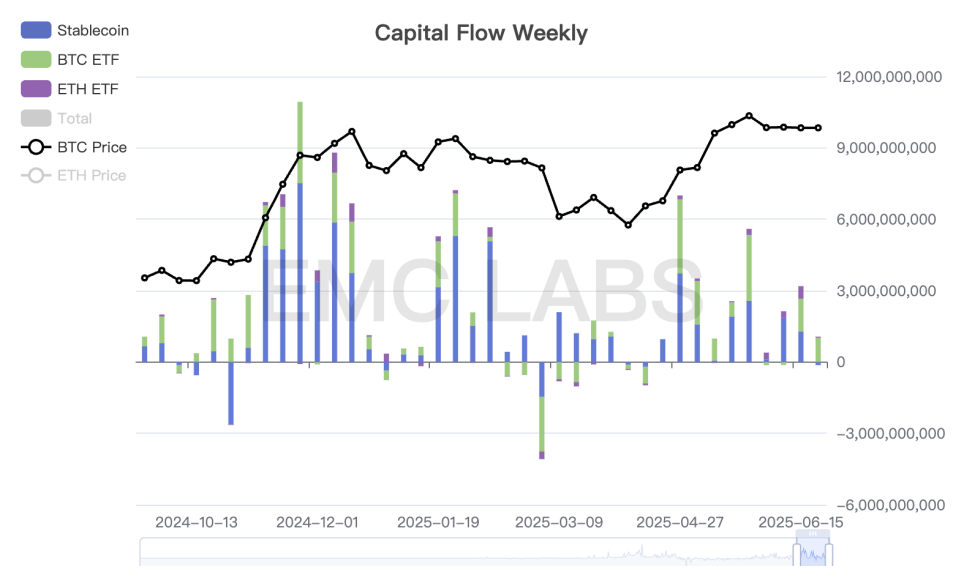
Crypto market capital inflow statistics (weekly)
The stablecoin channel had an inflow of 1.273 billion last week and an outflow of 132 million this week. This rapid cooling is consistent with the trend we have seen in the contract market and lending market.
This week, ETH Spot ETH inflows were 40.77 million USD. The inflows shrank in the first half of the week, but turned to outflows of more than 100 million USD by Friday. The reduction in the inflows of ETH funds may put pressure on high-β assets. Once a flash crash occurs, it will cause great damage to the market.
Selling pressure and selling
Amid the delay in interest rate cuts and the backdrop of rising geopolitical tensions, the price of BTC remained at a high level of $10 to $12, with the decisive force coming from institutional allocations and structural tensions within the market.
This week, long positions continued to increase by 28,920 coins, short positions continued to decrease by 24,650 coins, and the inventory of centralized exchanges continued to decrease. Due to panic selling and reduced speculative enthusiasm, the outflow scale of exchanges this week was greatly reduced to 1,555.9 coins.
The above data may indicate that the confidence of long-term holders in BTC is continuously increasing, but the enthusiasm of short-term traders is cooling down faster, and the short-term pricing power of BTC is jointly determined by short-term traders on the market and BTC Spot ETF channel funds. At present, both have cooled down. If the Iran-Israel conflict is resolved as soon as possible, BTC may turn danger into safety and return to the 105,000 level. If it worsens, it is likely to fall below the 100,000 US dollar level, and even test 90,000 US dollars (with a low probability).
EMC Labs believes that the logic of BTC’s medium- and long-term price trend has not changed, unless the Iran-Israel conflict evolves into a regional war with the intervention of the United States.
Cycle Indicators
According to eMerge Engine, the EMC BTC Cycle Metrics indicator is 0.625 and is in an upward period.

EMC Labs was founded by crypto asset investors and data scientists in April 2023. It focuses on blockchain industry research and Crypto secondary market investment, takes industry foresight, insight and data mining as its core competitiveness, and is committed to participating in the booming blockchain industry through research and investment, and promoting blockchain and crypto assets to bring benefits to mankind.
For more information, please visit: https://www.emc.fund


All Comments