


The information, opinions, and judgments regarding markets, projects, and currencies mentioned in this report are for reference only and do not constitute any investment advice.Written by 0xBrooker
Following last week's drop below the upper limit of the "Trump bottom" at $110,000, and accompanied by a sudden increase in macroeconomic uncertainty, BTC, which had stabilized and rebounded last week, experienced another collapse, falling 10.04% this week and breaking through two key technical support levels: the lower edge of the upward channel of this bull market and the 360-day moving average.
Although the US government has reopened, funds have not yet flowed out of the Treasury's accounts, and commercial bank reserves remain low, exacerbating short-term liquidity constraints. In the medium term, the number of hawkish Federal Reserve voting members continues to increase, and the probability of a rate cut in December has fallen below 50%.
The market is flooded with sell orders, with long-term holders continuously taking profits and short-term holders selling at a loss. The BTC ETF channel recorded its second-highest single-day sell-off in history. Buyers are present, but extremely passive, and all technical support appears to have lost its effectiveness.
With the lower edge of the upward channel and the 360-day moving average effectively broken, BTC has technically entered a bear market. If, in the coming weeks, funds do not flow back sufficiently and selling pressure persists, making it difficult for the BTC price to return above key technical indicator levels and confirm a valid break below these levels on the weekly chart, then the current BTC bull market that began in 2022 will most likely have officially ended.
Policy, macro-financial and economic data
The US government just reopened this week and will release the September CPI next week, but because no data was collected during the shutdown, the October CPI will be permanently missing. This significantly diminishes the objectivity of the Federal Reserve's December interest rate decision.
Non-farm payroll data has been absent for several weeks. The weekly ADP data released on the 11th showed that in the four weeks ending October, the private sector averaged a net weekly loss of 11,000 jobs, a shift to negative growth compared to an increase of 14,250 jobs per week earlier in October, indicating a possible reversal in hiring momentum. This is "good news" for interest rate cuts.
But the Federal Reserve continues its hawkish stance. Following hawkish comments from three voting members late last week, three more hawkish voting members joined this week. This has directly pushed down the probability of a December rate cut, from an initial 90% to 44% by Friday, essentially pausing the pricing of a December rate cut once again.
In terms of short-term liquidity, the government shutdown caused the Treasury's TGA account to accumulate nearly $1 trillion, resulting in a high SOFR (Socially Available Funds Rate). Liquidity tightness reached a recent high on Friday, causing the Nasdaq to fall for several consecutive days, breaking below its 60-day moving average on Friday and dropping more than 6% from its high.
However, due to hitting a strong support level, the Nasdaq experienced a sharp V-shaped recovery during the session, ultimately closing up 0.13% near last Friday's low and above the 50-day moving average.
Currently, the recent correction in US stocks can be characterized as a "valuation correction in overvalued AI concept stocks against the backdrop of tight liquidity and a lower probability of a December rate cut." For the overall turbulent year of 2025, no greater systemic risk is currently apparent in the US stock market.
Crypto Market
Compared to US stocks, BTC's situation is dismal. After three consecutive days of decline, it continued to plummet by 5.13% on Friday, with both the drop and trading volume approaching those of October 10th, making it the second worst day in this round of decline.
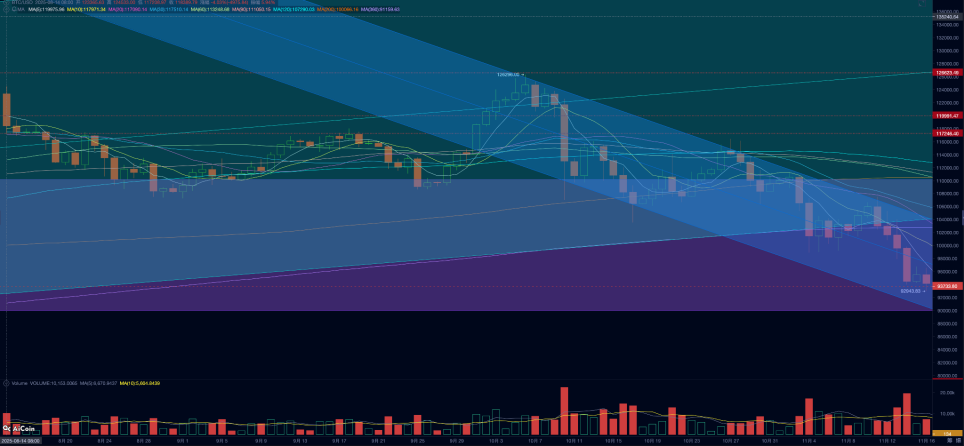
BTC Daily Chart
Since July, long-term traders have initiated the third wave of selling in this round, and the selling pressure has intensified in the last four weeks after the BTC price began to adjust downwards. This is often a characteristic of the transition between bull and bear markets.
The volume of sell orders flowing into exchanges this week remained high, though slightly lower than last week. However, the exchange has shifted from outflows to inflows, potentially leading to a weaker market outlook.
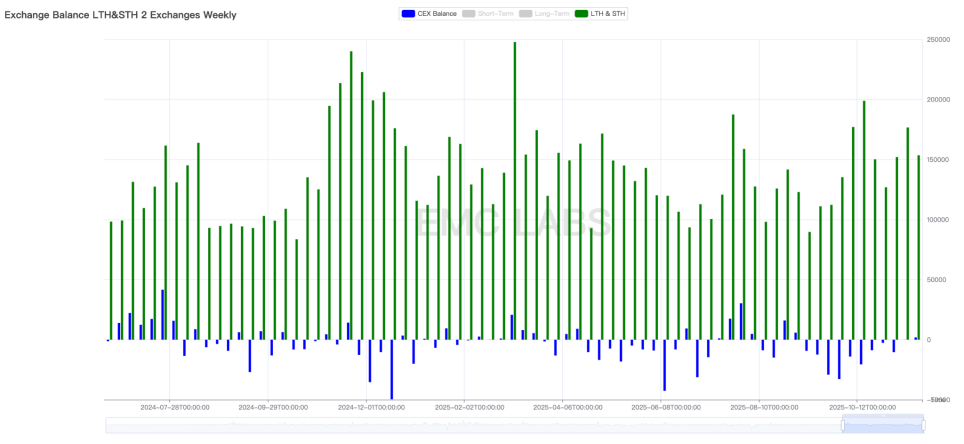
Scale of long and short position selling and changes in BTC inventory on central exchanges (weekly)
However, there is a severe shortage of funds to absorb these losses. As seen on most trading days last week, both the BTC ETF and ETH ETF were experiencing sell-offs, and the volume remained at a high level.
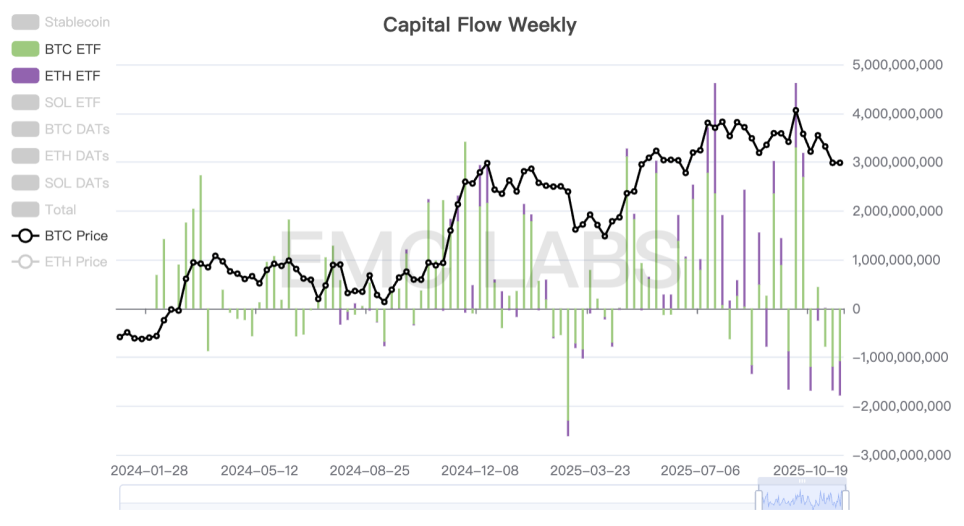
Among the major buyers this week, the BTC ETF channel has switched to selling. According to media reports, DATs companies Strategy and BMNR were still buying in the market this week, but their efforts alone were insufficient to sustain the gains. Ultimately, both BTC and ETH ended the week with significant declines.
From a technical perspective, BTC has effectively broken below the lower edge of the ascending channel on the daily chart, indicating a shift towards a bear market. Since November 2022, previous mid-term corrections have consistently found support at this channel line; this is the first time this key support level has been broken in this cycle. If, in the coming weeks, BTC fails to recover above the lower edge on the weekly chart, the bear market will be confirmed.
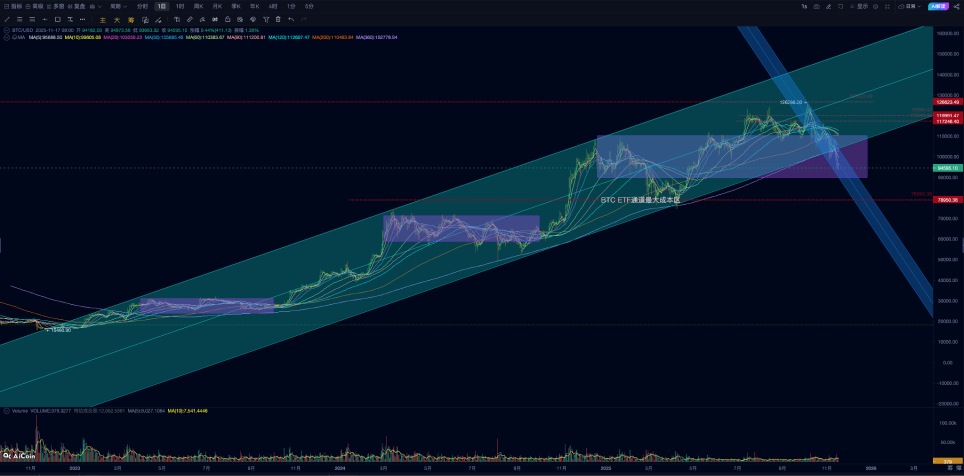
BTC price falls below the lower edge of the upward channel of this bull market.
With the Federal Reserve continuing to issue bonds, short-term dollar liquidity remains scarce and may even worsen, which could exacerbate the tight funding situation in the short term, putting continued pressure on BTC and Crypto.
In the medium term, the September CPI data to be released next week is also crucial. The 44% probability of an interest rate cut is already priced in; if it continues to decline, prices are likely to continue their downward correction. Conversely, if the CPI stabilizes but employment data is dismal, a December rate cut remains a possibility. Based on this optimistic assumption, funds through ETFs and other channels could flow back rapidly, and the current "bearish crisis" for BTC could logically be averted. Furthermore, long-term selling pressure deserves close attention; if it slows down or returns to accumulation, the market could gain some breathing room.
Cyclical Indicators
According to eMerge Engine, the EMC BTC Cycle Metrics indicator is 0, indicating that it has entered a "downtrend" (bear market).
EMC Labs was founded in April 2023 by crypto asset investors and data scientists. Focusing on blockchain industry research and cryptocurrency secondary market investment, EMC Labs leverages industry foresight , insights, and data mining as its core competencies. It is committed to participating in the booming blockchain industry through research and investment, driving the benefits of blockchain and crypto assets to humanity.

For more information, please visit: https://www.emc.fund


All Comments