Cointime

Download App
iOS & Android

Aave's TVL tanks $8B a day after $293M Kelp DAO hack

Total value locked on decentralized lending protocol Aave dropped by nearly $8 billion over the weekend after hackers behind the $293 million Kelp DAO exploit borrowed funds on Aave, leaving roughly $195 million in “bad debt” on the protocol and triggering withdrawals.

Data from DeFiLlama shows that Aave’s TVL fell from about $26.4 billion to $18.6 billion by Sunday, losing the top spot as the largest DeFi protocol. 

Aave v3’s lending pools for USDt and USDC are now at 100% utilization, meaning that more than $5.1 billion worth of stablecoins cannot be withdrawn until new liquidity arrives or borrows are repaid. 
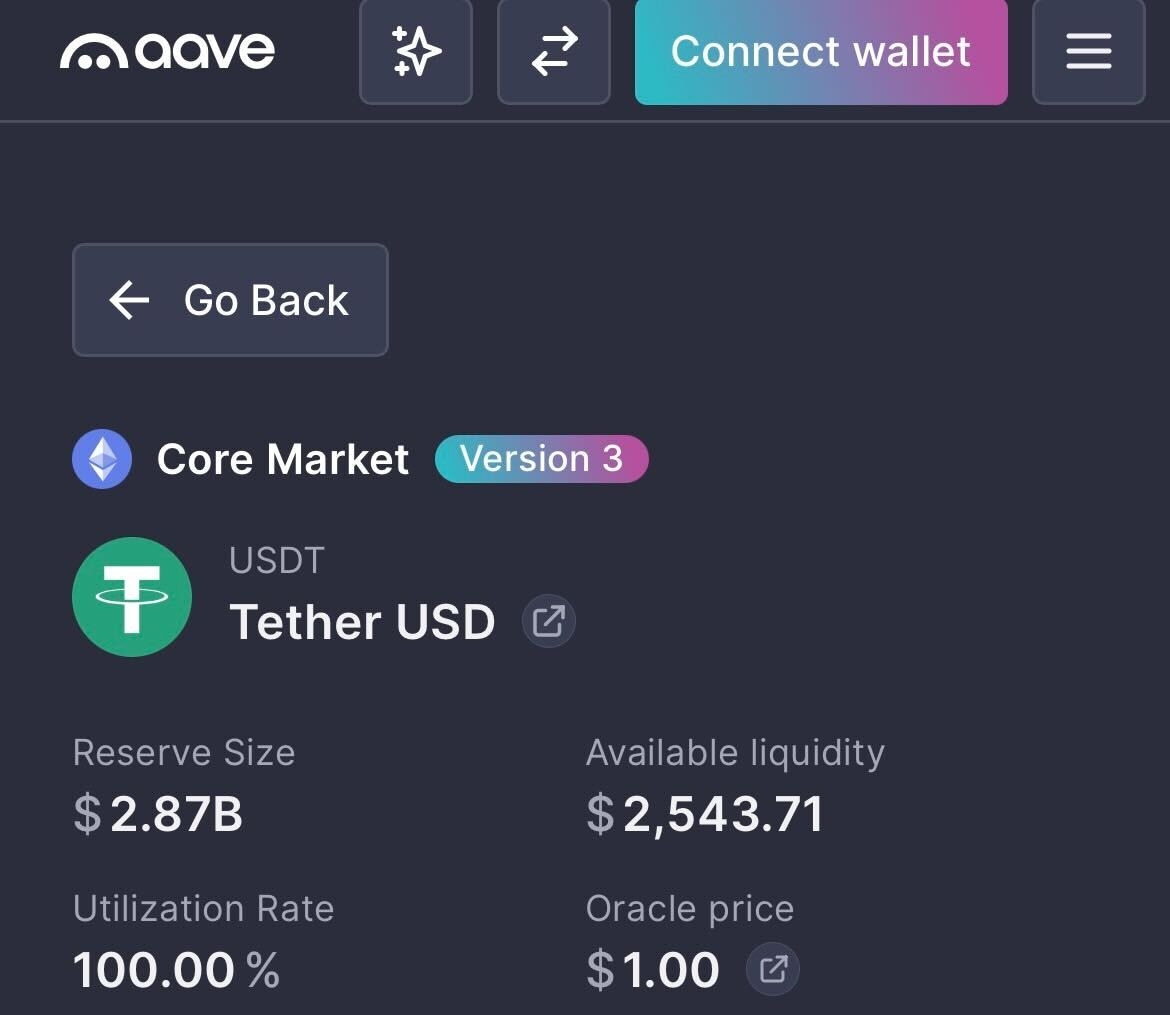
  $2,540 is available to be withdrawn from the $2.87 billion USDT pool on Aave v3 at the time of writing. Source: Aave


Aave’s TVL fall shows how rapidly risk from a single security incident can spread throughout the broader, interconnected DeFi lending market, potentially leading to a severe liquidity crisis.

The incident began on Saturday when hackers stole 116,500 Kelp DAO Restaked ETH (rsETH) tokens worth about $293 million from Kelp DAO’s LayerZero-powered bridge and used them as collateral on Aave v3 to borrow wrapped Ether (wETH).

Crypto analytics platform Lookonchain said the move created about $195 million in “bad debt” on Aave, which contributed to the Aave  token tankingnearly 20% from $112 on Saturday at 6:00 pm UTC to $89.5 about 25 hours later. 

Lookonchain noted that some of the largest crypto whales to withdraw funds from Aave were the MEXC crypto exchange and Abraxas Capital at $431 million and $392 million, respectively.
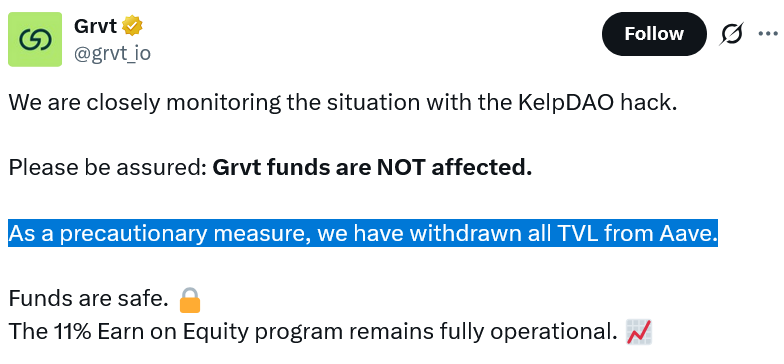
  Source: Grvt

Several crypto networks and protocols tied to rsETH or the LayerZero bridge have paused use of the bridge until the problem is resolved, including DeFi platform Curve Finance, stablecoin issuer Ethena and BitGo’s Wrapped Bitcoin (WBTC).

Aave has frozen several rsETH, wETH markets

Shortly after the Kelp DAO exploit, Aave said it froze the rsETH markets on both Aave v3 and v4 to prevent any suspicious borrowing and later stated that rsETH on Ethereum mainnet remains fully backed by underlying assets.

WETH reserves also remain frozen on Ethereum, Arbitrum, Base, Mantle and Linea, Aave said.

This incident marks the first significant stress test of Aave’s “Umbrella” security model, which was introduced in June 2025 to provide automated protection against protocol bad debt while enabling users to earn rewards.

Earlier this month, the Bank of Canada found that Aave avoided bad debt in its v3 market by using overcollateralization, automated liquidations and other strategies that shifted risk to borrowers.

In comments to Cointelegraph, Aave defended its liquidation-based model, framing it as a core safety mechanism that protects lenders while limiting downside for borrowers.

It comes as Aave parted ways with its longest-standing DeFi risk service provider, Chaos Labs, on April 6, following disagreements over the direction of Aave v4 and budget constraints.
Comments

All Comments

Recommended for you

  • CoinShares: $1.4 Billion Inflows into Digital Asset Investment Products Last Week

    On April 20, CoinShares reported that inflows into digital asset investment products reached $1.4 billion last week, marking the highest weekly inflow since January and achieving positive growth for the third consecutive week. Bitcoin saw inflows of $1.116 billion, bringing the total inflows for the year to $3.1 billion. The price of Bitcoin has surpassed the $76,000 mark, indicating a significant technical breakthrough after two months of range-bound trading. In contrast, inflows into Bitcoin short products were only $1.4 million, suggesting that while there is still hedging demand, it remains limited. Ethereum attracted $328 million in inflows, the strongest week since January, bringing its total inflows for the year to $197 million, while XRP and Solana recorded outflows of $56 million and $2.3 million, respectively.

  • Sources: Bank of Japan Unlikely to Raise Interest Rates in April Meeting

    On April 20, sources familiar with the Bank of Japan's thinking revealed that the central bank is unlikely to raise interest rates next week. The diminishing hope for a swift end to the Middle East conflict has left Japan's economic and price outlook fraught with uncertainty. Although the final decision still carries some uncertainty and will depend on the progress of peace negotiations between the U.S. and Iran, the sources indicated that the bank prefers to maintain the status quo this month to allow more time to assess the impact of the conflict. One source stated, 'Given the current level of uncertainty, the Bank of Japan may consider it feasible to hold steady this month.' Another source echoed this sentiment. A third source noted that the Bank of Japan is unlikely to raise rates, as the market has already fully priced in the possibility of no rate hike this month. These sources mentioned that even if the Bank of Japan keeps rates unchanged next week, it is likely to signal readiness to raise rates as early as June, given the escalating inflationary pressures.

  • Hong Kong SFC Announces New Regulatory Framework for Trading Tokenized Investment Products in Secondary Market

    On April 20, the Hong Kong Securities and Futures Commission (SFC) announced a new regulatory framework to promote the trading of tokenized investment products recognized by the SFC in the secondary market, aiming to enhance digital asset trading activities in Hong Kong and support the further development of the ecosystem. The first batch of products is expected to primarily consist of tokenized money market funds. The SFC will review the operation of these products and will consider expanding the range of products in due course.

  • Hackers impersonated eth.limo team to hijack its domain: Post-mortem

    EasyDNS CEO Mark Jeftovic said the social engineering attack was highly sophisticated and the company is conducting further investigation to determine how the breach occurred.

  • Saylor teases 'bigger' BTC buy days after floating semi-monthly dividends

    Strategy’s Michael Saylor posted “Think Even Bigger” on Sunday, coming just a week after it disclosed $1 billion of Bitcoin buying.

  • Iranian Foreign Ministry Spokesman: No Decision Yet on Next Round of Talks with the U.S.

    On April 20, Iranian Foreign Ministry spokesman Baghaei stated that there are currently no plans for a second round of negotiations with the United States. He emphasized that the U.S. has not learned from past experiences, and such an approach will not yield positive results.

  • BTC Falls Below $75,000

    Market data shows that BTC has fallen below $75,000, currently priced at $74,994.16, with a 24-hour decline of 0.09%. The market is experiencing significant volatility, so please ensure proper risk management.

  • ETH Falls Below $2300

    Market data shows that ETH has fallen below $2300, currently priced at $2299.87, with a 24-hour decline of 0.2%. The market is experiencing significant volatility, so please ensure proper risk management.

  • US Blockade of Strait of Hormuz Will Undermine Iran-US Peace Negotiations

    Senior Iranian sources: Discrepancies in nuclear program discussions remain unresolved, and the gap has not narrowed. The ongoing US blockade of the Strait of Hormuz will weaken peace negotiations between Iran and the United States. (Reuters)

  • Iranian Parliament Official: Iran Decides to Continue Negotiations with the U.S.

    On April 20, Al Jazeera reported that Ibrahim Azizi, chairman of the Iranian Parliament's National Security and Foreign Policy Committee, stated that Iran has decided to continue negotiations with the United States. However, he emphasized that this 'does not mean negotiating at any cost' nor does it imply acceptance of 'any actions taken by the other party.' (Xinhua)