


The information, opinions, and judgments regarding markets, projects, and currencies mentioned in this report are for reference only and do not constitute any investment advice.Written by 0xBrooker
This week, tight short-term liquidity in the United States and uncertainty surrounding a December interest rate cut became the main trading themes in global financial markets.
The U.S. Treasury’s TGA account was sluggish due to the government shutdown , accumulating nearly a trillion dollars. Although the government has resumed operations, the release of funds has been slow, leaving short-term liquidity still tight.
The lack of economic and employment data caused by the government shutdown meant that the Federal Reserve lacked sufficient objective data to refer to at its December policy meeting. Fed officials' continued hawkish stance over the past three weeks has consistently dampened market confidence, ultimately leading to three consecutive weeks of declines in US stocks.
Although on Friday, New York Fed President Williams, the third-ranking official in the Federal Reserve, suddenly delivered a dovish speech to the market, boosting the probability of an interest rate cut by a significant margin, whether there will be an interest rate cut in December remains uncertain, and whether there will be an interest rate cut in January is even more difficult to predict.
Uncertainty led to a sharp decline in high-risk assets, with AI giants and the Crypto market experiencing a collapse. The Nasdaq fell nearly 10% in November, potentially hitting its 120-day moving average, while Bitcoin's largest drop from its peak exceeded 35%. The impact of liquidity and uncertainty on financial markets was so significant that it caught everyone off guard.
Compared to US stocks, the BTC and Crypto markets face greater uncertainty. In addition to the pressure caused by tight liquidity, the sell-off brought about by the traditional 4-year cycle of bull and bear market in the cryptocurrency market has greatly aggravated the market pressure, resulting in a drop of more than 3 times that of the Nasdaq, compared to the usual 2 times correlation.
Liquidity tightness and uncertainty surrounding interest rate cuts are expected to gradually ease in the coming weeks, but whether the "cycle" of the crypto market will change, whether it will turn bearish, or whether it will recover from the sharp drop and then follow the bull market that is likely to continue in the US stock market during the interest rate cut cycle, recovering its losses and continuing to rise, will require more time to prove.
Policy, macro-financial and economic data
Since Federal Reserve Chairman Jerome Powell stated on October 29 that "a December rate cut is by no means a certainty" (at the time, the probability of a rate cut on FedWatch was over 90%), throughout November, most Fed voting members and governors have been making hawkish statements in various public speeches, emphasizing that the job market is only cooling down, while the stickiness of inflation is the mission that needs to be focused on.
This increasingly pronounced rhetoric over the past three weeks has pushed the probability of an interest rate cut from over 90% to less than 40%. Coupled with the short-term liquidity crunch caused by the US government shutdown, this has led to a three-week consecutive decline in US stocks, which were already at high valuations. Nasdaq 100 futures fell by nearly 10%, reaching the 120-day moving average.
During this period, Nvidia's much-anticipated earnings report failed to boost market confidence. The stock initially rose by 4% on the day of the report, but ultimately fell by 3%, with a fluctuation of more than 7%.
Nvidia's earnings report failed to dispel market doubts, and overvalued AI stocks responded to market liquidity constraints and the uncertainty of a December interest rate cut by selling off their valuations. Meanwhile, the continued large outflows from Spot ETFs will put significant selling pressure on BTC, which is considered a high-risk alpha-yield stock, forcing it to experience a sharp, precipitous drop to seek price rebalancing.
On Friday, dovish comments from Williams, president of the New York Fed and a permanent voting member of the Federal Reserve , were seen as a rescue signal for the US stock market during a critical period. He emphasized that downside risks to the employment goal are rising (the labor market continues to cool), while upside risks to the price stability goal are diminishing (inflation is on a downward trajectory, only slowed by tariff disruptions). Therefore, there is still room for further adjustments in the near term to bring policy closer to the neutral range. Given his special status as one of the Fed's "troika," the market believes his remarks indicate that the Fed's internal risk assessment focus is shifting slightly from "preventing inflation" to "protecting employment."
This assessment caused a dramatic reversal in the FedWatch's probability of a December rate cut in pre-market trading on Friday, soaring from less than 40% to 70%, and the three major stock indexes, which had been falling for several days, finally recorded gains that day.
Such a rapid correction warrants caution. For BTC's price action, this should at most be viewed as a temporary respite from the downtrend. Whether an interest rate cut is certain, and whether funds will flow back into high-risk assets once it is confirmed, remains to be seen and will be answered by the market.
Crypto Market
Compared to the Nasdaq, BTC's performance was even more disastrous, pressured by both macro liquidity and cyclical sell-offs. Following a 5.25% drop last week, it continued to plummet by 7.83% this week, trading below the 5-day moving average throughout the week, with trading volume nearly doubling compared to last week.
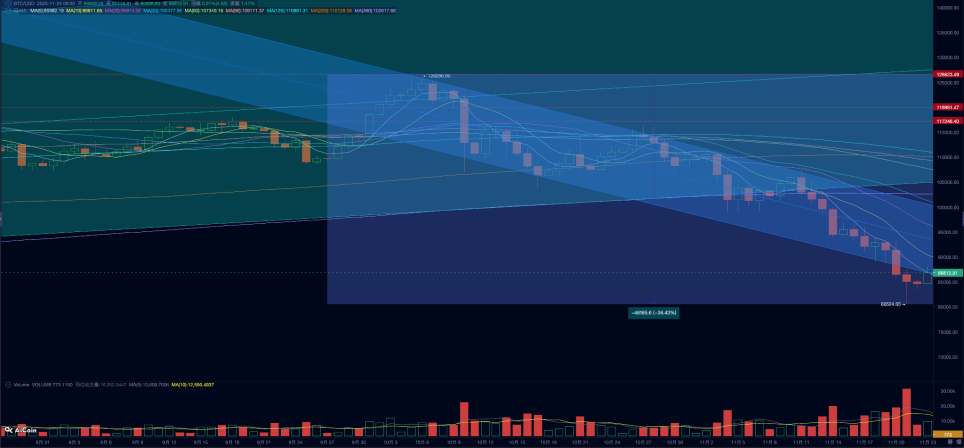
BTC Daily Chart
We have repeatedly emphasized recently that the "cyclical" selling has become the biggest source of pressure on BTC's upward movement. The continuous selling by long positions has loosened the market's supply structure, making the market extremely fragile. This week, during the market's waterfall-like decline, long positions further intensified their selling compared to last week, exceeding 42,000 coins, while the combined selling by long and short positions exceeded 260,000 coins.
BTC ETFs contributed funds to at least two waves of the current bull market. However, with the recent liquidity crunch and continuous sharp decline, these funds have turned into selling pressure, with an outflow of over 1.171 billion throughout the week, marking four consecutive weeks of significant declines.
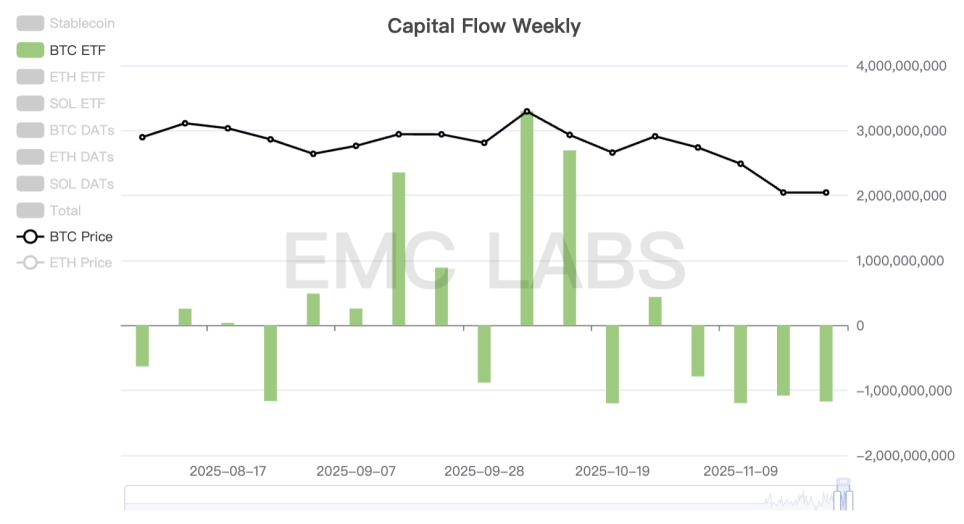
Another significant source of buying power was DAT (Strategy), which purchased $800 million worth of BTC last week, and BMNR continued to buy ETH during this week's crash. However, faced with the relentless selling pressure, their efforts were insufficient to slow the decline.
The indistinct whale shark group became the biggest buyer this week, with their on-chain address cluster experiencing a net inflow for seven consecutive days as of Saturday, amounting to nearly 110,000 coins.
Technically, BTC has completely broken down, remaining below the upward channel and the 360-day moving average for two consecutive weeks. On the pessimistic side, we see continued large-scale selling by both long and short positions; on the optimistic side, we see whales and DAT companies still buying, resulting in a slight outflow of tokens from exchanges rather than an accumulation. Furthermore, the most pessimistic period for macro liquidity may be passing, with the Treasury's TGA account starting to decline slowly, and the Federal Reserve beginning to "dovish," slightly shifting towards a December rate cut.
We haven't yet definitively confirmed the shift from a bull to a bear market —that will take more time. The transition between old and new cycles is even more uncertain—that will also require more time. In these challenging times, controlling position size, maintaining a rational outlook on price drops, and holding a long-term optimistic view of the industry's future may be the best course of action.
Cyclical Indicators
According to eMerge Engine, the EMC BTC Cycle Metrics indicator is 0, indicating that it has entered a "downtrend" (bear market).
EMC Labs was founded in April 2023 by crypto asset investors and data scientists. Focusing on blockchain industry research and cryptocurrency secondary market investment, EMC Labs leverages industry foresight , insights, and data mining as its core competencies. It is committed to participating in the booming blockchain industry through research and investment, driving the benefits of blockchain and crypto assets to humanity.

For more information, please visit: https://www.emc.fund


All Comments