

Cointime

Download App
iOS & Android

From Korea’s AI Boom to the Rise of Crypto AI

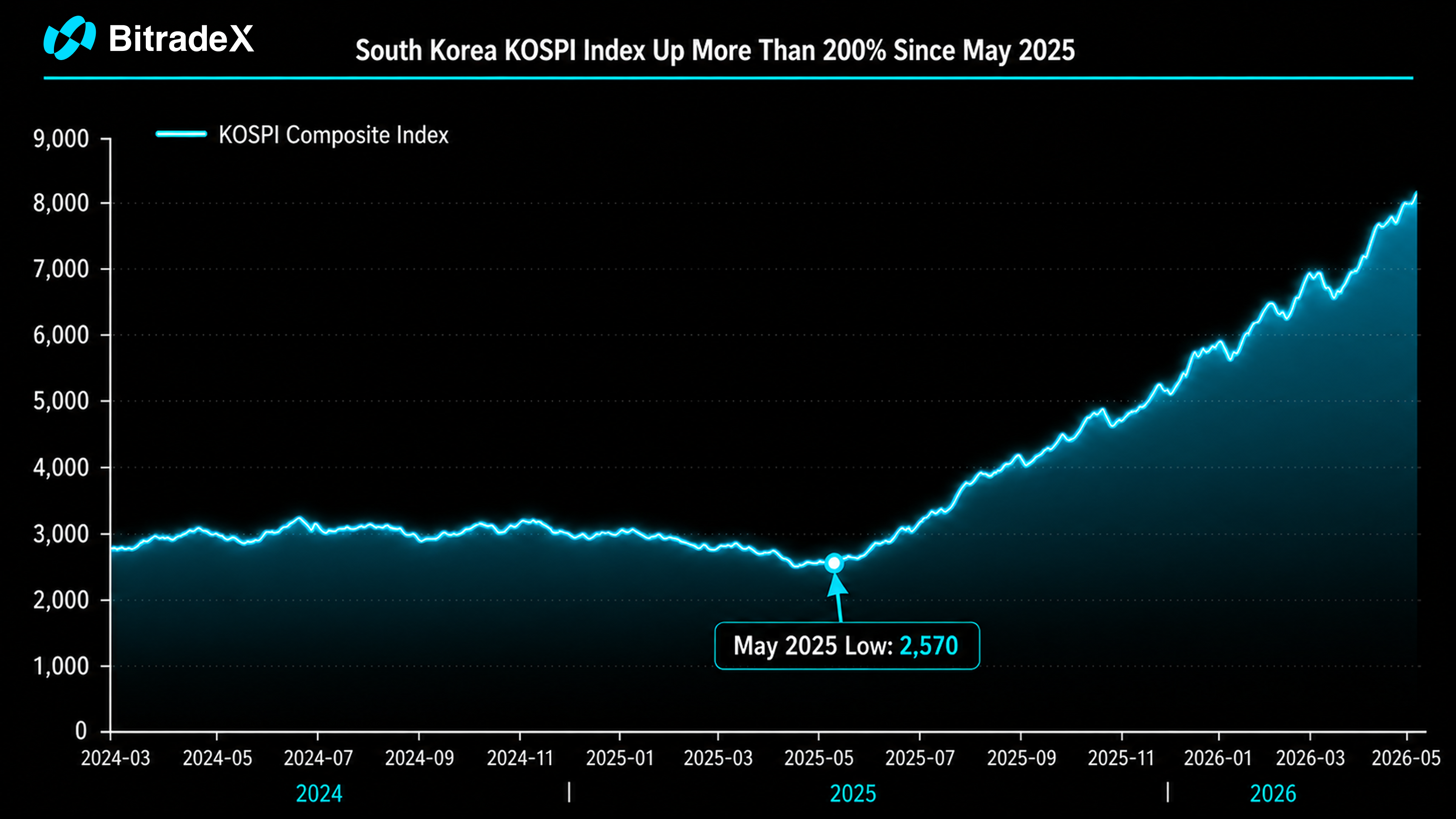
Over the past year, the Korean market has been almost completely ignited by AI. The Korea Composite Stock Price Index (KOSPI) rose from 2,570 points in May 2025 to around 8,000 points in May 2026, gaining more than 200% and becoming one of the world’s strongest capital markets. At the same time, SK Hynix, South Korea’s semiconductor giant, saw employee bonuses soar to more than 100 million won, driven by surging demand for AI chips. From capital markets to the industrial supply chain and even everyday users, the whole of South Korea has been taking part in this AI wealth boom.
Behind all of this, what is truly driving the market frenzy may not be AI technology itself. More and more people are realizing that AI could be changing global capital flows, reshaping the allocation of industrial resources, and forming the next global wealth structure. Looking at history over a longer cycle, almost every technological revolution that changed the world redefined wealth. During the First Industrial Revolution, the steam engine boosted productivity and enabled countries with industrialization capabilities to rise rapidly. During the Second Industrial Revolution, electricity, oil, and manufacturing became the core of wealth. During the Third Technological Revolution, the internet reshaped the global landscape of capital and tech giants once again.

What is happening now may be a fourth productivity revolution centered on AI. But unlike previous revolutions, the steam engine solved the problem of “physical power,” electricity improved “industrial efficiency,” and the internet transformed “information connectivity.” In a sense, the first three revolutions mainly extended humanity’s “limbs” and “senses.” AI is different. For the first time, AI is truly entering the realms of analysis, judgment, learning, and decision-making, and is even partially replacing human cognitive labor. In other words, AI is beginning to simulate the human “brain.” This is the most fundamental difference between AI and all previous technological revolutions.
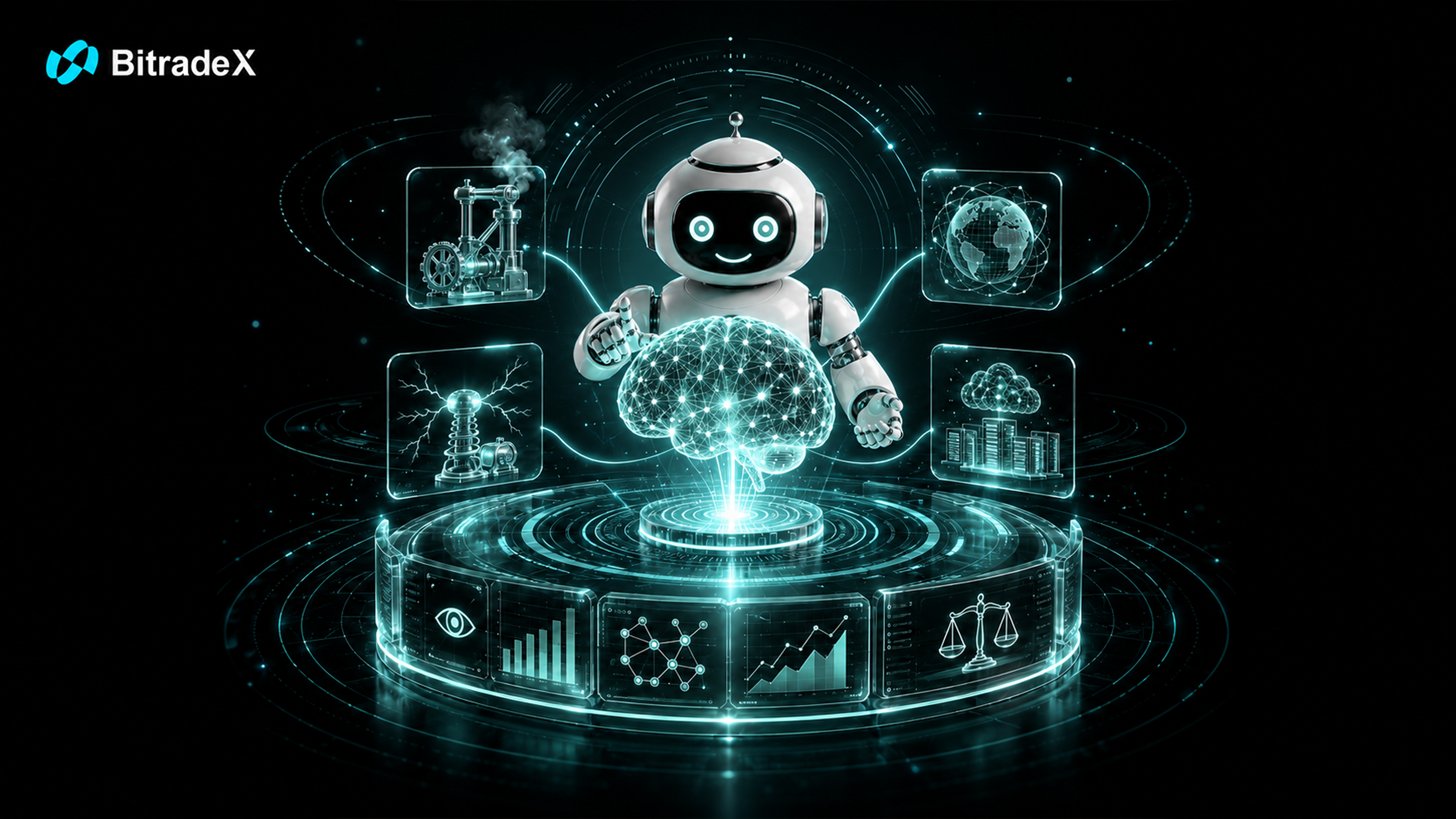
That means AI is affecting not just one industry, but finance, manufacturing, healthcare, education, content, trading, and even the way society as a whole operates. For this reason, global capital, industrial resources, and top talent are all pouring into AI. More and more people believe that the wealth effect of AI will far exceed that of previous technological revolutions.

Among all the possible application scenarios for AI, Crypto may be one of the first to change. This is an industry built almost entirely on data, liquidity, and real-time feedback. On-chain fund flows, shifts in market sentiment, and global trading behavior are changing almost constantly. Compared with many traditional industries, Crypto moves faster and depends more heavily on immediate judgment and continuous decision-making.
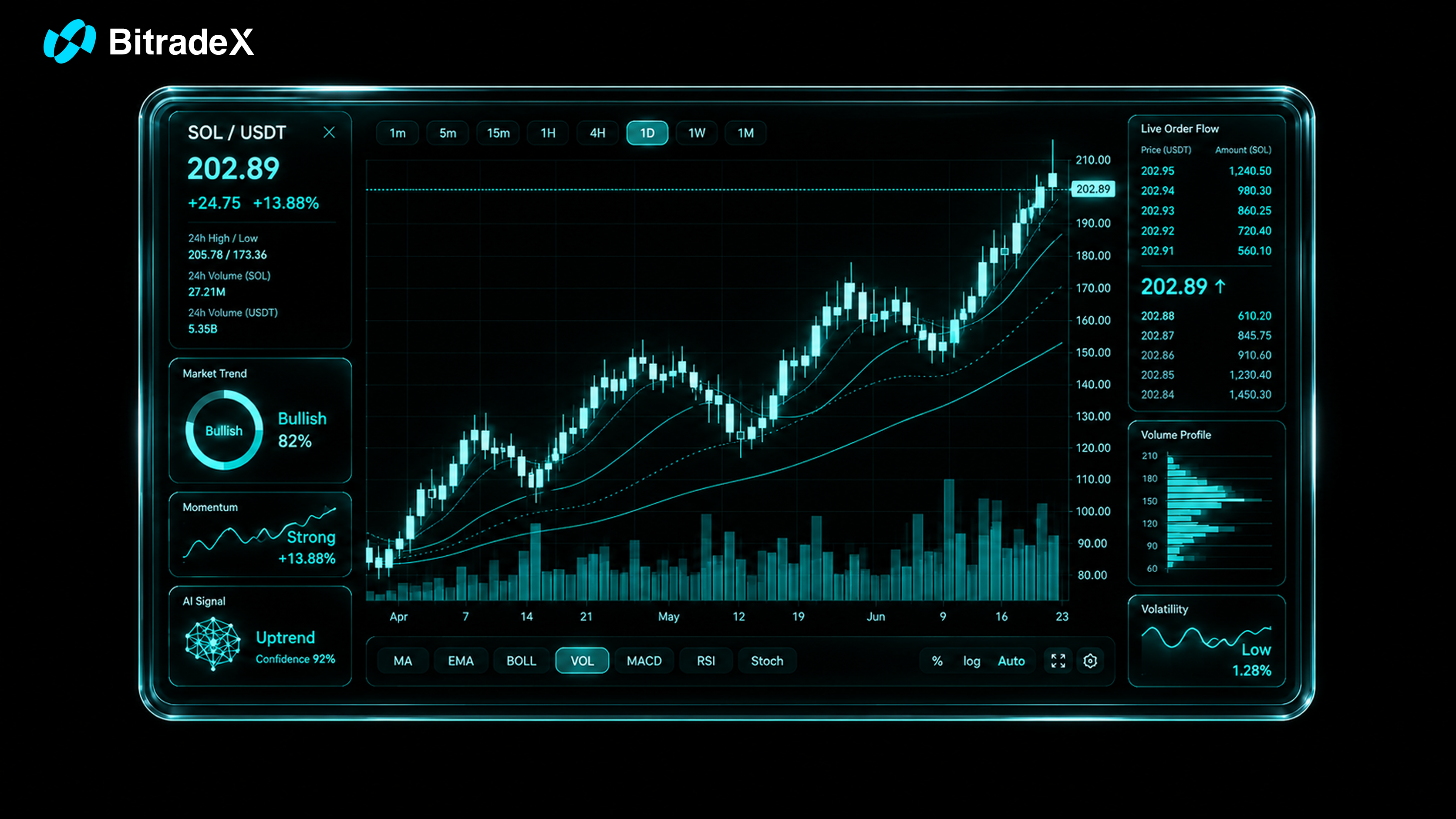
Within the entire Crypto ecosystem, trading is the most central and the closest thing to “real-time decision-making.” Trading, in essence, is about processing information, identifying trends, managing risk, and continuously making judgments. Especially in a market that never stops running 24/7, people constantly face volatility, emotions, and market changes, which makes trading a highly decision-intensive activity by nature. In a sense, this is exactly where AI can create the most value.

The problem is that human rationality is limited, and it is difficult to remain stable for long in a highly volatile market. In Crypto trading in particular, emotions such as greed, fear, FOMO, and overtrading affect user judgment almost every day. Many times, what really affects trading outcomes is not the information itself, but the decision bias created by emotional swings.

This is actually a question BitradeX has been rethinking for a long time: in a market with high volatility and high information density, can a more systematic approach help users reduce emotional interference and improve the stability of trading decisions? Compared with many quantitative products that are still stuck in the “automation tool” stage, BitradeX hopes that AiBot can genuinely lower the trading barrier for everyday users. What it aims to solve is not just “how to improve trading efficiency,” but the most real problems users face in trading: not understanding the market, not being able to hold positions, lacking the time to watch the market, and struggling to execute a strategy consistently over the long term.
In simple terms, the core logic of AiBot is to minimize the interference of emotions in trading decisions as much as possible. Tasks that used to rely heavily on experience, such as market trend identification, anomaly monitoring, position and risk control, and strategy adjustment, are gradually becoming more systematic. Users no longer need to stare at charts for long periods or make trading decisions while caught up in emotion. When market rhythm changes, AiBot keeps tracking market conditions and tries to dynamically adjust its strategy logic. Compared with emotional “chasing pumps and dumping bottoms” behavior, it emphasizes stability, discipline, and long-term logic. This is also one of the biggest differences between AiBot and traditional quantitative tools.

From a broader perspective, AiBot is only one part of the broader BitradeX ecosystem. Whether it is trading, AI Quant, payments, or Labs incubation, BitradeX is working to connect different businesses into a more complete Crypto ecosystem. AiBot is more like one of the true entry points for everyday users. Because future competition may no longer be about who gets information faster, but about who can understand the market and adapt to it more efficiently. And the integration of AI and Crypto may only just be starting to enter real-world use cases.


Comments

All Comments

Recommended for you

  • BTC Surpasses $63,000

    Market data shows that BTC has surpassed $63,000, currently priced at $63,006.88, with a 24-hour decline of 1.52%. The market is highly volatile, so please ensure proper risk management.

  • Zuckerberg Directs Meta to Develop Prediction Market Application

    On June 24, The New York Times reported that Zuckerberg has instructed Meta to develop a prediction market application. The internal name for the application is 'Arena', which is similar to Polymarket or Kalshi.

  • U.S. Senate Passes Resolution Aiming to Limit Trump's War Powers Against Iran

    On June 24, the U.S. Senate passed a resolution regarding war powers related to Iran, with 50 votes in favor and 48 against, following a similar approval by the House of Representatives. This marks the first time such a resolution has been approved by both chambers of Congress. The resolution calls for the president to end military actions against Iran without a declaration of war or authorization of force from Congress. However, since this resolution is a joint resolution of Congress, it is not legally binding and does not require the president's signature, thus serving mainly a symbolic purpose.

  • AI Smart Terminals Experience Full Explosion

    On June 23, according to CCTV Finance, at the fourth Chain Expo, the original "Digital Technology Chain" was upgraded to the "Smart Technology Chain." This change in wording reflects that artificial intelligence is becoming the main character in the industrial chain. A newly established AI zone at the event gathered leading AI companies from both domestic and international markets, showcasing the entire chain from data and computing power to applications. Various AI products were on display, including AI glasses, smart cars with digital chassis, and humanoid robots that can play soccer. CCTV Finance reporters observed that the integration of artificial intelligence into the physical world is transitioning from mobile phones and computers to various new smart terminals. This year, the application of AI agents has also experienced a full explosion. Qian Kun, Senior Vice President of Qualcomm, stated that the empowerment of AI agents is leading to a significant upgrade cycle for existing terminal devices. China's industrial chain is very complete, and through continuous collaboration with Chinese partners, their products can quickly reach the market and gain global acceptance. Liu Xiangwen, Vice President of Alibaba Cloud Intelligence Group, noted that AI has evolved from mere chatting to becoming a productive force. The development of all stacks, whether GPU cloud or CPU, is progressing rapidly, and there is still greater potential ahead.

  • U.S. Stock Indices Experience Short-Term Rally

    On June 23, the Dow Jones Industrial Average rose by 0.07%; the S&P 500 index narrowed its decline to 0.77%, having previously fallen over 1.5%; the Nasdaq Composite index also reduced its drop to 1.17%, after having been down more than 2.3% at one point.

  • Vitalik: Ethereum Foundation Budget Cut by 40%, Shifting to Long-term Fund Model

    On June 23, Vitalik Buterin revealed that the Ethereum Foundation (EF) will reduce its budget by approximately 40% this year. According to its previously announced financial management plan, EF is transitioning from a model where it spends about 15% of its remaining funds annually to a model where it will spend about 5% annually after 2030, moving towards a long-term donation-oriented organization. To this end, EF will adjust its multi-client model, relying more on AI-assisted formal verification. The PSE privacy and scalability exploration team will shift from 'exploration' to a focus on building around zero-knowledge proofs. The scale and losses of Devcon events will be reduced, and large projects beyond Ethereum itself will also decrease. EF's institutional work will focus on smaller-scale, replicable CROPS-friendly deployment cases.

  • Huo Qigang: In the AI Era, Our Own Judgment is Key

    On June 23, according to CCTV Finance, Huo Qigang stated that over the past year, the topic of AI has been overwhelming, shifting from 'not using AI' to 'having to use AI,' making him acutely aware that 'not participating will lead to elimination.' As a father, Huo Qigang candidly expressed the dilemma of whether parents should 'control' or 'assist' when their children use AI. He mentioned that he has already begun to assist with AI in his work, but emphasized that using AI does not mean bypassing the thinking process; one must rely on their own experience, thought, and logical judgment, and cannot simply replicate AI outputs.

  • NVIDIA's Market Value Falls Below $500 Billion

    On June 23, NVIDIA (NVDA.O) saw its market value drop below $500 billion, with a latest decline of 2.6%.

  • U.S. Manufacturing Activity Surges Beyond Expectations, But Factory Employment Falls to Six-Year Low

    Driven by companies placing orders in advance to prevent shortages and price increases, U.S. manufacturing activity expanded again in June. However, factory employment fell to a six-year low, primarily due to rising operational costs influenced by conflicts in the Middle East. The preliminary S&P Global Manufacturing PMI for June rose to 55.7 from 55.1 in May, marking the highest level since May 2022, while economists surveyed by Reuters had previously expected the index to drop to 54.8. The increase in the manufacturing PMI, combined with a rise in the services PMI from 50.7 in May to 51.3, contributed to a composite PMI output index increase from 51.5 last month to 52.2. The rebound in the services PMI is partially attributed to the World Cup events jointly hosted by the U.S., Canada, and Mexico.

  • Microsoft Completes Data Center Construction in Wisconsin

    Microsoft (MSFT.O) announced the completion of its first data center construction in Mount Pleasant, Wisconsin, USA.