

There is apparently a way to get Bitcoin from Earth to Mars in as little as three minutes using already-available technology. We just need someone, or something, to receive it.
Late last month, tech entrepreneur Jose E. Puente and his colleague, Carlos Puente, published a white paper unveiling Proof-of-Transit Timestamping — a concept he told Cointelegraph is the missing piece needed to make Bitcoin interplanetary.
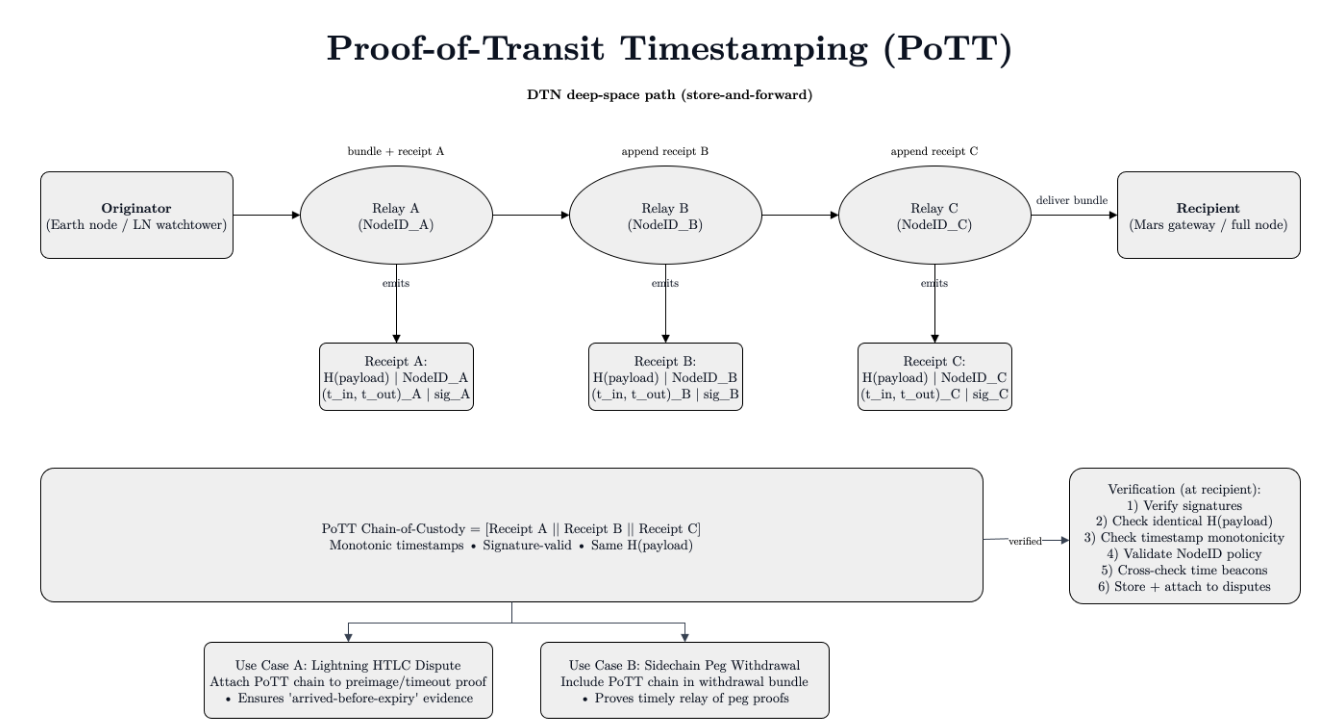
The concept suggests that when a Bitcoin user wants to send a payment to Mars in the future, the transaction could hop from the user through different stations, such as ground antennas, satellites, or even a relay around the Moon.
At each stop, the transaction is “stamped” before continuing until it reaches its destination.
Speaking to Cointelegraph, Puente said PoTT serves as the “receipt layer” on Bitcoin and the Lightning Network while leveraging optical links built by the National Aeronautics and Space Administration, Elon Musk’s Starlink, or another satellite provider.
“The technology is essentially ready. The moment there’s a stable Earth–Mars link, PoTT can ride on top, making Bitcoin the first currency to operate cleanly across planets,” he said.
“By simulating Mars-level delays, we could run a convincing end-to-end demo right now.”
When up and running, Puente said Bitcoin Lightning transfers could reach Mars in as little as three minutes, or as long as 22 minutes in a worst-case scenario.
Addressing the two-week blackout period on Mars that occurs every 26 or so months, Puente said a solution could “deliberately route around the Sun with relay satellites” to avoid the blackout.
PoTT is like ordinary Bitcoin timestamping except that it can extend to outer space and beyond, Puente explained.
“Imagine it’s 2050 and you’re sending money from Earth to your friend on Mars to help pay for their rent. Because the planets are so far apart, the message has to hop through different stations.”
“At each stop, that station stamps the message with the time it arrived and the time it left, like a passport getting stamped at every border crossing. By the time the message gets to Mars, you can look at all the stamps and see the exact path it took and when it moved.”
Puente said PoTT could be tested today.
Bitcoin has already made it to outer space
The concept builds on Blockstream’s work in December 2018, when it connected Bitcoin to five satellites to make outer space Bitcoin transactions possible. Then, in August 2020, Spacechain completed what it said was the first Bitcoin transaction from the International Space Station, showcasing that Bitcoin ,090can be received away from Earth.
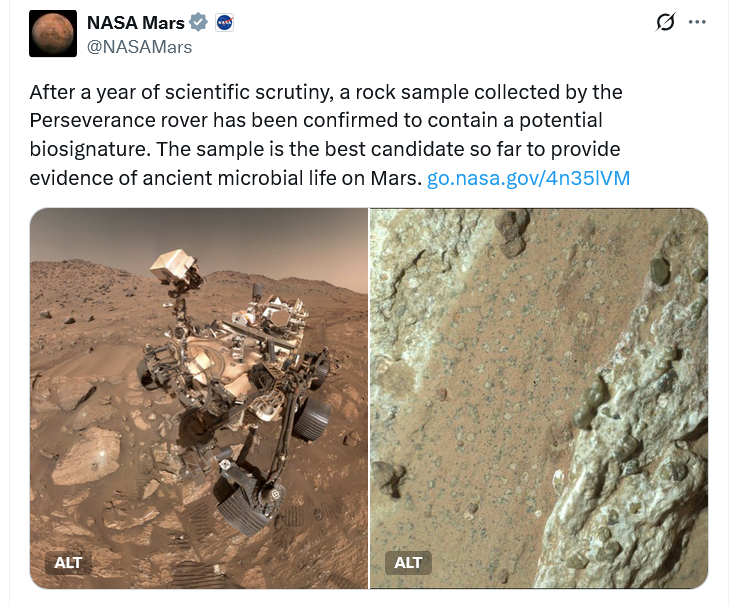
Of course, for a Bitcoin transaction to occur on Mars, a human — or an AI — would need to be there, and that hasn’t happened yet. Only landers, orbiters and rovers from NASA and other space agencies have explored Mars thus far.
There would need to be someone there willing to accept Bitcoin, too. The Jeff Bezos-founded Blue Origin started accepting crypto — including Bitcoin, Ether , Solana, and stablecoins Tether and USDC — last month, but so far they’ve only made it past the Kármán line, about 100 kilometers from Earth.
Musk also agrees that a standard money is needed
Musk’s SpaceX is looking to reach Mars by the end of 2026 with a long-term ambition to build a self-sustaining city there.
Like Puente, Musk agrees that a standard money is needed to transact between Earth and Mars. He previously expressed concern over Bitcoin’s 10-minute block times, but that’s where the Lightning Network comes into play, Puente said.
“PoTT plus Lightning provide the practicality Musk asked for: local speed with global settlement that works across planets.”
After initially dismissing Bitcoin as a solution last January, he eventually agreed that interplanetary payments could be more feasible through the Lightning Network.
“If we’re serious about a multi-planet civilization, we need an open, neutral monetary base that doesn’t depend on any single company, government, or ground station,” Puente said, making his case for Bitcoin as the most appropriate interplanetary currency.
“That’s why we focused on Bitcoin as the shared standard and designed PoTT as a practical way to move value across vast distances while preserving accountability and individual agency.”
PoTT is built for all planets
Puente noted that PoTT was built to be planet-agnostic across a star’s habitable zone, meaning the “travel receipts” it generates could be reached from transactions sent to the Moon or any other planet.
He said the research just focused on Earth and Mars as it is the “cleanest near-time case study.”


All Comments