

1. PayPal USD (PYUSD), explained
PayPal has launched its own stablecoin, PayPal USD (PYUSD), with the goal of simplifying digital payments, particularly within the blockchain ecosystem.
PYUSD is currently available to eligible PayPal customers in the United States and offers a seamless way to exchange between the stablecoin and U.S. dollars directly within the PayPal platform.
Designed for users seeking stability, PYUSD is pegged to the U.S. dollar and fully backed by USD deposits, short-term U.S. Treasurys and similar cash equivalents. This ensures that the value of PYUSD remains consistent with the U.S. dollar, even in the face of cryptocurrency market fluctuations or an unforeseen event causing the stablecoin to depeg from the correlated fiat currency.
Users can buy, sell and transfer the PYUSD stablecoin through the PayPal app or website. Additionally, PYUSD can be used for online purchases at supporting merchants, sent to compatible cryptocurrency wallets, or converted to other cryptocurrencies supported by PayPal, such as Bitcoin (BTC), Bitcoin Cash (BCH), Ether (ETH) and Litecoin (LTC).
PayPal doesn’t charge fees for transferring PYUSD between users; however, there are fees associated with converting between PYUSD and other cryptocurrencies, as well as for online purchases and withdrawals. These fees are transparently disclosed to users during transactions.
2. Who is the issuer of the PYUSD stablecoin?
PayPal USD is issued and managed by Paxos Trust Company.
Paxos Trust Company is a regulated blockchain infrastructure firm that is subject to the oversight of the New York State Department of Financial Services (NYDFS), meaning that PayPal USD is a regulated product.
Paxos previously issued Binance USD (BUSD) but stopped due to pressure from the U.S. Securities and Exchange Commission and the NYDFS after it was alleged that the stablecoin was an unregistered security.
In June 2022, PayPal was granted a BitLicense by the NYDFS. A BitLicense is a permit that allows businesses to engage in cryptocurrency-related activities in the state of New York. PayPal’s BitLicense allows the firm to provide cryptocurrency services to customers in the state of New York.
Paxos Trust Company, the issuer of PYUSD on behalf of PayPal, publishes monthly Reserve Reports detailing the composition of PYUSD reserves. Paxos also provides third-party attestations of the value of PYUSD reserve assets, conducted by an independent accounting firm adhering to the standards set by the American Institute of Certified Public Accountants. This ensures transparency and trust in the stablecoin’s backing.
3,. Which blockchains support PayPal’s PYUSD stablecoin?
PYUSD was initially launched as an ERC-20 token on the Ethereum blockchain. This implies that it is available to a growing community of external developers and will be supported by many Web3 applications in the future, especially those built on the Ethereum blockchain.
On May 29, 2024, PayPal announced the availability of its stablecoin, PYUSD, on the Solana blockchain. This move aims to make PYUSD transactions faster and cheaper, providing users with increased flexibility and control through the choice of multiple blockchains.
Solana’s speed and scalability make it an ideal platform for PYUSD, which was created to revolutionize commerce by offering an efficient payment method. The collaboration with PayPal furthers Solana’s goal of driving fintech innovation.
Users can easily manage PYUSD within their PayPal or Venmo wallets, and when transferring to external wallets, they have the choice of using either the Ethereum or Solana blockchains.
Crypto.com, Phantom and Paxos are early adopters of PYUSD on the Solana blockchain, making it simple for users to buy PYUSD directly with traditional (fiat) currency, providing a streamlined experience for both individual consumers and businesses.
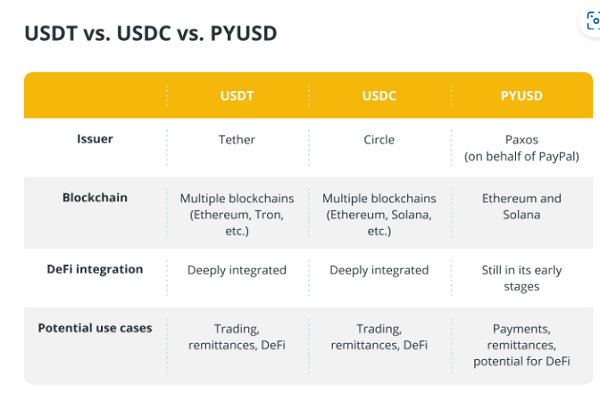
4. USDT vs. USDC vs. PYUSD: Key differences
Tether (USDT), USD Coin (USDC) and PYUSD are all stablecoins pegged to the U.S. dollar, meaning they aim to maintain a 1:1 value ratio with the USD.
However, they differ in terms of issuer, transparency, regulatory oversight and blockchain availability. USDT is issued by Tether and is the oldest and most widely adopted stablecoin, but it has faced scrutiny over its reserves.
USDC, issued by Circle, is known for its transparency and regulatory compliance. PYUSD, the newest stablecoin, is issued by Paxos on behalf of PayPal and emphasizes transparency and consumer protection.
While USDT and USDC have large market capitalizations reaching billions, PayPal USD is poised to rapidly expand its market capitalization by capitalizing on its huge user base.
5. How to buy PayPal USD (PYUSD) in the United States
There are several ways to buy PayPal USD (PYUSD) in the United States, including through PayPal, crypto exchanges or other wallets and platforms.
Directly through PayPal
Eligible PayPal users can directly purchase PYUSD through their existing PayPal account using their balance or a linked bank account or debit card. This feature is accessible through the PayPal app or website.
Cryptocurrency exchanges
Alternatively, cryptocurrency exchanges like Coinbase and Kraken list PYUSD, allowing users to purchase it with various payment methods like bank transfers, debit or credit cards, or other cryptocurrencies.
Other wallets and platforms
As PYUSD gains traction, it is already accessible on other platforms such as Crypto.com and Phantom, potentially offering additional ways to acquire it, such as peer-to-peer (P2P) trading or using other cryptocurrencies.
6. Steps to buy PYUSD on Coinbase and Kraken in the United States
To buy PYUSD in the U.S., create an account on Coinbase or Kraken, link your payment method, find PYUSD, enter the amount, and review and confirm your purchase.
Buying PYUSD on Coinbase in the United States
Create a Coinbase Account: If you don’t already have one, sign up for a Coinbase account and complete the necessary verification process.
Link payment method: Connect your bank account, debit card or wire transfer to your Coinbase account.
Search for PYUSD: In the Coinbase search bar, type “PYUSD” and select it from the results.
Enter purchase amount: Enter the amount of PYUSD you want to buy in USD or the equivalent in your local currency.
Review and confirm: Review the details of your purchase, including the amount, fees and total cost. Confirm the purchase to complete the transaction.
Store PYUSD: Once the purchase is completed, your PYUSD will be available in your Coinbase wallet. You can choose to keep it there or transfer it to an external wallet.
Buying PYUSD on Kraken in the United States
Create a Kraken Account: Sign up for a Kraken account and complete the required identity verification process.
Deposit funds: Deposit USD or other supported currencies into your Kraken account using bank transfer, debit or credit card, or other available methods.
Navigate to the PYUSD trading pair: In the Kraken interface, find the PYUSD/USD or PYUSD/EUR trading pair.
Place a buy order: Enter the amount of PYUSD you want to buy and set your desired price. You can choose between market orders (executed immediately at the current market price) or limit orders (executed when the price reaches your specified level).
Review and confirm: Review the details of your order and confirm the purchase.
Receive PYUSD: Once your order is filled, your PYUSD will be credited to your Kraken account. You can store it there or withdraw it to an external wallet.
After buying PYUSD on Coinbase or Kraken, users can store it in their exchange account wallets. However, for enhanced security, they can transfer PYUSD to a self-custodial wallet that supports either the Ethereum or Solana blockchains, depending on which network you purchased PYUSD on. This allows users to have full control over their private keys and assets, minimizing the risk of exchange hacks or restrictions.
7. Is PayPal USD (PYUSD) a good investment?
PYUSD is not a typical investment like stocks or other cryptocurrencies, where price appreciations are expected.
PYUSD’s primary function is to maintain a stable value pegged to the U.S. dollar. Because of its stability, it can be a smart choice for holding onto wealth in the cryptocurrency realm or for enabling easy transactions within the PayPal ecosystem and possibly other platforms as its use develops.
Additionally, holding PYUSD can diversify a crypto portfolio and reduce overall volatility. However, PYUSD is not suitable for investors seeking significant returns. Potential investors should also be aware of the evolving regulatory landscape for stablecoins and concerns regarding centralization, even with Paxos’ transparency efforts.
The choice to adopt PYUSD ultimately comes down to personal risk tolerance and financial objectives. Should stability and the possibility of its broader acceptance in payments be your top concerns, PYUSD may be something to think about. However, if the goal is high returns, exploring other investment options might be more suitable.


All Comments