

For every internet product, each version update should ideally be an improvement over the previous one, aimed at providing users with a better experience. However, the issue with ordinal numbering that arose after the release of version 0.9.0 of Ordinals serves as a classic counterexample. Let me briefly explain this event.
Ordinals" founder Casey has released a solution for resolving the issue with inscription numbering on platform X:
“Ord 0.9.0 introduced a new, more robustinscription parser. Before release, we compared 0.9.0 with previous releases of ord to make sure that it produced the same inscription numbers. However, after release,inscriptions,including 35321413 and 35329860 were created which exercised an edge case in the parser which previous versions of ord did not handle.”
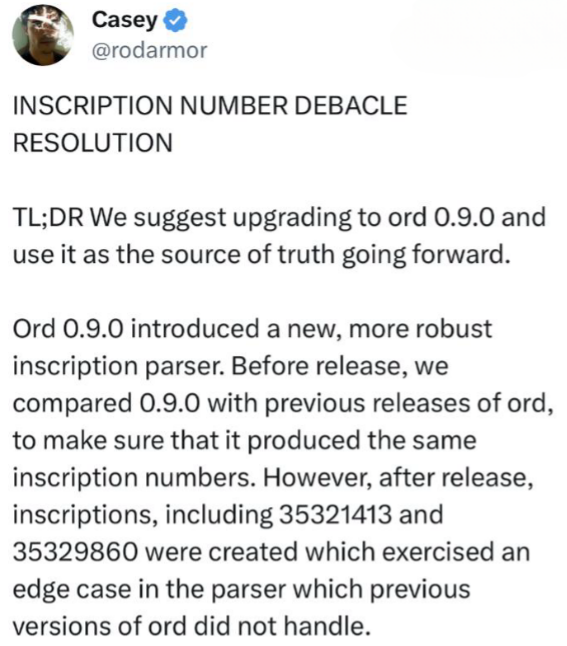
Casey added, “We suggest upgrading to ord 0.9.0 and use it as the source of truth going forward.”
However, many users have found that after using the new version, the previous issue with rune numbering has still not been resolved. This has caused a great deal of dissatisfaction among users. Looking back at the entire incident, we can't help but ask: Did the Ordinals team really conduct thorough testing before releasing version 0.9.0? Did they genuinely consider the interests of the users when faced with problems? Hasty decisions could potentially harm a project's reputation and, even more importantly, erode users' trust.
Regardless of whether the legacy issues can be completely resolved after the version upgrade, the upgrade itself will impose a significant burden on users.
Firstly, the cost of upgrading is not a minor concern for many users. This is especially true for those who are not tech-savvy, as they may need to invest a significant amount of time and effort in understanding the new features of the latest version and how to carry out the upgrade. This undoubtedly increases the complexity of user adoption and may lead some users to choose not to upgrade.
Secondly, compatibility issues and potential technical risks are two significant technical challenges. Users who upgrade to a new version may face the risk of functionality not working correctly or data loss. This not only affects the user experience but can also erode user confidence in Ordinals.
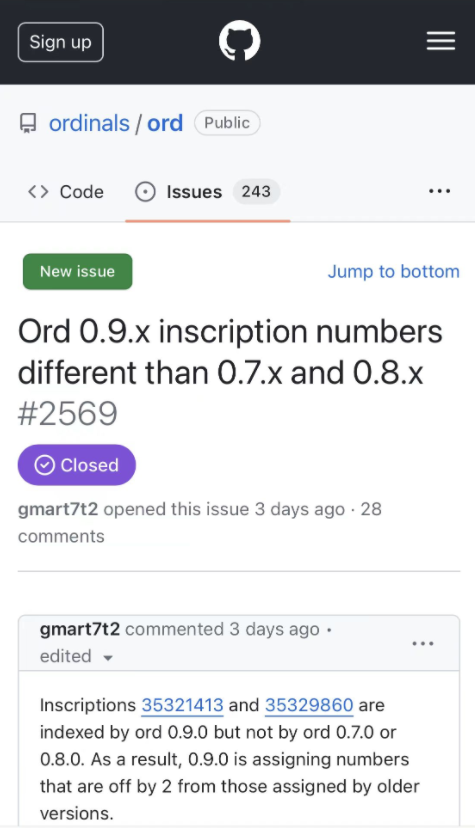
More seriously, the Ordinals team's decision not to change the version and encourage everyone to upgrade has directly resulted in trust issues among users. When faced with technical issues, a responsible team should first consider how to solve the problem rather than choosing to evade it. This decision may raise doubts among some users about whether Ordinals truly values user experience. Directly optimizing the underlying functionality of the product is the core solution to the problem, while upgrading the version may seem perfunctory.
Furthermore, important factors that users need to consider include potential changes in functionality with the new version, community division, and possible economic impacts. Especially in the field of digital currencies, a minor technical issue can lead to significant economic losses.
In summary, the decision made by the Ordinals team when faced with the issues in version 0.9.0 may not have been the wisest. They should place greater emphasis on user experience and needs, ensuring that every decision is made with the primary goal of maximizing benefits for users.
In the first two sections, we delved into the issues surrounding the 0.9.0 version of Ordinals in depth. Unfortunately, this isn't the first time Ordinals has sparked controversy. In fact, a series of technical issues and handling approaches throughout its history have highlighted significant deficiencies in both the project's technical aspects and community management.
In early March, Ordinals found itself embroiled in yet another whirlwind of technical problems. Some successfully engraved inscriptions were not assigned inscription numbers, rendering them unsearchable. This issue quickly garnered widespread attention within the community, being described as "Misprint Errors" or "Orphan Inscriptions." What's even more puzzling is that Ordinals' core team chose to label these inscriptions as "Cursed Inscriptions" and assigned them negative inscription numbers in version 0.6.0. This approach not only failed to address the problem but may have exacerbated technical issues and community dissatisfaction.
The release of the Runes version by Ordinals founder Casey Rodarmor introduced significant uncertainty to the community. This new version has the potential to replace the existing BRC-20, causing many users to worry about the security of their assets and transactions, which in turn has led to a decrease in Ordinals inscription activity.
These concerns are not unfounded. Data shows that the number of Bitcoin transactions peaked at 600,000 on September 20th, but within a short period, by October 9th, this number plummeted to 283,000. This significant drop is directly related to the reduced activity in Ordinals inscriptions. Analyst Rebecca Stevens of The Block Research has pointed out a clear correlation between Ordinals inscriptions and Bitcoin transactions, further demonstrating the impact of Ordinals' technical issues on the entire cryptocurrency market.
In conclusion, the ongoing technical and community management failures of Ordinals have severely strained its relationship with users and the community. The success of a project depends not only on the sophistication of its technology but, more importantly, on how it handles issues and communicates and interacts with the community.
In today's digital age, the stability and innovation of technology are the cornerstones of project success. However, equally important is the trust relationship between the project and its users and community. Despite some technological innovations, Ordinals has recently suffered a series of continuous failures, and its handling of these issues has seriously damaged this trust.
In the face of technical problems, Ordinals' approach appears to be overly passive, even somewhat evasive. This attitude not only fails to solve the problems but may also exacerbate dissatisfaction among both the technical issues and the community. A responsible team should prioritize how to genuinely resolve issues rather than opting for simple solutions that may lead to more problems.
More critically, Ordinals seems to have not fully realized the importance of communicating with the community. An open and transparent means of communication is key to building trust when facing issues. However, Ordinals appears to have fallen short in this regard.
In summary, Ordinals' consistent mistakes and handling of situations demonstrate significant deficiencies in their technical and community management. This attitude and approach could potentially further divide the community and even pose a threat to Ordinals' long-term development. Ordinals needs to engage in deep reflection, rebuild trust with the community, and ensure the provision of genuinely stable and reliable services for users. Only in this way can Ordinals hope to overcome its current challenges and embrace a brighter future.


All Comments