


The Dawn of the On-Chain "Automation Era"
Over the past few years, core DeFi innovations have primarily focused on the protocol layers of liquidity, lending, and trading. Whether through AMM models, liquidity mining, or on-chain derivatives, the evolution of DeFi has consistently revolved around "Protocolized Finance." However, as market scale expands and transaction complexity rises, a critical bottleneck has emerged: the reliance on manual decision-making and human intervention.
In traditional financial markets, over 70% of trades are executed by quantitative systems and algorithms. Automated trading, market-making systems, arbitrage strategies, and risk hedging form the bedrock of modern capital markets. In contrast, most current DeFi protocols remain in the "Tool-based Finance" stage, requiring users to manually manage, operate, and rebalance assets.
The partnership between DexFV and OpenClaw addresses this gap. Together, they are not just launching a product; they are building a vital piece of infrastructure for the entire on-chain ecosystem: evolving the market from "Human-Driven" to "AI-Driven."
While DexFV provides the on-chain capital and quantitative strategy framework, OpenClaw delivers a distributed AI Agent execution network. Their fusion grants on-chain finance its first complete automated execution capability, birthing a new financial structure: an AI-Driven On-Chain Capital Market.
DexFV: The Infrastructure for On-Chain Capital and Strategy
DexFV is positioned not merely as a DEX, but as an on-chain quantitative asset management platform. Its primary mission is to integrate traditional quantitative strategies and automated market-making systems into the blockchain environment to construct stable yield structures.
In the DexFV ecosystem, user assets enter a unified pool system governed by a strategy engine. This pool is not a simple liquidity reservoir; it is a dynamic system where capital is allocated across four core strategy modules:
- CTA Trend-Following Strategies: Capturing periodic market trends and executing trades when clear directional momentum is identified. This is a staple of traditional quant funds, ideal for the high volatility of the crypto market.
- Market-Neutral Strategies: Utilizing long-short hedging and arbitrage combinations to ensure returns are derived from market structure rather than price direction, thereby reducing volatility.
- Arbitrage Strategies: Capturing structural yields through cross-market price discrepancies, cross-chain arbitrage, and depth-based price gaps.
- Liquidity Market-Making Strategies: Providing continuous liquidity via automated algorithms to capture trading fees and market-making incentives.
This combination allows DexFV to maintain a stable yield structure across various market cycles. However, even with a complete strategy suite, a challenge remains: Execution Efficiency. Traditional DeFi often relies on centralized servers to trigger strategies, limiting scalability. This is where OpenClaw becomes the essential catalyst.
OpenClaw: The AI Agent Execution Network
OpenClaw provides a distributed execution network where complex automated tasks are run via a decentralized node system.
In the OpenClaw architecture, every node can host an AI Agent. These Agents are not simple scripts; they are intelligent systems capable of strategy execution, data analysis, and task scheduling. When DexFV’s strategy engine generates a signal, the task is distributed to the OpenClaw Agent network. These nodes then autonomously execute trades—whether market-making orders, arbitrage, or hedging.
The advantage lies in the distributed nature of the execution layer. By replacing single-server reliance with a node-collaborative network, OpenClaw enhances system stability and flexibility. In this model, OpenClaw acts as the "hands and eyes" (the execution layer), while DexFV acts as the "brain and fuel" (the strategy and capital).
DexFV × OpenClaw: The AI-Powered Quantitative Finance Network
The synergy between DexFV and OpenClaw creates a closed-loop Automated Financial Cycle that operates in four distinct phases:
- Capital Entry: Assets are pooled within DexFV.
- Strategy Generation: The engine identifies opportunities based on real-time data.
- AI Execution: OpenClaw Agents execute the tasks across multiple venues (DEXs, CEXs, or liquidity pools).
- Revenue Backflow: Yields are returned to the DexFV protocol and distributed to participants.
This structure mimics the operations of a top-tier traditional quantitative fund but operates entirely on-chain with decentralized execution.
A New Vision for On-Chain Capital Markets
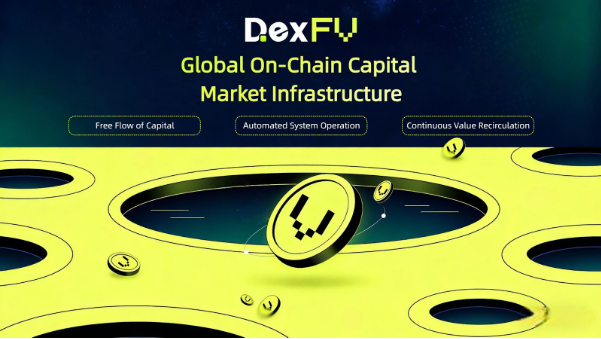
From a macro perspective, DexFV and OpenClaw are reorganizing the three pillars of finance: Capital, Strategy, and Execution.
- Capital: Managed via DexFV’s transparent on-chain environment.
- Strategy: Developed through DexFV’s quantitative frameworks.
- Execution: Handled by OpenClaw’s distributed AI network.
Key Characteristics of this New Infrastructure:
- Full Automation: 24/7 market operation without human fatigue.
- Distributed Execution: Replacing single-point failure servers with a resilient node network.
- Continuous Optimization: AI systems that refine strategy models as data accumulates.
- Absolute Transparency: All fund flows and execution results are verifiable on the blockchain.
Strategic Significance and the Future
As the DeFi market matures, the era of "single-product" innovation is closing. The next frontier of competition lies in the infrastructure layer.
The DexFV × OpenClaw collaboration is a pioneering attempt to build an AI-driven financial structure. In the future Web3 landscape, financial systems will evolve from simple protocol collections into automated networks driven by AI Agents. DexFV and OpenClaw are not just participating in this trend—they are defining the infrastructure that will allow global capital to obey the transparent, efficient, and unceasing order of algorithms.



All Comments