


From CoinShares Research Blog by Max Shannon
Why Uniswap was built
The decentralised finance (DeFi) sector has advanced significantly since the launch of Uniswap in 2018, which pioneered DeFi exchanges using automated market makers (AMMs). Before this innovation, trading was dominated by centralised exchanges, valued for their deep liquidity, fast execution, thin spreads, and user-friendly platforms. However, these exchanges are associated with significant risks, such as centralised control, lack of transparency, and vulnerability to hacking or mismanagement of funds. These issues spurred demand for DeFi trading platforms where users could retain control over their assets without relying on centralised intermediaries, although other risks such as hacking, loss of funds, higher slippage are inherent.
Issues
AMM-based exchanges have faced several criticisms over the years such as impermanent loss, susceptibility to Maximal Extractable Value (MEV) bots, worse slippage than other types of DEXs, limited functionality (e.g., lack of limit orders and leverage), high fees, and UI challenges. As Uniswap has evolved, endeavouring to solve for these issues.
Evolution of Uniswap through versions
From V2 to V3, Uniswap became more capital-efficient, cost-effective, and flexible, enabling over 465 million swaps without a single hack or exploit. Key upgrades — such as direct ERC20/ERC20 swaps, decentralized price oracles, and flash swaps in V2, as well as concentrated liquidity, multiple fee tiers for liquidity providers (LPs), and enhanced oracles for more cost-effective price feeds in V3 — have aimed to overcome historical barriers to AMM adoption.
The v4 codebase has undergone extensive reviews, including: nine audits (reports on core and periphery contracts), a $2.35M security competition with over 500 participants, and the largest bug bounty in history, offering up to $15.5M for any critical v4 bugs. V4 is a step-change upgrade for Uniswap and broader DEX space.
V4 update
Three main takeaways include: improved customisation, cheaper trading and better UX.
More Customisation: Uniswap v4 introduces “hooks” and flexible accounting, allowing developers to add custom features to liquidity pools. This means new tools such as limit orders, dynamic pricing, and tailor-made oracles can be built directly into pools. Liquidity providers (LPs) can fine-tune pools to better fit their strategies, leading to deeper liquidity, tighter spreads, and an overall better trading experience — driving up volumes and fees. One Contract for All Pools: Instead of deploying separate contracts for each pool, Uniswap v4 consolidates everything into a single contract. This has three major benefits:
- Pool creation is now 99% cheaper, making it more accessible for developers and traders. (This efficiency played a big role in Hyperliquid’s success.)
- Trades involving multiple pools (multi-hop trades) now feels like swapping between just one pool, and costs less to trade.
- Liquidity is used more efficiently across the platform.
Native ETH Support: Uniswap v4 brings back direct support for ETH, eliminating the need for Wrapped ETH (WETH). Since ETH transactions are up to 50% cheaper than ERC-20 token transfers, this reduces gas fees and removes the extra step of wrapping/unwrapping ETH. The result? A smoother, cheaper, and more profitable experience for traders.
Uniswap volume and price performance
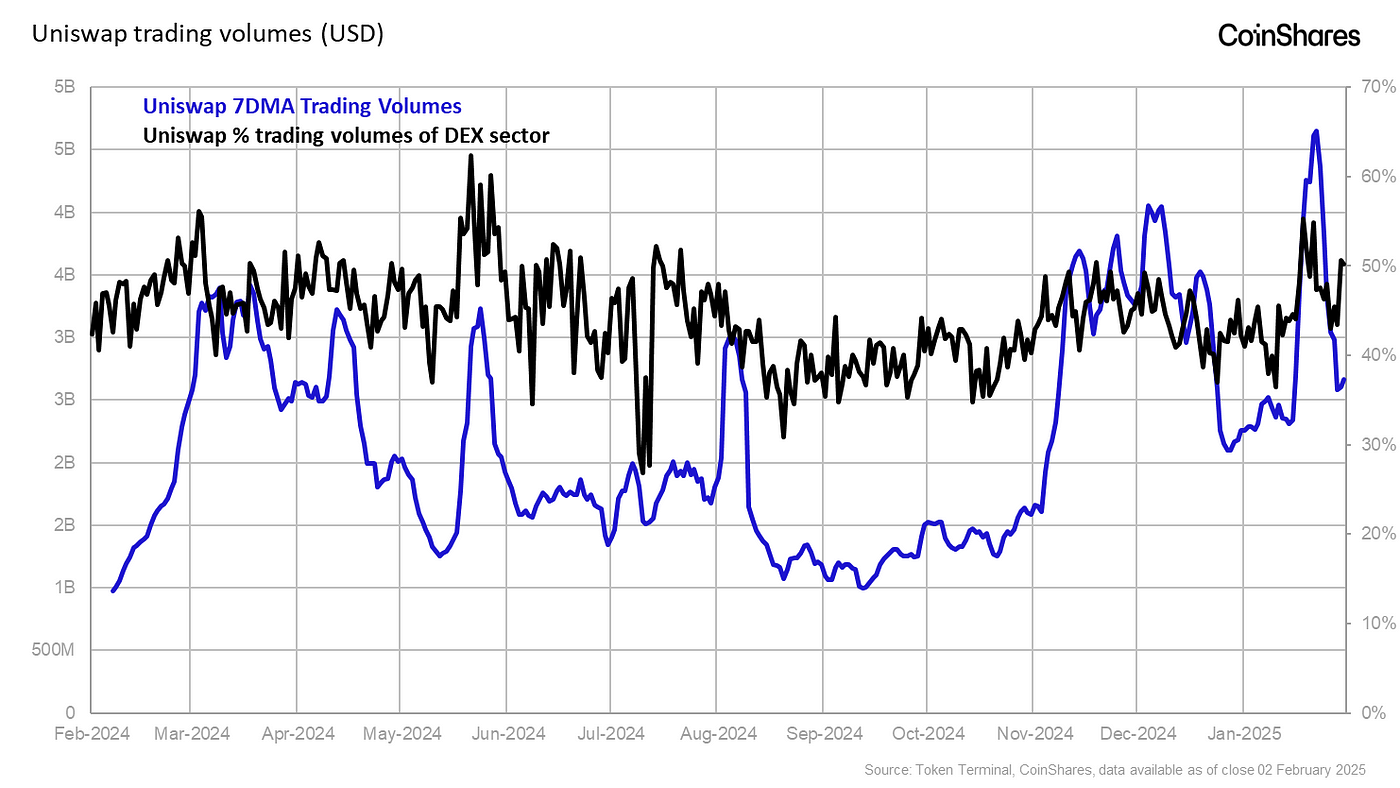
In 2024, Uniswap contracts expanded to Layer 2 (L2) solutions, surpassing $500 billion in cumulative volume on Ethereum L2s, with $871Bn in volume last year in around $666m swaps. As a result, Uniswap passed $2.5Tn in all-time protocol volume and then launched its own L2, Unichain, with additional features to the protocol which were added to UX.
Uniswap traded mostly between 40% and 60% of all AMM volumes, which equates to an average of $2.1Bn (~44% of peer group) per day year-over-year. These statistics are a cumulation of built network effects from the trail-blazing AMM and a constantly improved product throughout the versions of the protocol.
Update of valuation model
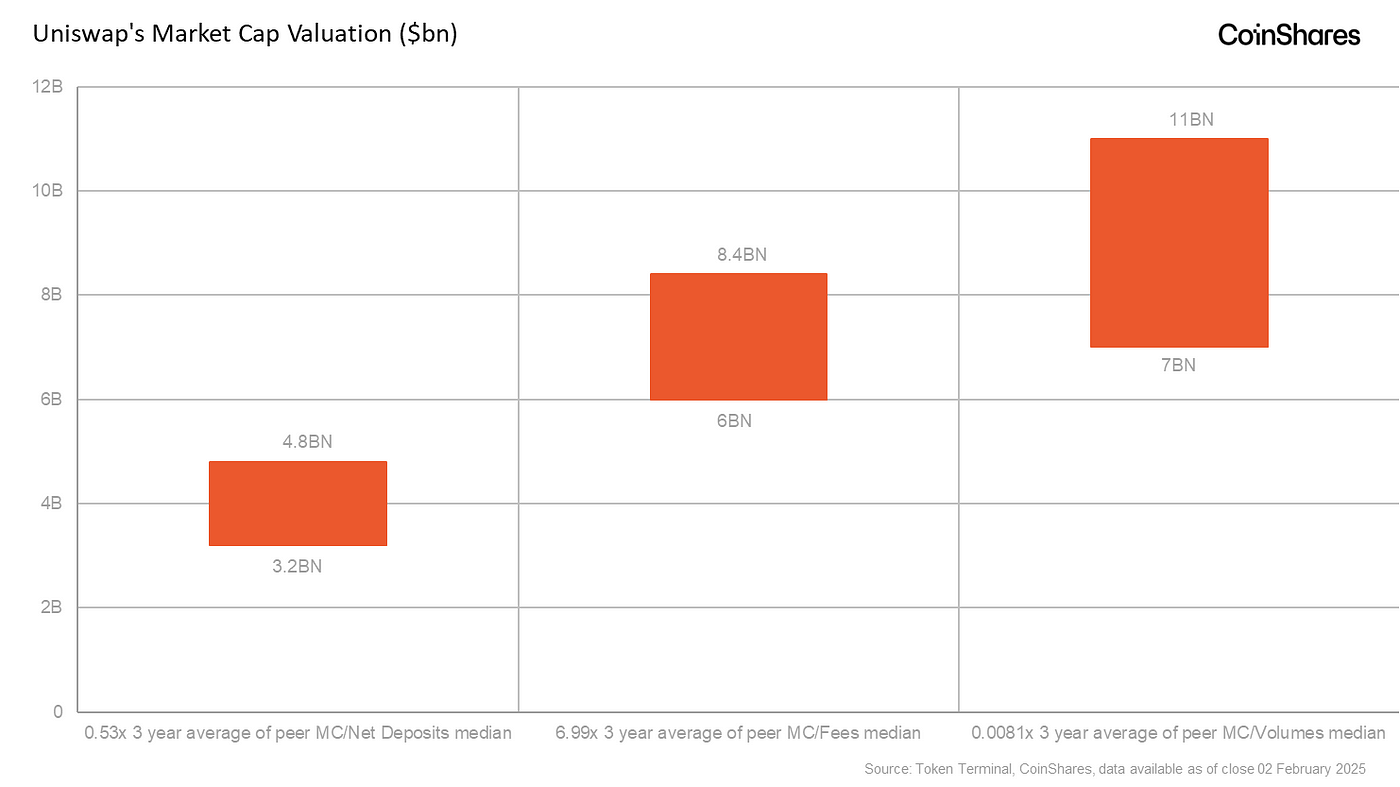
At a current market capitalisation of approximately $5.98 billion (with BTC at ~$98.9K), UNI exhibits an estimated 40% upside based on the three-year average Market Cap/Fee median of peers, implying a valuation of $8.4 billion. Additionally, based on the three-year average Market Cap/Trading Volume median of peers, the potential upside extends to 84%. These ratios are more growth ratios, and probably useful when analysing liquid tokens in crypto.
However, when evaluated against the three-year average Market Cap/Net Deposits median, UNI appears relatively overvalued, with a potential 46% downside. This ratio is more conservative — a baseline metric — and can be thought of a multiple above Book Value.
Taking a weighted approach across these valuation models, the projected outlook suggests a 35% upside under relatively aggressive assumptions and a 10% downside under relatively conservative scenarios.
Conclusion
Uniswap has continuously evolved to address the limitations of decentralised exchanges, with its latest v4 update introducing key improvements in customisation, cost efficiency, and user experience. By implementing features like “hooks” for tailored liquidity pools, a unified contract system for cheaper and more efficient trading, and native ETH support to lower transaction costs, Uniswap aims to enhance capital efficiency and drive greater adoption.
Uniswap remains a dominant player and exchange in the crypto space. Given the prevailing market volatility and the speculative nature of crypto markets — where pricing is often driven by narratives and leverage rather than fundamentals — UNI appears to be roughly fairly valued at its current levels, and does not exhibit extreme under-or-over valuation.


All Comments