

Cointime

Download App
iOS & Android

UK u-turn on retail access to crypto ETNs signals push to become crypto hub

Validated Media

The United Kingdom’s financial regulator has lifted a ban on crypto exchange-traded notes (cETNs) for retail investors in a move welcomed by industry leaders as a step toward aligning the country with global crypto markets and strengthening its position as a digital asset hub.

On Friday, the UK’s Financial Conduct Authority (FCA) reversed the ban on retail access to cETNs, with regulatory changes taking effect from Oct. 8. The ban was enforced in January 2021, citing extreme volatility and “lack of legitimate investment need.” 

The cETN ban reversal reflects a change in the regulator’s approach to crypto assets. In a statement, an FCA executive said the decision reflects how the market has evolved and how crypto-related products are now better understood.

With the FCA lifting the ban, onlookers and industry stakeholders shared their thoughts on the development. Some hailed the move as a step toward progress, while others criticized the UK using satire. 

Community reacts to FCA lifting the ban on crypto ETNs

“We are delighted to see this reversal,” said Ian Taylor, board adviser at CryptoUK and chief operating officer of HT Digital. “Until now, the UK has been an outlier on ETNs. This change reflects the progress we’ve made toward introducing a more proportionate approach to consumer risk.”

Taylor told Cointelegraph that CryptoUK, a trade association for the digital asset industry, has been lobbying for more inclusive access to regulated products like ETNs, which track the performance of crypto assets without requiring direct ownership. 

Riccardo Tordera, the director of policy and government relations at the UK-based payments industry body, The Payments Association, echoed Taylor’s optimism:

“The intrinsic nature of crypto means it can be accessed by everyone, from everywhere. The FCA ban on retail access to certain crypto products was hindering the UK’s chances of becoming a global crypto hub.”

Tordera told Cointelegraph that the FCA’s decision allows individuals to “make their own choices at their own risk.” 

He said restricting access to the cETNs puts the UK at a disadvantage, undermining its global competitiveness.

“This is a welcome move,” he added. “The FCA ban was extremely protective and was already smoothed when professional investors were allowed access last year.”

While some welcomed the move, skeptics also chimed in. WallStreetBets founder Jaime Rogozinski summed up the moment with sarcasm, saying, “Britain loves financial risk—just not the kind that involves, say, vegetables or an industrial policy.”
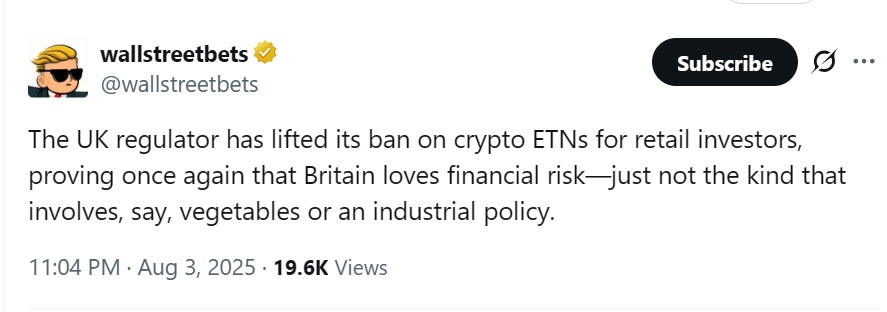
  Source: Jaime Rogozinski

Crypto derivatives remain banned

While the FCA reversed its ban on cETNs, the regulator clarified that crypto derivatives are still prohibited. 

“The FCA’s ban on retail access to crypto asset derivatives will remain in place,” the FCA said on Friday.

Crypto derivatives include futures, options and perpetual contracts. The regulator added that it will monitor market developments and consider its approach to high-risk investments. 

Comments

All Comments

Recommended for you

  • Xi Jinping Holds Restricted Meeting with Trump in Zhongnanhai

    May 15 — Chinese President Xi Jinping held a restricted meeting with US President Donald Trump at Zhongnanhai. (CCTV News)

  • US Spot Bitcoin ETF Sees Net Inflow of $131.32 Million Yesterday

    On May 15, according to monitoring by Trader T, the US spot Bitcoin ETF experienced a net inflow of $131.32 million yesterday.

  • Kechuang 50 Index Declines by 2%

    On May 15, the Kechuang 50 Index experienced a decline of 2.36% during the day. Among the constituent stocks, JinkoSolar fell by 7.60%, Tianyue Advanced dropped by 7.11%, Canadian Solar decreased by 5.54%, and Zhongke Feiyun fell by 5.64%. (Dongxin News Agency)

  • Nikkei 225 Index Falls Below 62,000 Points for the First Time Since May 7

    On May 15, the Nikkei 225 index fell below 62,000 points during trading hours, marking the first time it has done so since May 7. (Tokyo News Agency)

  • U.S. 30-Year Treasury Yield Rises to 5.056%, Reaching 10-Month High

    On May 15, the yield on U.S. 30-year Treasury bonds rose to 5.056%, marking a 10-month high, while the yield on 10-year Treasury bonds reached 4.512%. (Dongxin News Agency)

  • Japan's 10-Year Government Bond Yield Reaches Highest Level in Nearly 29 Years

    On May 15, according to CCTV, the yield on newly issued 10-year government bonds, which serves as a long-term interest rate indicator in Japan's domestic bond market, rose to 2.665%, reaching its highest level in nearly 29 years. This increase is attributed to inflationary pressures from rising oil prices and market concerns about the deterioration of fiscal policy due to Japan's domestic economic measures, leading to selling pressure on bonds. (Dongxin News Agency)

  • ETH Surpasses $2300

    Market data shows that ETH has surpassed $2300, currently priced at $2300.06, with a 24-hour increase of 1.42%. The market is experiencing significant volatility, so please ensure proper risk management.

  • ETH Surpasses $2300

    Market data shows that ETH has surpassed $2300, currently priced at $2300.02, with a 24-hour increase of 1.97%. The market is highly volatile, so please ensure proper risk management.

  • Trump's Securities Trading Records Exposed, Invests in Nvidia and Apple

    On May 15, the U.S. Office of Government Ethics released two new financial disclosure documents on Thursday, revealing that Trump disclosed large-scale financial transactions worth at least $220 million earlier this year, involving securities from several major U.S. companies. The newly disclosed documents cover the first three months of 2026, with transaction values ranging broadly from $220 million to approximately $750 million. Significant purchases valued between $1 million and $5 million include S&P 500 index funds, Nvidia, and Apple. Large sales valued between $5 million and $25 million include Microsoft, Amazon, and Meta. The documents do not consistently specify the exact types of securities involved, such as whether they are stocks or corporate bonds, nor do they indicate which accounts the transactions occurred in or who authorized the trades. Such disclosure documents are mandatory but only partially reflect officials' financial activities, as they only list transactions exceeding $1,000 and present them in broad value ranges without disclosing specific transaction prices, profit situations, or whether assets were directly purchased or held through managed accounts. Trump's assets are held in a trust controlled by his children, and some transactions in the new documents indicate the involvement of brokers as agents. (NBC)
