

Cointime

Download App
iOS & Android

TronBank: A Trillion-Dollar Track Most People Overlook

The crypto market never runs out of new stories.

From public blockchains, DeFi, and NFTs to memes, AI, and RWA, one hot narrative after another takes over the market. Most people’s attention is always drawn to whatever is the loudest, hottest, and most capable of triggering emotional swings.

But if you stretch the timeline, a different pattern emerges: the businesses that truly endure across cycles and continue to create value are often not the ones best at generating buzz, but the ones built on real demand.

Many people still think of gas fees as nothing more than “transaction costs on-chain,” just another expense users pay whenever they transfer assets or interact with a protocol. On the surface, it may not seem like a business with much room for imagination.

But from a commercial perspective, gas fees have never been just fees.

As long as there are on-chain transactions, transfers, stablecoin circulation, and smart contract calls, this cost will continue to exist. It is not a short-term narrative, nor a temporary concept wrapped in marketing language. It is a stream of underlying cash flow generated every single day in the real market.

What truly deserves attention is not simply how large gas fees are, but who can build more efficient management around this ever-present cost, provide lower-friction services, and turn it into a more sustainable platform business.

Once the chain expenses users originally had no choice but to bear are reorganized into a resource demand that can be optimized, scheduled, and integrated, the value of this business changes completely.

And within the TRON ecosystem, that logic is becoming increasingly clear.

As the user base on-chain expands and USDT circulation continues to grow, the market formed around transfers, energy, and fee optimization is no longer a marginal demand. It is an increasingly large and very real pie. Against this backdrop, TronBank should not simply be viewed as an energy rental platform. It is better understood as a resource aggregator positioned at the entry point of TRON’s high-frequency on-chain demand.

So this article is not only about why gas fees matter. More importantly, it is about whether a market this underestimated, when combined with a project like TronBank, represents a growth opportunity and long-term potential that more and more people are beginning to recognize.
Gas Fees Are a Business That Has Been Seriously Underestimated

When most people hear “gas fees,” their first reaction is simply “transfer fees” or “the cost of on-chain operations.” It sounds like a small payment users casually make during each interaction, hardly worth serious attention.

But if you shift your perspective from a single transaction to an entire blockchain, an entire ecosystem, and an entire year of activity, you begin to see that this is far from trivial. It is a highly predictable cash-flow business.

As long as there are transfers, smart contract interactions, stablecoin circulation, and active users on-chain, gas fees will not disappear. They are not driven by hype, not manufactured by narratives, and not temporarily inflated by storytelling. They are real costs incurred every day, and real money flowing every day.

Within the TRON ecosystem in particular, the scale of this business is much larger than many people imagine.

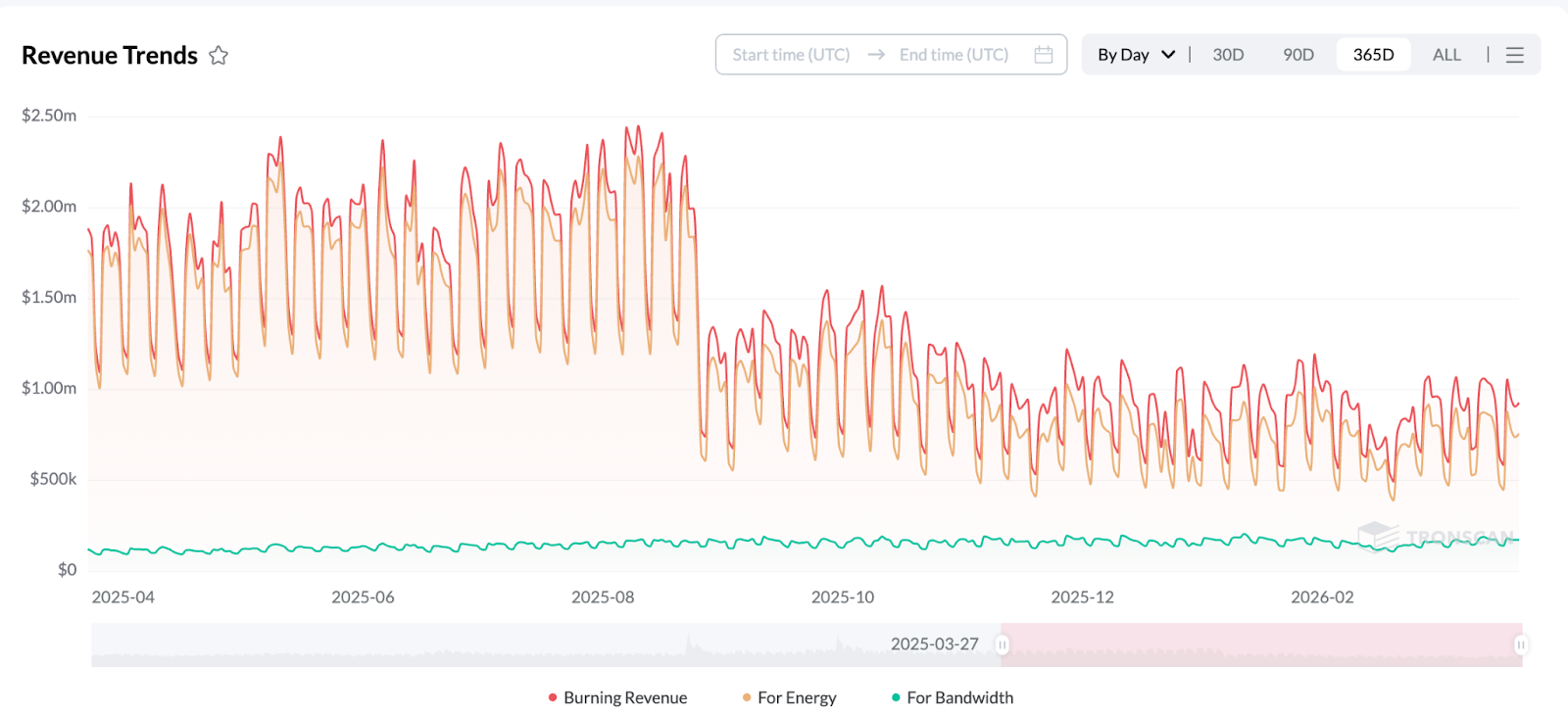
According to project materials, TRON generated a total of USDT 3.482 billion in transaction fee revenue in 2025, with the highest single-day revenue reaching USDT 16.17 million and the lowest still at USDT 5.46 million.

What does that mean?

Comments

All Comments

Recommended for you

  • Spot Gold Returns to $4,500 per Ounce

    Spot gold has returned to $4,500 per ounce, rising 2.80% during the day.

  • BTC Falls Below $66,000

    Market data shows that BTC has fallen below $66,000, currently priced at $65,959.56, with a 24-hour decline of 5.01%. The market is experiencing significant volatility, so please ensure proper risk management.

  • U.S. Stocks Continue Downtrend, Nasdaq Decline Quickly Expands to 1%

    U.S. stocks continue their downtrend, with the Nasdaq's decline quickly expanding to 1%.

  • Nasdaq 100 Down 10% From October High

    On March 27th, the Nasdaq 100 index fell 10% from its peak in October of last year, with markets anticipating a technical correction.

  • WTI Crude Oil Rises Short-Term, Surpassing $98 per Barrel with Over 4% Increase

    On March 27, WTI crude oil experienced a short-term rise, surpassing $98 per barrel, with an increase of over 4% during the day.

  • IRGC: Devastating Drone Attacks Launched Against Israeli Bases and Airports

    On March 27, the Iranian Revolutionary Guard Corps announced that since last night, Iranian forces have launched devastating drone attacks against the Israeli military support base and military transport center in Tel Aviv, as well as the military assembly point at Ben Gurion Airport. This wave of drone attacks aims to target the professional units of the Israeli military, disrupting the enemy's ground and air force preparation and support facilities and systems. It is expected that this drone attack will pose a sustained threat to the enemy's supply lines and directly impact Israel's rapid, secure, and large-scale transportation, ultimately affecting the regime's offensive operational capabilities.

  • Yili Hua: Crypto Market Disappoints Over the Past 4 Years, Mid-tier Investors, Retail Investors, and VCs Have All Been Harvested

    On March 27, Yili Hua, founder of Liquid Capital (formerly LD Capital), stated that the cryptocurrency market is currently in a bear phase and that the war is not over, with no significant rebound in sight. The past four years in the crypto space have been disappointing; the 1011 event harvested mid-tier crypto investors, the demise of altcoins harvested retail investors, and the 1+3 rule harvested crypto VCs. Meanwhile, exchanges, market makers, and project teams have been continuously drawing blood, with the only source of lifeblood being Wall Street's ETFs and DAT, along with a few remaining believers. The anticipated disruptive innovation in crypto has yet to occur, raising questions about whether the next bull market will emerge simply due to the four-year cycle or for other reasons.

  • Vance Set to Lead US-Iran Talks, His Anti-War Stance May Facilitate Diplomatic Breakthrough

    On March 27, according to AXIOS, U.S. Vice President Vance is preparing to take on the most significant task of his career: leading the U.S. efforts aimed at ending the war, having expressed reservations about the initiation of the conflict from the outset. Vance has had multiple conversations with Israeli Prime Minister Netanyahu and has participated in indirect communications with the Iranians. He is expected to become the chief negotiator for the U.S. in potential peace talks. According to sources from the U.S. and Israel, Vance is deeply skeptical of Israel's optimistic pre-war assessments regarding the conflict's trajectory, with expectations that the war will continue for several more weeks. Vance's advisors believe that there are individuals within Israel attempting to sideline the Vice President, possibly due to perceptions that he is not tough enough. Israeli officials have denied this. White House officials stated that Vance's qualifications within the government and his consistent opposition to endless overseas conflicts make him a more acceptable dialogue partner for the Iranians compared to Witkoff and Kushner, who were responsible for the previous two rounds of unsuccessful negotiations.

  • Intercontinental Exchange Announces $600 Million Investment in Polymarket

    On March 27, The Wall Street Journal reported that the Intercontinental Exchange announced a $600 million investment in Polymarket.

  • Ancient Whale Moves 500 BTC to Binance, Realizing $363 Million Profit

    According to on-chain analyst Ember, an ancient whale who has held Bitcoin for 13 years transferred 500 BTC to Binance for sale, valued at $33.28 million. This whale accumulated 5,000 BTC in 2013 at a price of $332 per coin and began selling in November 2024. To date, the whale has transferred a total of 4,000 BTC to Binance, with an average selling price of approximately $91,258, realizing a profit of $363 million. The address currently still holds 1,000 BTC, valued at $66.62 million.
