


From coinshares by CoinShares Research Blog
The decentralised finance (DeFi) sector has advanced significantly since the launch of Uniswap in 2018, which pioneered DeFi exchanges using automated market makers (AMMs). Before this innovation, trading was dominated by centralised exchanges, valued for their deep liquidity, fast execution, and user-friendly platforms. However, these exchanges are associated with significant risks, such as centralised control, lack of transparency, and vulnerability to hacking or mismanagement of funds. These issues spurred demand for DeFi trading platforms where users could retain control over their assets without relying on centralised intermediaries, although other risks such as hacking, loss of funds, higher slippage are inherent.
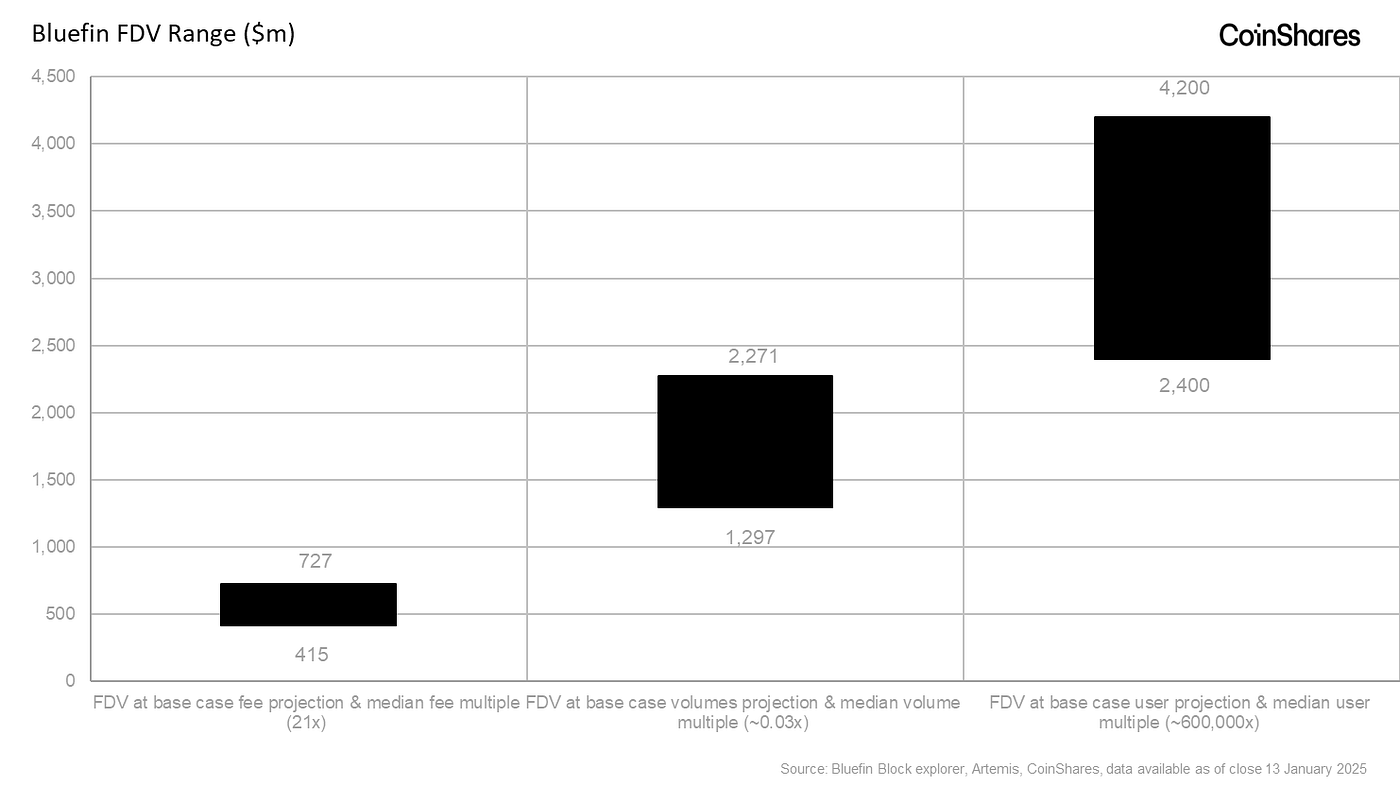
In this article, I explore the evolution of perpetual decentralised exchanges (Perp DEXs), analyse Hyperliquid’s rapid adoption, and provide a brief valuation assessment of Bluefin’s token. Perp DEXs initially emerged as a response to the inefficiencies of AMMs. While many of these challenges have been addressed by protocols such as Uniswap, a significant gap remained — particularly in the realm of leveraged trading. Over the years, Perp DEXs have evolved through various models, but Hyperliquid stood out in the past year, excelling in decentralized exchange architecture, community-driven tokenomics, and strategic positioning in the memecoin sector. Finally, as a case study in fundamental valuation, I present Bluefin’s potential upside, estimated at ~2x, ~4x, and ~8x based on peer-median multiples of fees, trading volumes, and user growth.
Issues with AMMs
AMM-based exchanges face several criticisms, including impermanent loss, susceptibility to Miner Extractable Value (MEV) bots, slippage, limited functionality (e.g., lack of limit orders and leverage), high fees, and UI challenges. Many users unfamiliar with DeFi find navigating these platforms difficult. As crypto adoption grows, simplifying the onboarding process is crucial. Uniswap has addressed some of these issues. Initially launched on Ethereum to leverage its liquidity and network effects, Uniswap expanded to Layer 2 (L2) solutions, surpassed $500 billion in cumulative volume on Ethereum L2s, then launched its own L2, Unichain.
Preference for Perpetual DEXs
Perpetual futures contracts, which allow traders to speculate on asset prices without expiration dates, gained popularity on centralised exchanges due to their flexibility and leverage opportunities. These contracts let traders profit from both upward and downward price movements by taking long or short positions. However, perpetual futures contracts faced slower adoption in DeFi due to challenges with liquidity, price feeds, and latency. However, 2024 was where this changed.
Evolution of Derivative Trading
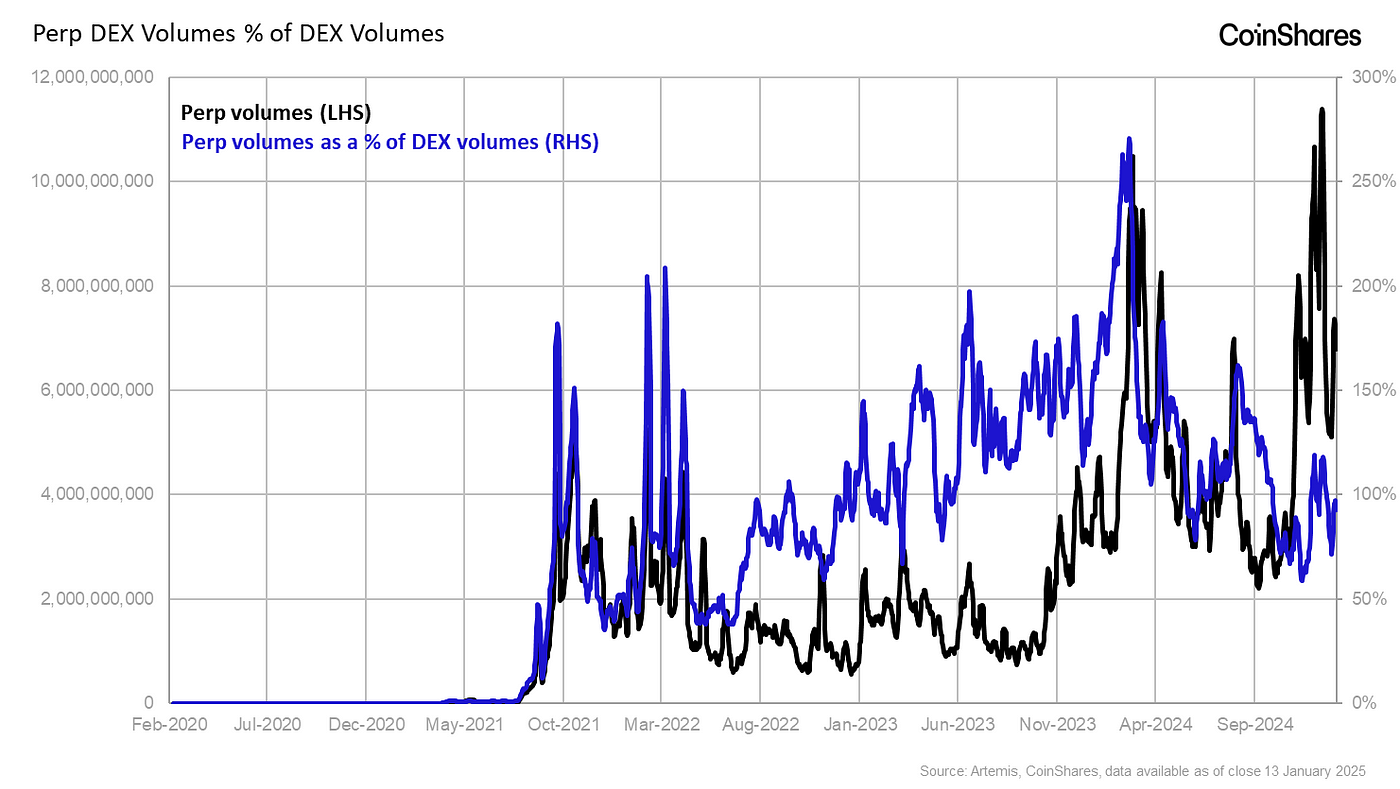
The landscape of decentralised derivatives trading has diversified. For example, Peer-to-Pool models include GMX, off-chain order book models like dYdX, virtual AMMs such as Perpetual Protocol, and hybrids like Drift, which combine AMMs and order books. In 2024, perpetual DEXs showed a skewed distribution of success, with total volumes growing 210% year-over-year across platforms. Median growth was 208%, while the mean was 1,184%, driven by standout performers like Solana-based Jupiter and Drift, which saw volume increases of 5,176% and 628%, respectively. These gains were largely fueled by meme-coin trading and prediction markets, particularly in the run up to the U.S. election.
DYdX also had a very good year after transitioning to its own Cosmos-based chain (V4), which was in fact a good omen for Hyperliquid taking the same route as being its own chain. Hyperliquid achieved a 25.3x volume increase, from $21 billion to $570 billion annually, generating $10 million in fees in the last nine days of the year alone, which equated to $410m annually.

Hyperliquid’s Success
Hyperliquid operates on a high-performance Layer 1 (L1) chain with native components like perpetual and spot order books. Its permissionless EVM chain supports Ethereum-compatible smart contracts that integrate with on-chain liquidity. By avoiding external funding and prioritizing neutrality and long-term goals, Hyperliquid aims to emulate Bitcoin’s decentralized ethos. The ecosystem also fosters network effects with tools like HypurrFun (a memecoin trading app), HypurrScan (a blockchain explorer), and other integrations. Memecoin projects like CATBAL and PIP have further driven adoption.
Recommendations for DEX Development
Perhaps a controversial opinion, but to ensure sustainable growth, DEXs should avoid market-making their own assets, such as they do with the HLP vault. In Hyperliquid’s case, running loss-making market-making strategies and turning the collective P&L negative could lead to insolvency, wider spreads, and reputational harm. It’s great when it works, but very bad when it doesn’t. However, its perfectly reasonable and, instead, ideal to incentivise professional or institutional market-makers. This can be done by transparent order-matching mechanisms attracting market makers and liquidity providers, improving the overall trading experience.
DEXs should also focus on enabling permissionless trading and listing of assets to support price discovery for new and illiquid tokens. A second order effect would incentivising meme-crazes and community engagement, which Hyper liquid successfully did.
Bluefin’s Journey and Opportunities
Bluefin is a Perpetual Futures DEX, and one that we think is currently underpriced with >2x upside on fee multiples; >4x upside with volume multiples ; >8x upside with user multiples.
The team has demonstrated adaptability, evolving from its initial launch on Polkadot in 2020 to Arbitrum in 2022 and eventually to Sui. Initially branded as dTrade, the platform underwent several rebranding efforts before settling on Bluefin. Leveraging Sui’s Move-based technology, Bluefin achieves low latency, fast finality, and parallel processing, with features like zkLogin and one-click trading enhancing user experience. The platform could benefit from complementary product launches, such as prediction markets, to drive adoption. However, Sui’s limited adoption and high valuation ($50 FDV) pose risks downside risks as BLUE is correlated to SUI. Still, competitive pressures, such as Backpack acquiring FTX EU, signal rising challenges from legitimate perpetual trading venues.
Summary
The DeFi sector has evolved significantly since Uniswap’s launch in 2018, which introduced AMMs as an alternative to centralized exchanges, addressing issues like transparency and control but bringing new challenges like impermanent loss and slippage. Perpetual DEXs have gained traction recently, with platforms like Jupiter, dYdX, and Hyperliquid driving impressive growth in derivatives trading, fueled by innovations in liquidity, order books, and user-friendly tools. Hyperliquid achieved a 25.3x volume increase in 2024, leveraging a high-performance L1 chain, meme-coin adoption, and robust ecosystem tools. Bluefin, another perpetual DEX, has shown adaptability, transitioning across ecosystems and focusing on enhanced user experiences, though risks tied to Sui’s valuation and adoption remain. Sustainable growth in DEXs hinges on incentivizing professional market-makers, supporting permissionless trading, and fostering community-driven engagement.


All Comments