

Cointime

Download App
iOS & Android

The Most Important Chart in the World

From Vincent Launay

“People that use fiat currency as a store of value — there's a name for them; we call them poor.”

Michael Saylor, Chairman of Microstrategy

For thousands of years, gold was money. But in the West, people forgot about it and stopped saving in it. It was replaced by pieces of paper with the faces of famous people on them, and we were told this was money. Governments, sorry, central banks, can print this fiat money in unlimited quantities. People and markets have to trust that this money won’t be debased too quickly, which would erode its purchasing power. But based on what has been happening in the gold market in recent weeks, the market seems to have doubts about the ability of central banks to protect the value of their fiat currencies.

Price of Gold in US Dollar per Troy Ounce over the past 5 years

Over the past five years, the price of gold has gone up by more than 80% in US Dollars, and much more when measured against most other fiat currencies. Did gold suddenly get better? Was an upgrade recently rolled out? Did the supply change? No, no, and no. Gold has remained exactly the same. It is still element 79 on the periodic table, and its symbol is still Au. It hasn’t changed. It’s the money that got worse.

One way to visualize the loss of value of the US Dollar against gold is to flip the chart and show the change in value of the US Dollar against gold. Over the past five years, it has been down more than 40%.

Change in value of the US Dollar vs. Gold over the past five years

Many of my readers are in Europe, so let me show you how the Euro has done against gold since the Euro was launched on January 1, 1999.
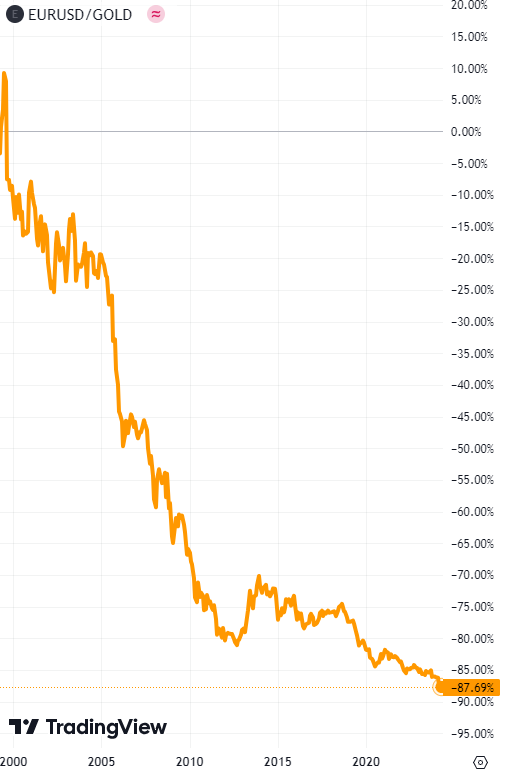
Change in value of the Euro against Gold since January 1, 1999

Since it was launched, the Euro has lost more than 87% of its value against gold. Put another way, a European investor that would have just bought gold on January 1, 1999, and not done anything with it for 25 years would have eight times more euros today.
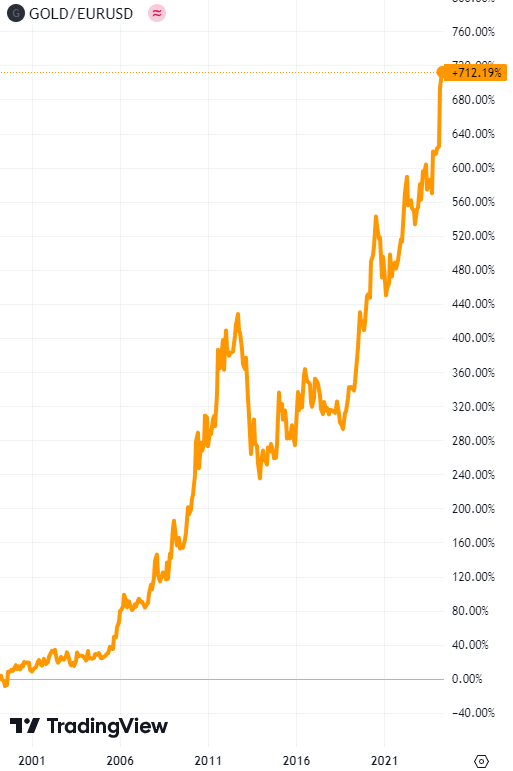
Change in gold price in euro since January 1, 1999

Most people are hardwired to avoid volatility in their own fiat currency. They earned this money, so the thought of seeing the value of their hard-earned money go down, even temporarily, is unbearable. But this is the wrong mindset. Fiat currencies are designed to lose value. Central bankers keep telling you they aim to get inflation to 2%, i.e., they want your money to lose 2% of its value every year.

But in reality, through debasement, the increase in the number of units of the currency, the value of assets has gone up significantly more.

Just because you are paid in a token that central banks can print in unlimited quantities doesn’t mean you have to save in this token…

So what is going on at the moment, and why are investors suddenly rushing to buy gold?

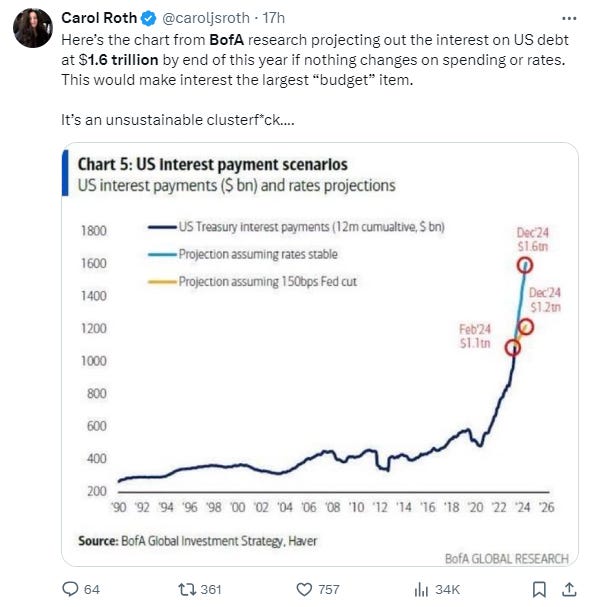
Long story short, the US is on a fiscally unsustainable path. The chart below, prepared by Bank of America, shows that the US government's annual interest expense is projected to reach $1.6 trillion by the end of the year, three times more than it was before Covid-19 and twice the defense budget. For reference, the US Government revenues in 2023 were $4.4 trillion.
Over the past decades, investors were conditioned to think that high real rates, i.e., nominal interest rates minus inflation, were bad for gold because gold doesn’t pay any interest. Gold tended to move in parallel with the price of long-term bonds (government debt). But something broke in 2020. Government deficits went through the roof, and they were financed with freshly printed money. When inflation picked up, which only came as a surprise to people unaware of the work done by Milton Friedman decades ago, the price of government debt went down, and real interest rates became positive again. But gold didn’t go down. It went up.

The chart below shows the change in the price of TLT, an Exchange-Traded Fund (ETF) that holds long-term US Government debt, compared to the price of gold since 2017. The market has spoken on which of the two is the better store of value. This is the most important chart in the world at the moment.
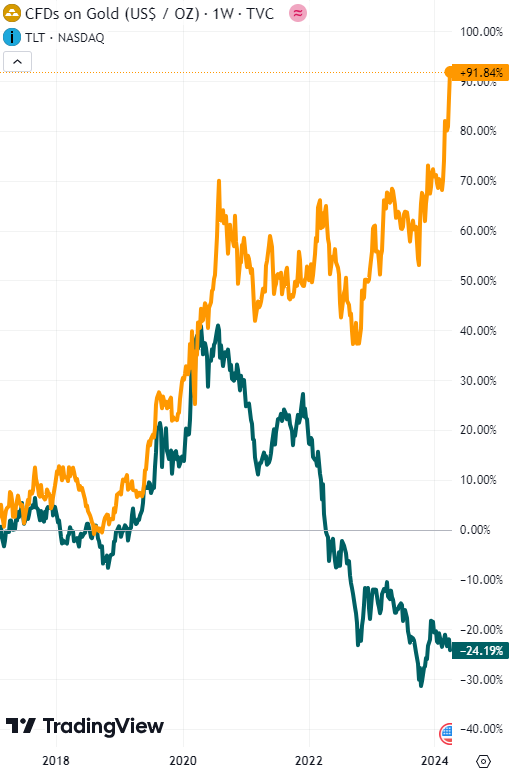
Change in the price of TLT and Gold since January 2017

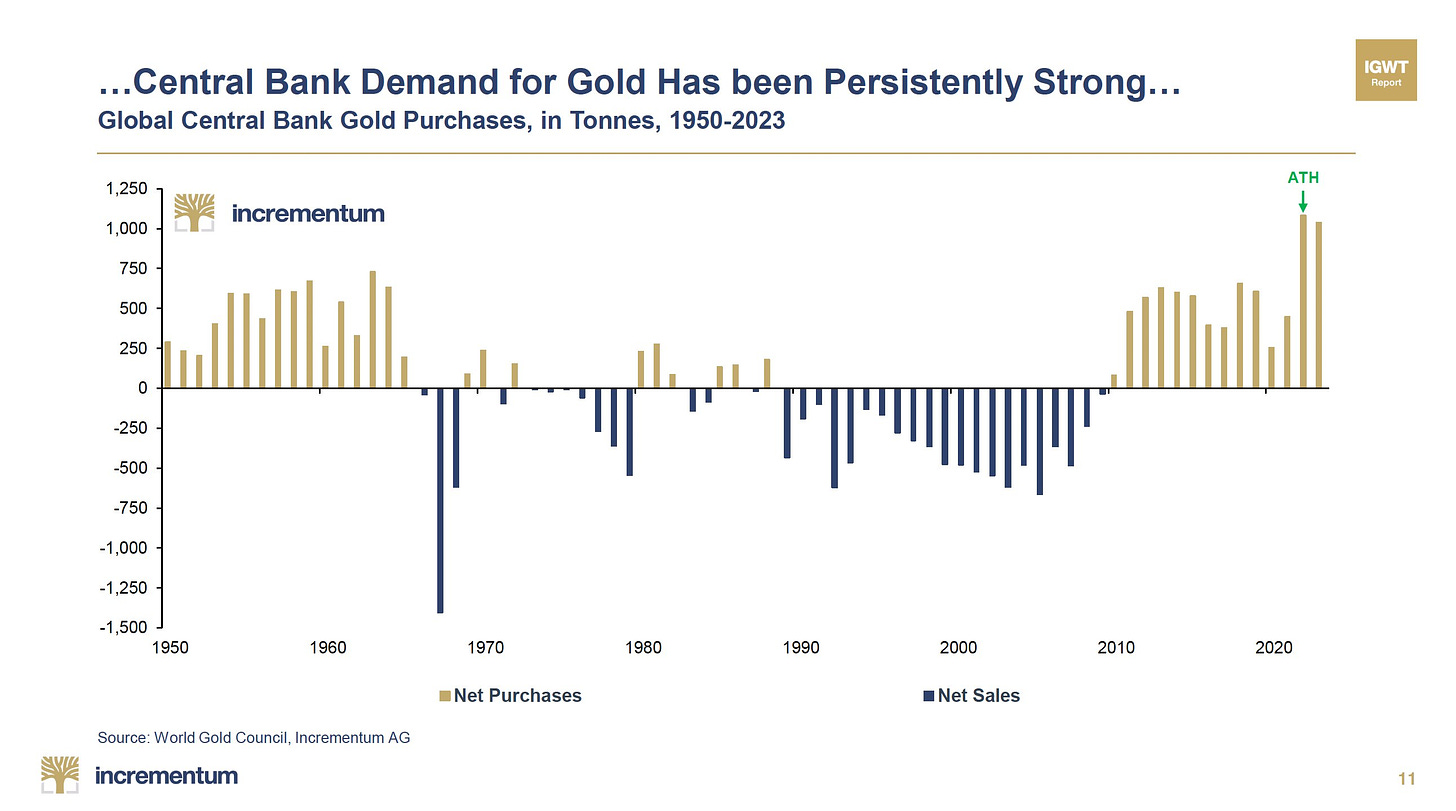
Since Covid, central banks have ramped up their gold purchases. They stopped increasing their stock of US Treasuries and instead bought gold. In addition to providing a hedge against currency debasement, gold cannot be seized the way the foreign exchange reserves of the Russian central bank were seized following the invasion of Ukraine. It’s too early to tell to what extent the seizure of these reserves is playing a role in the recent surge in gold purchases by central banks, but it should not be dismissed.
Comments

All Comments

Recommended for you

  • Saudi Arabia Depletes 86% of Patriot Missile Stockpile

    According to British media reports, within the first 38 days after the outbreak of the war, Saudi Arabia launched approximately 2,400 PAC-3 (Patriot-3) interceptor missiles, accounting for about 86% of the country's total stockpile of 2,800 missiles. By April of last year, Saudi Arabia had only about 400 interceptor missiles remaining. Other Gulf Arab states also consumed missile reserves on a similar scale, highlighting the military crisis facing the region. (Jin Shi)

  • Experts: The Strait of Hormuz 'Will Never' Return to Pre-War Status

    Ali Akbar Dareini, a researcher at the Iranian Strategic Studies Center, stated that Iran and Oman are about to reach an agreement on the future management of the Strait of Hormuz, with the main obstacle being U.S. pressure on Oman to adopt a position more aligned with Washington. Dareini emphasized that Iran considers future control of the strait crucial for its national security. In recent months, the U.S. has conducted strikes against Iran, which Iran claims were launched from bases in the region. Dareini noted that the ongoing negotiations between Iran and Oman present the U.S. with a 'good opportunity to extricate itself from this quagmire' by recognizing Iran and Oman as the countries that will determine the 'future' of the Strait of Hormuz. 'However, the Strait of Hormuz will never return to its pre-war status,' he continued. 'The geopolitical landscape of the region has changed.'

  • Iran: Negotiations with Oman Unrelated to Reopening of Strait of Hormuz

    On August 8, a spokesperson for the Islamic Revolutionary Guard Corps of Iran stated that the reopening of the Strait of Hormuz is unrelated to negotiations between Iran and Oman, but rather depends on whether the United States fully accepts Iran's conditions and ceases interference in regional negotiations. "Once the United States accepts Iran's conditions, the Strait will undoubtedly reopen." (CCTV News)

  • Whale Shorting $102 Million in Bitcoin Faces Partial Liquidation, Remaining Liquidation Price Around $65,300

    On August 8, TheDataNerd reported that a whale using 40x leverage to short $102 million in Bitcoin recently faced partial liquidation, incurring a loss of $1.46 million over the past week. Currently, the margin call has reduced the short position to approximately $60 million, with an opening price of $64,212.5 and a liquidation price of $65,310.2.

  • BTC Falls Below $65,000

    Market data shows BTC has fallen below $65,000, currently reported at $64,999.23, with a 24-hour increase of 1.01%. Market volatility is high, please exercise risk control.

  • Hedge Fund AISituational Awareness's Mysterious $400 Million Investment Targets Chip Startup Source Foundry

    On August 8, sources revealed that the hedge fund Situational Awareness, managed by former OpenAI researcher Leopold Aschenbrenner, made a mysterious $400 million investment in the chip manufacturing startup Source Foundry just days after facing imminent collapse. Previously, Bloomberg reported that the hedge fund invested in a private company backed by Sequoia Capital, but did not disclose the name of the specific company. The Wall Street Journal had earlier reported that the recipient of the investment was Source Foundry, unveiling the target of this mysterious funding deployment by Situational Awareness.

  • US Spot Bitcoin ETF Sees $101.79M Net Inflow Yesterday

    On August 8, according to Trader T's monitoring, US spot bitcoin ETFs saw a net inflow of $101.79 million yesterday.

  • US Official: Ukraine Agrees to Avoid Strikes on Non-Russian Tankers and Black Sea Oil Facilities

    On August 8, according to a US official, Ukraine has agreed not to target certain non-Russian tankers and Black Sea infrastructure vital to Kazakhstan's crude oil exports. This follows ship attacks last month that caused loading disruptions. The US official said Ukraine has set up contact points so commercial shipping companies can communicate information and ensure safe passage. The commitment was reached after meetings between senior US government leaders and Ukrainian leadership, marking a potentially significant step toward increasing regional oil shipments. Previously, activity in the region had cooled significantly due to several recent attacks near the Caspian Pipeline Consortium terminal in Russia's Novorossiysk. (Jin Shi)

  • U.S. July Nonfarm Payrolls Fall by 23,000, Missing Market Expectations

    On August 7, U.S. nonfarm payrolls decreased by 23,000 in July, compared with market expectations of an increase of 80,000, and the previous value was an increase of 57,000.

  • US May and June Nonfarm Payroll Additions Revised Down by 103,000 Combined

    On August 7, the US Bureau of Labor Statistics: May nonfarm payroll additions were revised down from 129,000 to 63,000; June nonfarm payroll additions were revised down from 57,000 to 20,000. After the revisions, the combined additions for May and June were 103,000 lower than previously reported.
