

Cointime

Download App
iOS & Android

The minimal definition of user agency

So, here’s a provocation from Rabble, who also happened to be a founding engineer at Twitter:
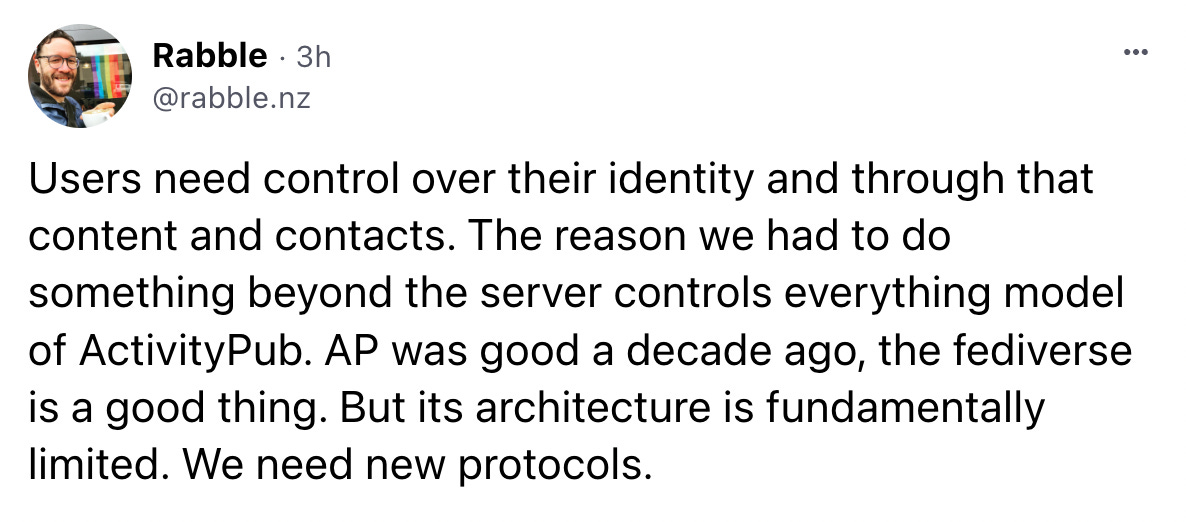
This is a great minimal definition of user agency!

  • Own your ID
  • Own your content
  • Own your contacts

Why do you need all three?

  • If you don’t own your content, you’re stuck. Owning your content is necessary for agency! However, it is not sufficient, because…
  • If you own your content, but don’t own your contacts, then you will lose your entire social graph when you switch services. Network effect will keep you locked in.
  • If you own your content and contacts, but don’t own your ID, you don’t really own anything. Why? IDs are upstream of access. Specifically, this is about who owns your name, and the cryptographic keys that secure your ID, under the hood. If your name is owned by an authority, you lose it if you leave. If your keys are owned by an authority, they are in control. They can lock you out of your stuff, snoop on your private messages, delete your account, or refuse to let you move it elsewhere. So self-sovereign IDs and keys are crucial for agency.

When you own your ID, content, and contacts, you have agency, because you have credible exit. You can seamlessly change services and bring everything important with you, like switching carriers for your mobile phone.

The minimal definition of user agency: own your ID, your content, and your contacts.

User agency is a core goal for us at Subconscious. It’s why we built Noosphere, a protocol for thought.

Noosphere is sort of like “what if Roam/Notion/LogSeq, but a protocol”. A worldwide decentralized thought graph, made up of individual graphs called spheres.

Your sphere is like your inventory on Noosphere. It’s a data structure that contains your content and contacts.

Spheres are published to IPFS, a decentralized network. This decouples your data from any particular app or domain. Your sphere can live anywhere or everywhere at once, and is accessible from any IPFS peer. If a service tries to lock you in, you can always get your content through another node in the decentralized network.

Your sphere is signed with a key that you control. This decouples auth from any particular app or authority. Using your cryptographic key, it’s possible to prove content is secure, no matter where it lives on the network, or what service is hosting it. You own your keys, you own your identity, you own your content.

A decentralized name system ties everything together, keeping your ID portable. In apps and on the web, names are rooted to a particular service, such as facebook.com/alice. If you change services, you lose your name and everything else. On Noosphere, your keys belong to you, and your account name stays the same, no matter where your content happens to live. You can change providers without losing your ID or breaking your links.

With Noosphere, we’re aiming to build a worldwide decentralized repository for thought, belonging to everybody. A decentralized graph, where you own thoughts, and have agency to move your data between services and apps. If that sounds like your jam, come build with us!

GitHub: subconsciousnetwork/noosphereLicense: Apache/MIT

Subconscious is our tool for thought, powered by Noosphere protocol.Sign up for the Subconscious Beta


Comments

All Comments

Recommended for you

  • Tether makes a $100 million strategic equity investment in Anchorage Digital

    Tether announced a $100 million strategic equity investment in Anchorage Digital. Anchorage Digital Bank N.A. is the first federally regulated digital asset bank in the United States, providing staking, custody, governance, settlement, and stablecoin issuance services to global institutions and innovators to promote the shared goal of advancing the next phase of digital asset applications.

  • ETH falls below $2100

    the market shows ETH fell below $2100, currently at $2099.68, with a 24-hour decline of 7.97%. The market is highly volatile, please manage your risk accordingly.

  • U.S. Labor Department: Non-farm payrolls will be released on February 11, CPI data will be released on February 13.

     U.S. Bureau of Labor Statistics has rescheduled the release date of the January non-farm payroll report to February 11; the January CPI report release date has been rescheduled to February 13. In addition, the December Job Openings and Labor Turnover Survey report will be released on February 5.

  • Bloomberg ETF analysts: ETF funds showed high stability during the Bitcoin decline, with 94% of holdings remaining stable.

     Bloomberg ETF analyst Eric Balchunas stated that despite Bitcoin experiencing a significant pullback of about 40% and some investors still being at a floating loss, only about 6% of assets in Bitcoin ETFs have been withdrawn, with approximately 94% of funds remaining, indicating that ETF investors' holdings remain relatively resilient.

  • An entity sold a large amount of ETH on Hyperliquid to repay its Aave loans held in 11 wallets.

     according to MLM monitoring, an entity has been selling a large amount of ETH on Hyperliquid to repay its Aave loans in 11 wallets. The entity sold 31,700 ETH (worth $80.8 million) on the Hyperliquid platform in the past 5 hours, bringing the total sales over the past 4 days to 47,000 ETH (worth $120 million). It is reported that the entity deposited 49,600 ETH (worth $112 million) into the Aave account and borrowed $86 million USDC against it as collateral. However, due to the decline in ETH prices, the institution's position is close to liquidation, so it has to continue selling ETH to repay the debt and avoid being fully liquidated.

  • CMC released its January 2026 exchange reserve ranking report, with Binance leading the pack.

    On February 4th, CoinMarketCap released the "Mainstream Crypto Exchange Reserve Rankings Report for January 2026." The data shows that Binance ranks first among mainstream exchanges with a total reserve size of approximately 155.64 billion USD, significantly leading the market. The report indicates that Binance's stablecoin reserves are about 47.47 billion USD, accounting for 30.5%, while Bitcoin-related reserves are about 49.84 billion USD, the highest proportion. The overall asset structure maintains high liquidity and diversification.

  • The US spot Bitcoin ETF saw a net outflow of $269.93 million yesterday.

     according to Trader T's monitoring, the US spot Bitcoin ETF had a net outflow of $269.93 million yesterday.

  • BTC falls below $76,000

    the market shows BTC falling below 76,000 USD, currently at 75,997.97 USD, with a 24-hour decline of 3.42%. The market is highly volatile, please manage your risk accordingly.

  • UBS Group increased its stake in Strategy by 3.23 million shares, bringing its total holdings to 5.76 million shares.

     according to CoinDesk, that Switzerland's largest bank UBS Group increased its holdings by 3.23 million shares in the Bitcoin reserve company Strategy, bringing its total holdings in Strategy to 5.76 million shares (valued at $805 million).

  • Wintermute: This bear market may end faster than previous ones, and the market will most likely recover in the second half of the year.

    Wintermute posted on X stating that it is clear we are already in a bear market, and in fact, it has lasted for some time—especially judging by the performance of altcoins, the extreme concentration of rebounds, and market sentiment on X. However, what makes this bear market different is that it was not triggered by structural collapses like FTX, Luna, or 3AC, but rather driven by macroeconomic conditions and cyclical trend changes, representing a relatively natural deleveraging process, with the core driving forces being changes in positions, risk appetite, and market narratives.