

Cointime

Download App
iOS & Android

The Intersection of AI, Distributed Ledger Technology, Tokenization, and Web3: A Paradigm Shift for Humanity

The World Economic Forum 2024 Annual Meeting in Davos has ended. Can you believe it? Many people are traveling back home or reflecting on the intense experiences and inspiring people they have met these past few days. Whilst Hedera and its ecosystem hosted panels on Tokenization, Finance, and linking Artificial Intelligence (AI) Distributed Ledger Technology (DLT) to the Future of Money, it was also so exciting to see some of my colleagues amplify the importance of sustainability and its impact to our climate (they have been doing so for some time now). Let’s not forget open source and its foundational role across all these technologies. It should be said that there were other wonderful sessions at the Global Blockchain Business Council (GBBC) and CV Labs to name a few. However, I do believe that it is crucial to reflect on the profound transformations occurring at the intersection of AI, DLT, tokenization, and Web3. This convergence is reshaping industries, economies, and the very fabric of our society.

This blog reflects my own observations, on the intersectionality of AI, DLT, Tokenization and Web3 to humanity as a takeaway from the inspiring sessions in Davos. AI unleashed by DLT is breaking down data silos for collective intelligence. The advent of DLT has set the stage for a new era of AI capabilities. DLT facilitates secure and decentralized data sharing, enabling the collaboration of AI models across organizational boundaries. We are witnessing the collective intelligence of interconnected AI systems, pooling vast amounts of data and knowledge to generate insights that were previously unattainable. This breakthrough allows us to build AI models with a holistic understanding of the world, leading to unprecedented advancements in various fields, including healthcare, finance, and climate research. As my colleague, Dr. Leemon Baird, the inventor of the hashgraph protocol asserted, we are at the beginning of a promising journey.
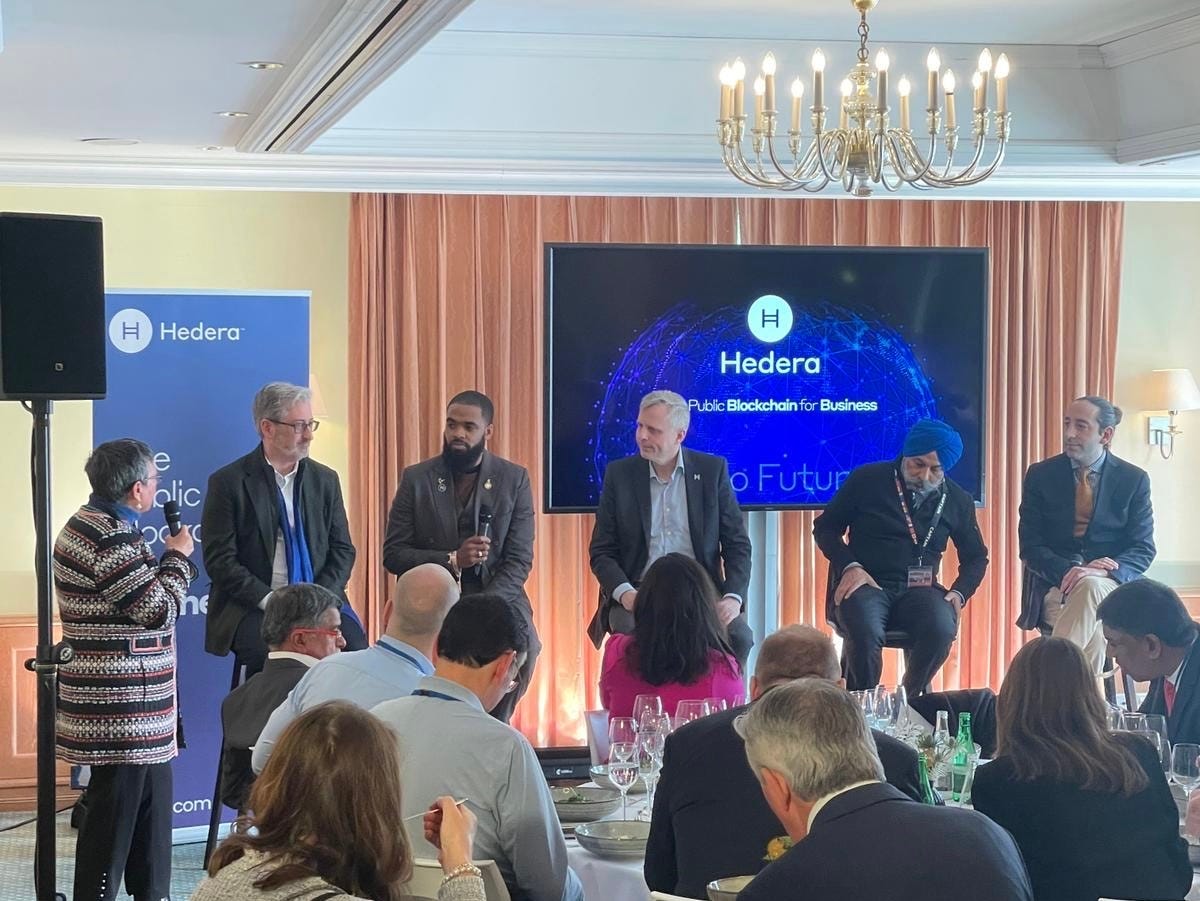
Luncheon panel on Using Blockchain to Govern Innovation: From AI to the Future of Money, moderated by Hedera board member Monique Morrow with panelists (L to R) David Shrier, Jamar Montgomery, Dr. Leemon Baird, Gurvinder Ahluwalia, and Jonathan Dotan

Tokenization, fueled by Web3 technologies, is revolutionizing the way we exchange value and interact within the digital realm. By leveraging blockchain-based solutions, individuals now have direct control over their digital assets, enabling secure and transparent transactions without intermediaries. This shift grants people sovereignty over their creative works, empowers communities to govern shared resources, and promotes economic inclusivity. From decentralized finance to non-fungible tokens (NFTs) certifying ownership of digital assets, tokenization is reshaping industries and democratizing access to opportunities in ways previously unimaginable.
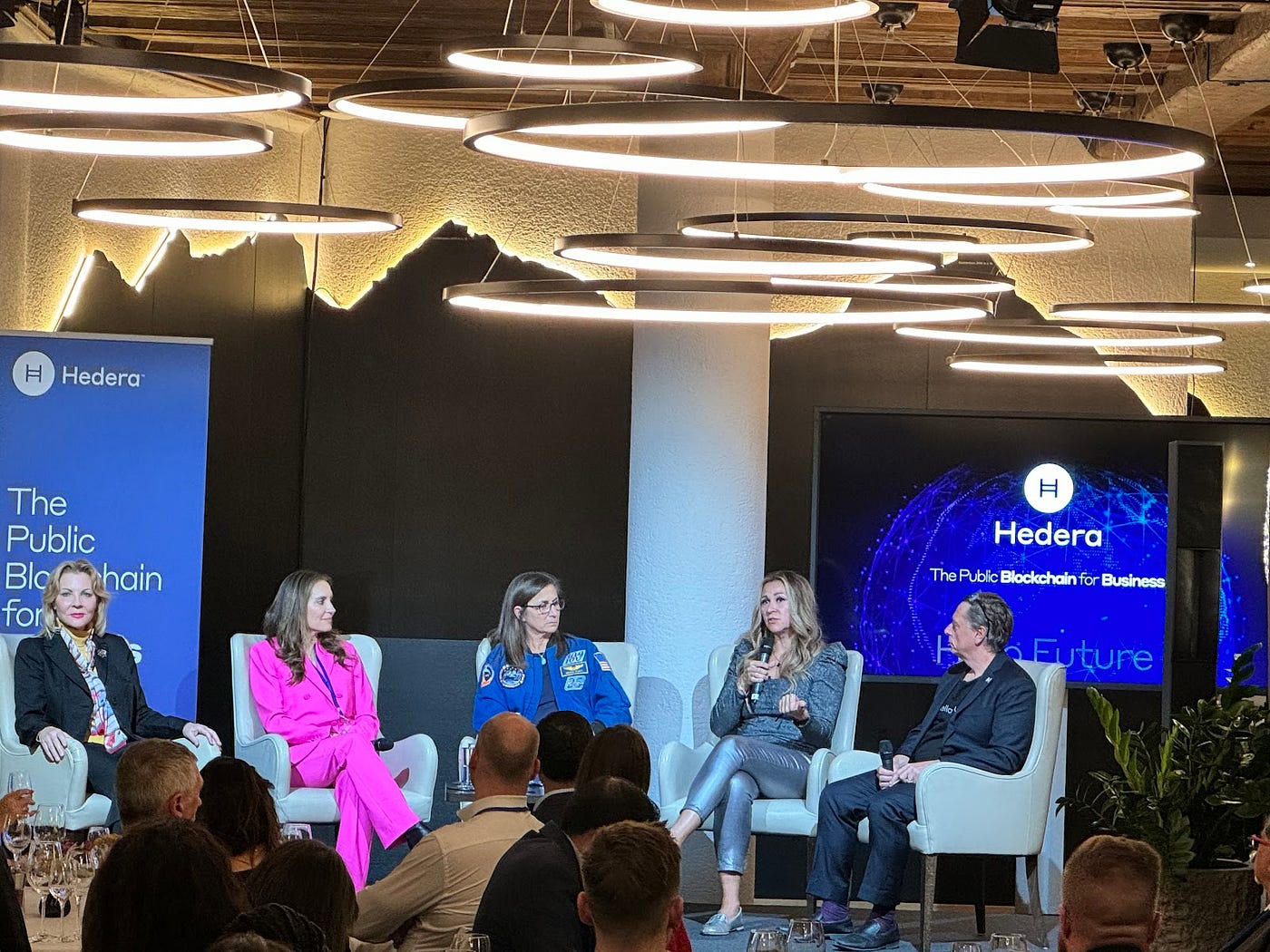
Dinner panel on Tokenizing Everything: From the Clothes on Your Back to Your Ticket to Space, moderated by Hedera board member Scott Thiel, with panelists (L to R) Shelli Brunswick, Sandra Campos, Nicole Stott and Christina Korp

The convergence of AI, DLT, tokenization, and Web3 brings significant opportunities for economic growth, societal advancement, and individual empowerment. However, we must also navigate the challenges that arise. Ethical considerations surrounding data usage, privacy, and algorithmic biases must remain at the forefront of our discussions. Ensuring the responsible development and deployment of these technologies requires collaborative efforts from policymakers, industry leaders, and society. It is imperative that we establish robust frameworks to protect individual rights, foster trust in emerging systems, and address the potential societal divides that may arise if equitable access to these technologies is not ensured.

As we witness the transformative power of AI, DLT, tokenization, and Web3, it is essential for us all to actively engage in shaping this new paradigm. Collaboration between governments, academia, industry, and civil society is vital to guide the development and application of these technologies in a manner aligned with our collective values. Education and upskilling initiatives must be prioritized to bridge the digital divide and ensure that all individuals can participate in the emerging digital economy. By embracing this paradigm shift, we can unlock the immense potential of these technologies for the betterment of humanity a profound “Hello Future!”

Finally, the convergence of AI, DLT, tokenization, and Web3 signifies a pivotal point in our technological evolution. This profound paradigm shift has the power to reshape our world, revolutionize industries, and empower individuals unlike ever before. By actively participating in the discourse surrounding the responsible and inclusive development of these technologies, we can harness their potential to address global challenges, foster equitable opportunities, and create a future that benefits us all. Let us embrace the promise of AI, DLT, tokenization, and Web3 with a steadfast commitment to building a more prosperous and inclusive world for humanity.

This is the art of the possible from WEF 2024 Davos!

Comments

All Comments

Recommended for you

  • American Bitcoin's Bitcoin reserves have increased by approximately 623 BTC in the past 7 days, bringing its current holdings to 4941 BTC.

    Emmett Gallic, a blockchain analyst who previously disclosed and analyzed the "1011 insider whale," posted on the X platform revealing updated data on the Bitcoin reserves of American Bitcoin, a crypto mining company supported by the Trump family. In the past seven days, they increased their holdings by about 623 BTC, of which approximately 80 BTC came from mining income and 542 BTC from strategic acquisitions in the open market. Currently, their total Bitcoin holdings have risen to 4,941 BTC, with a current market value of about 450 million USD.

  • The US spot Ethereum ETF saw a net outflow of $19.4 million yesterday.

    according to TraderT monitoring, the US spot Ethereum ETF had a net outflow of 19.4 million USD yesterday.

  • Listed companies, governments, ETFs, and exchanges collectively hold 5.94 million Bitcoins, representing 29.8% of the circulating supply.

    Glassnode analyzed the holdings of major types of Bitcoin holders as follows: Listed companies: about 1.07 million bitcoins, government agencies: about 620,000 bitcoins, US spot ETFs: about 1.31 million bitcoins, exchanges: about 2.94 million bitcoins. These institutions collectively hold about 5.94 million bitcoins, accounting for approximately 29.8% of the circulating supply, highlighting the trend of liquidity increasingly concentrating in institutions and custodians.

  • The Bank of Japan is reportedly planning further interest rate hikes; some officials believe the neutral interest rate will be higher than 1%.

    according to insiders, Bank of Japan officials believe that before the current rate hike cycle ends, interest rates are likely to rise above 0.75%, indicating that there may be more rate hikes after next week's increase. These insiders said that officials believe that even if rates rise to 0.75%, the Bank of Japan has not yet reached the neutral interest rate level. Some officials already consider 1% to still be below the neutral interest rate level. Insiders stated that even if the Bank of Japan updates its neutral rate estimates based on the latest data, it currently does not believe that this range will significantly narrow. Currently, the Bank of Japan's estimate for the nominal neutral interest rate range is about 1% to 2.5%. Insiders said that Bank of Japan officials also believe there may be errors in the upper and lower limits of this range itself. (Golden Ten)

  • OKX: Platform users can earn up to 4.10% annualized return by holding USDG.

    According to the official announcement, from 00:00 on December 11, 2025 to 00:00 on January 11, 2026 (UTC+8), users holding USDG in their OKX funding, trading, and lending accounts can automatically earn an annualized yield of up to 4.10% provided by the OKX platform, with the ability to withdraw or use it at any time, allowing both trading and wealth management simultaneously. Users can check their earnings anytime through the OKX APP (version 6.136.10 and above) - Assets - by clicking on USDG. Moving forward, the platform will continue to expand the application of USDG in more trading and wealth management scenarios.

  • The Federal Reserve will begin its Reserve Management Purchase (RMP) program today, purchasing $40 billion in Treasury bonds per month.

     according to the Federal Reserve Open Market Committee's decision on December 10, the Federal Reserve will start implementing the Reserve Management Purchase (RMP) program from December 12, purchasing a total of $40 billion in short-term Treasury securities in the secondary market.

  • Bitcoin treasury company Strategy's daily transaction volume has now surpassed that of payment giant Visa.

    according to market sources: the daily trading volume of Bitcoin treasury company Strategy (MSTR) has now surpassed the payment giant Visa.

  • The US spot Bitcoin ETF saw a net outflow of $78.35 million yesterday.

    according to Trader T's monitoring, the US spot Bitcoin ETF had a net outflow of $78.35 million yesterday.

  • JPMorgan Chase issues Galaxy short-term bonds on Solana network

     JPMorgan arranged and created, distributed, and settled a short-term bond on the Solana blockchain for Galaxy Digital Holdings LP, as part of efforts to enhance financial market efficiency using underlying cryptocurrency technology.

  • HSBC expects the Federal Reserve to refrain from cutting interest rates for the next two years.

    HSBC Securities predicts the Federal Reserve will maintain interest rates stable at the 3.5%-3.75% range set on Wednesday for the next two years. Previously, Federal Reserve policymakers lowered rates by 25 basis points with a split vote. The institution's U.S. economist Ryan Wang pointed out in a report on December 10 that Federal Reserve Chairman Jerome Powell was "open to the question of whether and when to further cut rates at next year's FOMC press conference." "We believe the FOMC will keep the federal funds rate target range unchanged at 3.50%-3.75% throughout 2026 and 2027, but as the economy evolves, as in the past, it is always necessary to pay close attention to the significant two-way risks facing this outlook."
