

Cointime

Download App
iOS & Android

The Hidden Force Driving DEX Volumes: High-Frequency Trading

Cointime Official

From sealaunch by sealaunch

Introduction

We analyzed High-Frequency Trading (HFT) activity on DEXs. In TradFi, HFT plays a crucial role in market efficiency, providing liquidity and narrowing spreads. But it has also raised concerns about market manipulation and unfair advantages. Now, HFT is becoming more prominent, affecting volume on DEXs.

Check the Dune Dashboard we created on this topic.For this analysis, we set a threshold of 1,000 transactions per day per address to define a HFT address. That’s about 1 transaction per minute over 16 waking hours. While lower than TradFi’s millions of transactions per day, this benchmark highlights significant, likely non-human activity.

Many of the topline metrics shared in respect to chains or DEXs rely on transaction volume or activity. Lower tx costs make it easier for HFT to inflate these metrics. This can skew our understanding of actual market behavior.This analysis is non-opinionated. It focuses on analysing addresses with over 1,000 transactions per day. Some of this activity is legitimate, like arbitrage. Other cases, like wash trading, might be less so. The goal is to add more context to DEX data.

HFT impact on DEXs across chains

On DEXs, HFT activity can be tied to several use cases, some of them are:- Airdrop farming- Arbitrage trading- Volume inflation (e.g., to appear on trending charts, especially for memecoins)- Wash tradingThe higher the throughput of a chain, the higher the HFT activity is expected to be. However, this activity should be characterized based on the diverse strategies employed.

HFT activity has grown significantly across both EVM chains and Solana. For months, it has accounted for around 20% of DEX volume across all chains (split between Solana and EVM chains). But recently, Solana has taken the lead. Most of the HFT-driven volume now happens there. In terms of trades, HFT activity on Solana represents 30% of trades across all DEXs in all chains and EVM chains represent 6%.
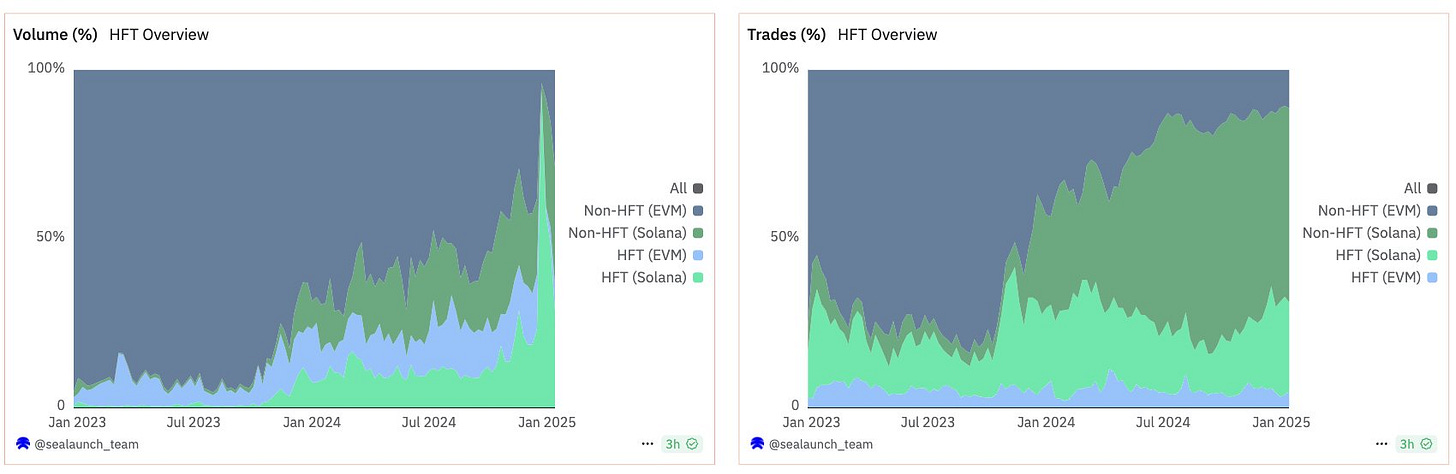
Source: @sealaunch on Dune

Analyzing the last 7 days, 8 of the top 10 HFT addresses by volume are on Solana. One example is GPsJvKbGWFw1kqjQzb7gVneBikC8QcWjgwxjCepFjbVh, which executed $8B in volume from 2,000 trades. Half of this volume ($4B) came from trading TRUMP.

Source: @sealaunch on Dune

In the last 7 days, the top 4 assets by HFT volume (SOL, USDC, TRUMP, USDT) are all on Solana. For example, TRUMP recorded $7B in volume from 629 HFT addresses. As noted earlier, $4B of this volume came from a single address. An exception is WETH on Base, which had $2.3B in volume driven by 293 HFT addresses over the same period.
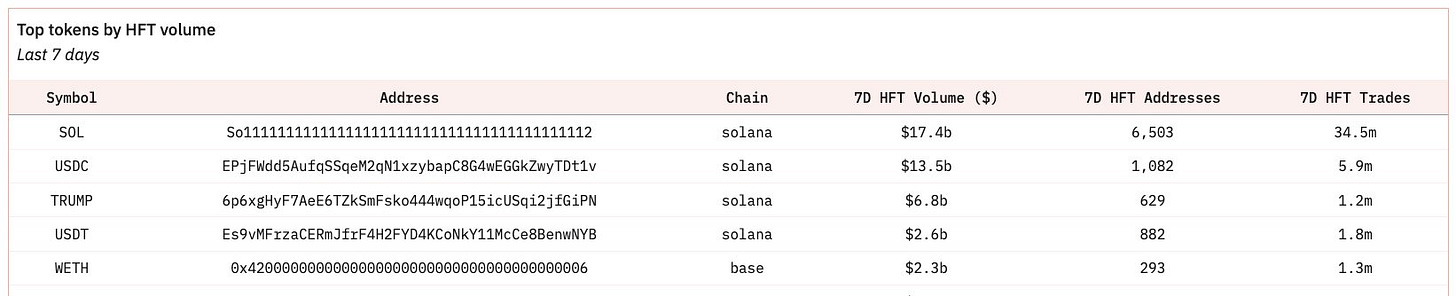
Source: @sealaunch on Dune

Looking at the last 7 days, the chains with the highest percentage of volume driven by HFT are:- Solana: 44% of total volume from HFT addresses.- On EVM, Linea leads with 46%, followed by Arbitrum at 40%.

Benchmarking 4 chains with significant DEX activity (Solana, Ethereum, Base, and Arbitrum), we see a clear trend:- HFT activity is growing across all chains, impacting both volume and trades.- The chain where HFT addresses represent more of the total volume is Solana, now accounting for ~50% of total volume, and in some weeks close to 70%.- On Base and Arbitrum, HFT’s impact is also increasing. HFT addresses represent ~35% of volume of these chains.- On Ethereum, HFT accounts for 15% of volume, as expected, Ethereum’s lower throughput and higher transaction costs act as barriers, limiting the scale of HFT compared to other chains.
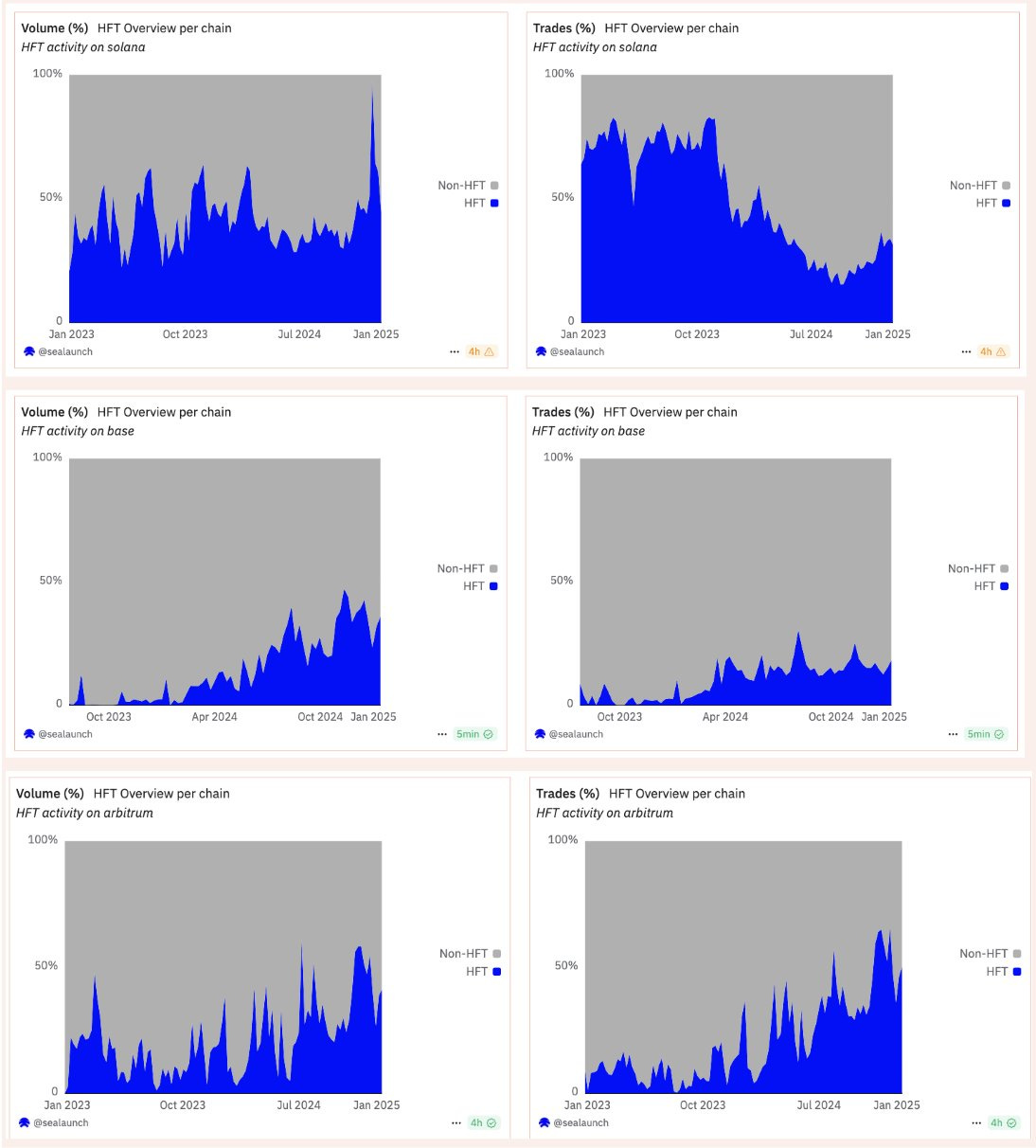
Source: @sealaunch on Dune

This analysis provides an initial overview of the influence of HFT on DEXs.Future analyses may delve deeper into:- Patterns of usage to understand how HFT strategies evolve over time.- Clusters of addresses to identify networks or entities behind HFT activity.- Categorization per LPs’ liquidity usage, focusing on whether HFT primarily targets low-liquidity pools or operates across deeper markets.


Comments

All Comments

Recommended for you

  • Circle minted 500 million USDC on the Solana network.

    according to Onchain Lens monitoring, Circle has minted 500 million USDC on the Solana network. Since October 11, Circle has issued a total of 18 billion USDC on the Solana network.

  • Sources familiar with the matter: JPMorgan Chase is considering offering cryptocurrency trading services to institutional clients.

    according to Bloomberg, as major global banks deepen their involvement in the cryptocurrency asset class, JPMorgan Chase is considering offering cryptocurrency trading services to its institutional clients. A knowledgeable source revealed that JPMorgan is evaluating what products and services its market division can offer to expand its business in the cryptocurrency field. The source stated that these products and services may include spot and derivatives trading.

  • Federal Reserve Governor Milan: We believe that the policy rate will eventually be lowered.

    Federal Reserve Board member Mylan stated that due to the US government shutdown, there were some anomalies in last week's inflation data; he believes that the US will not experience an economic recession in the near term, but if policies are not adjusted, the US will face an increasing risk of economic recession. We believe that policy interest rates will eventually be lowered.

  • BlackRock deposited 819.39 BTC, worth approximately $73.72 million, into Coinbase.

     according to Onchain Lens monitoring, BlackRock deposited 819.39 BTC into Coinbase, worth approximately 73.72 million USD.

  • Ghana passes law legalizing the use of cryptocurrency

    according to Bloomberg, the Ghanaian Parliament has approved a cryptocurrency legalization bill aimed at addressing the expanding use of cryptocurrencies in the country but the lack of regulation. According to Johnson Asiamah, Governor of the Bank of Ghana, the newly passed Virtual Asset Service Providers Act will facilitate the licensing of crypto platforms and the regulation of related activities.

  • CryptoQuant: Bitcoin network activity cools, market shows clear bearish signs.

    CryptoQuant published an analysis stating that the Bitcoin market continues to be in a bear market state, with multiple network indicators showing a significant cooling of activity. Data shows that the 30-day moving average of Bitcoin is below the 365-day moving average (-0.52%), and the bull-bear cycle indicator confirms the current bear market pattern. The number of network transactions has dropped from about 460,000 to about 438,000, fees have decreased from $233,000 to $230,000, and highly active addresses have reduced from 43.3K to 41.5K, all indicating reduced speculative activity and that the market is in a defensive phase.

  • ETH falls below $3,000

    the market shows that ETH has fallen below $3000, currently at $2999.5, with a 24-hour increase of 0.86%. The market is highly volatile, please manage your risks accordingly.

  • BTC breaks through $89,000

    market shows BTC breaking through $89,000, currently at $89,014.5, with a 24-hour increase of 0.85%. The market is highly volatile, please manage your risk accordingly.

  • F2Pool co-founder: Last year, 500 bitcoins were transferred in to confirm whether the private key had been leaked; hackers took 490 bitcoins.

    regarding the community's heated discussion about the 50 million USDT phishing attack, F2Pool co-founder Wang Chun tweeted, "Last year, I suspected that my private key was leaked. To confirm whether the address was really hacked, I transferred 500 bitcoins to that address. To my surprise, the hacker 'generously' only took 490 bitcoins, leaving me 10 bitcoins, enough for me to make a living."