


Introduction: From “Trading Tool” to “Capital Order”
In the history of financial systems, power has never been determined by simple buying and selling, but by the underlying structures that carry those transactions.
From the Amsterdam Stock Exchange in the 17th century to the modern Nasdaq, capital markets have always followed a core logic: whoever defines the rules of trading and controls the orchestration of liquidity occupies the top of the profit-distribution hierarchy.
However, in today’s DeFi landscape, although permissionless asset exchange has been achieved, the true “market structure” still remains in a primitive stage.
A vast number of liquidity providers inject capital into protocols, yet unknowingly assume extremely unfavorable risk-return dynamics. Due to the lack of sophisticated capital orchestration and risk-control systems, on-chain capital often drifts in a state of “random float.”
During bullish cycles, it fails to capture premium opportunities at maximum efficiency; during volatile markets, it suffers structural erosion.
This phenomenon reveals a deeper industry deficiency: on-chain finance lacks a true capital market infrastructure with institutional-grade efficiency.
The emergence of DexFV is intended to fill this gap.
We are not simply building a trading protocol—we are reconstructing, on blockchain, a foundational capital market system capable of supporting large-scale capital operations, automatically executing strategies, and enabling precise value distribution.
Chapter 1: Structural Diagnosis — The Root Causes of Profit Leakage in DeFi
To rebuild a market, one must first understand the fractures within the existing order. In today’s on-chain environment, the inefficiency of capital originates from three core contradictions:
1. The “Liquidity Island” Problem
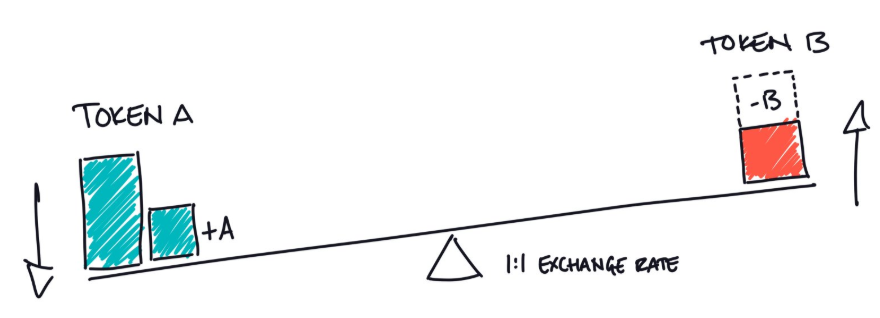
On-chain liquidity is currently scattered across thousands of isolated pools that do not communicate with one another. For capital, fragmentation translates into high opportunity costs and sunk costs. When an opportunity emerges on Chain A, idle capital on Chain B cannot perceive or participate in it in real time. This spatial dislocation leads to enormous efficiency loss.
2. The Game Between “Harvesters” and “Fuel”
Under the existing AMM (Automated Market Maker) mechanism, liquidity provided by ordinary users often becomes “fuel” for professional quantitative teams and arbitrage bots. This phenomenon, commonly referred to as LVR (Loss Versus Rebalancing), essentially arises from the absence of proactive protection mechanisms in the protocol. As a result, profits that should belong to liquidity providers are captured by technologically advantaged intermediaries.
3. The Absence of Deterministic Execution Logic
In traditional capital markets, every movement of capital is guided by clear strategies and bounded by strict risk controls. In contrast, most transactions in today’s Web3 ecosystem still remain at a primitive peer-to-peer level, lacking systematic capital orchestration. The core narrative of DexFV is to define order through algorithms, transforming on-chain capital from a passive harvesting target into an active market leader.
Chapter 2: DexFV’s Top-Level Architecture — The Co-Evolution of Five Core Systems
DexFV is not a single functional module but a highly integrated financial engineering system.
We deconstruct the operational logic of capital markets into five core subsystems, ensuring that every unit of liquidity functions at its most optimal position.
1. Modular Technical Foundation
This forms the neural infrastructure of DexFV. Through a highly scalable protocol architecture, we achieve atomic-level trade execution and cross-chain settlement. This allows DexFV to seamlessly integrate with any major public blockchain, becoming the “capital bus” for liquidity flows across the entire on-chain ecosystem.
2. Intelligent Liquidity Network
Unlike traditional passive liquidity pools, DexFV’s liquidity system is adaptive. It dynamically routes capital based on global market depth, buy-sell pressure, and volatility curves. Such real-time adjustments ensure that the market maintains extremely high capital efficiency at all times.
3. Value-Return Growth Engine
This system is designed around the concept of shared prosperity. DexFV believes that the growth dividends generated by markets should belong not to the platform, but to the contributors of the system. Through a precise algorithmic model, we reintegrate trading fees, market-making profits, and cross-chain premiums, directing them back to ecosystem participants.
4. Real-Time Dynamic Security System
In capital markets, security is not static defense—it is dynamic hedging. DexFV introduces a real-time risk engine that adjusts margin requirements dynamically and activates insurance pool hedging mechanisms. When black-swan events occur, the system can automatically trigger protective protocols to safeguard capital boundaries.
5. Decentralized Governance Network
The long-term evolution of markets cannot depend on a single authority. DexFV’s governance system grants core token holders decision-making power over protocol parameters, asset listings, and strategic upgrades—ensuring that the system continues to represent the interests of its broadest participant base.
Chapter 3: The Efficiency Revolution — Algorithm-Driven Autonomous Finance
The progress of finance is essentially a migration of decision-making power from human intuition to the rationality of code. The breakthrough of DexFV’s core engine lies in its automated capital orchestration logic.
1. Hybrid Trading Model
DexFV integrates the precision of limit order books with the automation of AMM mechanisms. Within the DexFV ecosystem, users experience trading depth comparable to centralized exchanges, while liquidity providers benefit from algorithm-optimized price execution. This hybrid model significantly compresses spread loss and enhances overall market efficiency.
2. Proactive Yield Capture
DexFV does not simply wait for trades to occur. Its built-in algorithmic engine continuously scans for arbitrage opportunities across protocols and blockchains. Once profitable opportunities are identified, the system automatically deploys idle capital to capture them. This proactive capability transforms DexFV into a 24-hour capital appreciation network.
3. Precision Capital Allocation
Through an AI-driven orchestration hub, the system automatically allocates capital according to liquidity tiers and risk weights of different assets. This precision ensures that capital does not accumulate in low-yield zones nor become excessively exposed in high-risk environments.
Chapter 4: The Value Loop — Restoring Sovereignty to Capital
In the world of DexFV, value no longer flows into opaque black boxes. Instead, it forms a transparent and complete economic loop.
1. The Ultimate Form of Asset Ownership
All capital flows, strategy executions, and profit distributions occur entirely on-chain. No centralized institution can misappropriate funds, and no hidden manipulation can alter outcomes. Code is law, and within DexFV this principle is implemented in its most rigorous form.
2. Deflationary Mechanism and Value Anchoring
To ensure long-term ecosystem health, DexFV introduces a buyback and deflation mechanism backed by real protocol revenue. Every unit of market profit generated through the DexFV system partially converts into support for the ecosystem token. This mechanism ensures that token value is no longer driven purely by sentiment, but by the prosperity of the entire on-chain capital market.
3. Self-Reinforcing Growth Structure
As more capital enters the DexFV system, market depth increases, attracting more traders. Higher trading volume generates greater protocol revenue, which further strengthens participant incentives. This self-reinforcing cycle is the fundamental engine behind DexFV’s continuous expansion.
Chapter 5: The Node Class — Builders and Partners of the On-Chain Capital Market
DexFV advocates a financial participation model centered on sovereignty restoration. In traditional systems, participants are merely customers who pay transaction fees. Within the DexFV ecosystem, however, becoming a node allows participants to leap directly into the role of capital market operating partners.
- Distribution Rights Nodes gain direct access to DexFV’s profit distribution layer, sharing the foundational revenue generated by global capital flows.
- Governance Rights Participants are no longer passive recipients of rules; through the governance network, they directly participate in defining the future direction of the market.
- Compounded Growth As early builders of the system, nodes benefit from both network-wide trading tax distribution and governance privileges, enabling long-term returns that go far beyond simple trading profits.
Conclusion: Defining the Financial Infrastructure of the Next Era
Every evolution of financial cycles is fundamentally a search for more efficient forms of value distribution. From banks to exchanges, from early DeFi protocols to DexFV today, the direction of evolution has always been the same: greater transparency, higher efficiency, and fairer participation. What DexFV is doing is returning the “control of markets”—once monopolized by a small number of institutions—to every participant through code and algorithms. We are not merely participating in a digital experiment. We are establishing a new operational standard for capital. When capital can move freely, securely, and efficiently across global on-chain markets; when every participant can fairly share the premium created by technology; when finance relies no longer on trust in intermediaries but on the inevitability of mathematics—that will be the moment when the DexFV vision is fully realized.
Join DexFV. We are not just predicting the future—we are rewriting every line of code that will define the capital markets of tomorrow.



All Comments