

Cointime

Download App
iOS & Android

Tether CEO’s MiCA concerns, Buterin to ‘Purge’ Ethereum inefficiencies: Finance Redefined

Cointime Official

From cointelegraph by Zoltan Vardai

Concerns are mounting over the implications of Europe’s upcoming crypto regulatory bill. Despite being a significant step forward for the industry, the European framework poses significant banking risks for stablecoin issuers, Tether CEO Paolo Ardoino told Cointelegraph.

In the wider crypto space, Vitalik Buterin outlined his plan to reduce Ethereum’s data bloat and simplify the overall protocol as part of his plans called “The Purge,” aiming to create more efficiency in the world’s second-largest blockchain network.

EU MiCA rules pose “systemic” banking risks for stablecoins — Tether CEO

Europe’s forthcoming regulatory framework will introduce banking concerns for stablecoin issuers that could threaten the stability of the broader crypto space, according to Paulo Ardoino.

The Markets in Crypto-Assets Regulation (MiCA) is the first comprehensive regulatory framework for the crypto industry and is set to go into full effect on Dec. 30. Under MiCA, stablecoin issuers will be required to hold at least 60% of reserve assets in European banks.

Considering that banks can loan up to 90% of their reserves, this may introduce “systemic risks” for stablecoin issuers, according to Ardoino, CEO of Tether — the issuer of the world’s largest stablecoin, USDt USDT$0.999 which recently surpassed $120 billion in market capitalization.

Ardoino shared his concerns with Cointelegraph during an interview at Plan B Lugano in Switzerland:

“If you have 10 billion euros under management, you have to put 6 billion euros in cash deposits. That is 60% of 10 billion euros. We know that banks can lend out 90% of their balance sheet. So of the 6 billion euros, they lend out 5.4 billion euros to people […] 600 million euros will remain in the bank balance sheet.”

Tether’s Paolo Ardoino, interview with Cointelegraph’s Zoltan Vardai, clip 1. Source: YouTube

Continue reading

The “Purge” — Vitalik’s plan to reduce Ethereum’s bloat

Vitalik Buterin, co-founder of Ethereum, has released the fifth part of his blog series on the blockchain network’s future path titled “The Purge,” which aims to reduce data bloat and simplify Ethereum’s protocol.

The Purge focuses on trimming unnecessary data storage and eliminating outdated features to make Ethereum more efficient while preserving “the permanence” of the blockchain.

The Purge is not set to directly impact Ethereum’s gas fees. However, the proposed changes may enhance network performance and reduce operating costs.

Continue reading

Radiant Capital $58 million hack an expensive “lesson” for DeFi

Radiant Capital resumed its Ethereum lending markets after a hack that cost about $58 million in digital assets. 

On Nov. 1, the lending protocol said it had implemented improvements, including transferring ownership into a timelock contract. The Radiant Capital team said this enforces a mandatory 72-hour waiting period for any adjustments, fortifying Radiant’s security. 

The team also implemented an emergency admin role using a multisignature structure. The role is tasked with pausing and unpausing the lending protocol’s markets as necessary. 

Continue reading

Crypto surges in Eastern Europe: DeFi drives 33% of transactions

Decentralized finance-related activity is increasing in Eastern Europe, showcasing continued cryptocurrency adoption, according to the onchain analytics platform Chainalysis.

Eastern Europe received over $499 billion worth of cryptocurrency between July 2023 and June 2024.

Decentralized finance (DeFi) activity accounted for a third of the region’s crypto value flow, totaling more than $165 billion, according to the Oct. 30 Chainalysis crypto adoption report.

Continue reading

Solana flips Ethereum in daily fees, surpasses $2.5 million in 24 hours

Solana has surpassed Ethereum in daily network fee generation, indicating growing user activity on the world’s third-largest blockchain.

Solana generated over $2.54 million worth of fees in 24 hours, surpassing Ethereum’s $2.07 million on Oct. 28 — making Solana the fifth-largest fee-generating protocol in the crypto space, according to DefiLlama data.

Solana’s soaring fees are correlated with growing trading activity on its leading decentralized exchange (DEX), Raydium, which generated over $3.41 million worth of fees on the Solana blockchain in 24 hours.

Continue reading

DeFi market overview

According to data from Cointelegraph Markets Pro and TradingView, most of the 100 largest cryptocurrencies by market capitalization ended the week in the red.

Of the top 100, the Celestia TIA$4.50 token fell over 19% as the week’s biggest loser, followed by the Immutable IMX$1.07 token down 19% over the past week.
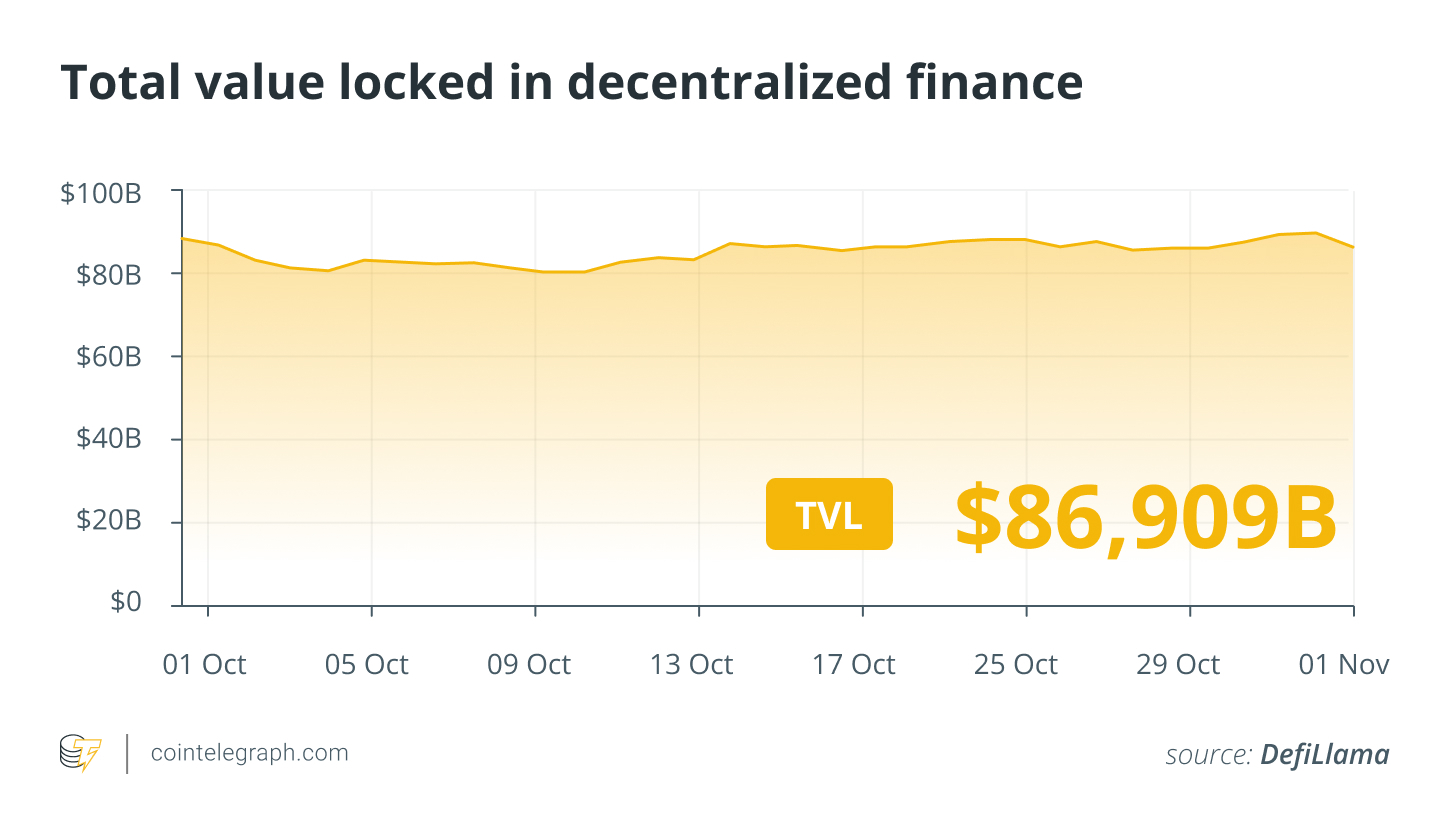
Total value locked in DeFi. Source: DefiLlama

Thanks for reading our summary of this week’s most impactful DeFi developments. Join us next Friday for more stories, insights and education regarding this dynamically advancing space.


Comments

All Comments

Recommended for you

  • BTC Surpasses $76,000

    Market data shows that BTC has surpassed $76,000, currently priced at $76,039.83, with a 24-hour increase of 1.67%. The market is highly volatile, so please ensure proper risk management.

  • Trump: Bombs Will Explode if Ceasefire Agreement Expires

    On April 20, according to PBS, U.S. President Trump stated on Monday that if the ceasefire agreement with Iran expires on Tuesday, there will be a large number of bombs exploding. Trump made this remark during a call with White House reporter Liz Landers, focusing on the issue of the Iran war, while a U.S. delegation was preparing for further peace negotiations. When asked whether Iran would still participate in the talks scheduled to take place in Islamabad, Trump replied, "I don't know. I mean, they should show up. It's arranged. We'll see if they come. If they don't, that's fine too." When asked about his expectations for the negotiations, Trump stated, "Very simple, Iran absolutely cannot have nuclear weapons."

  • U.S. Vice President Vance and Delegation to Arrive in Islamabad Today

    On April 20, according to the New York Post: U.S. Vice President Vance and the American delegation will arrive in Islamabad today.

  • BitMine Increases ETH Holdings by Over 100,000, Total Holdings Exceed 4.97 Million ETH

    As of April 19, Eastern Time, BitMine's total cryptocurrency and cash holdings, including the 'Moon Landing Plan,' amount to $12.9 billion. BitMine holds 4,976,485 ETH (an increase of 101,627 ETH from last week), which represents 4.12% of the total Ethereum supply of 120.7 million ETH. Additionally, it holds 199 BTC, shares in Beast Industries worth $200 million, $107 million in Eightco Holdings (NASDAQ: ORBS), and $1.12 billion in unsecured cash. As of April 20, 2026, the total amount of staked ETH by BitMine is 3,334,637 ETH, valued at $7.7 billion based on a price of $2,301 per ETH.

  • Strategy Acquires 34,164 Bitcoins for $2.54 Billion Last Week

    On April 20, Strategy purchased 34,164 Bitcoins last week for a total of approximately $2.54 billion, at a unit price of about $74,395, achieving a 9.5% return on Bitcoin from 2026 to date. As of April 19, 2026, Strategy holds a total of 815,061 Bitcoins, valued at approximately $61.56 billion, with a unit price of about $75,527.

  • Binance Wallet to Launch 46th TGE Project OpenGradient (OPG)

    On April 20, Binance Wallet will launch the 46th exclusive TGE project OpenGradient (OPG). The subscription period is from April 21, 17:00 to 19:00 (UTC+8), and users must participate using Binance Alpha Points and meet the corresponding qualifications. According to the official announcement, OPG tokens will be available for collection and trading starting at 19:00 (UTC+8) on the same day. Additionally, 23,000,000 OPG tokens are reserved for future activities, with specific rules to be announced later.

  • CoinShares: $1.4 Billion Inflows into Digital Asset Investment Products Last Week

    On April 20, CoinShares reported that inflows into digital asset investment products reached $1.4 billion last week, marking the highest weekly inflow since January and achieving positive growth for the third consecutive week. Bitcoin saw inflows of $1.116 billion, bringing the total inflows for the year to $3.1 billion. The price of Bitcoin has surpassed the $76,000 mark, indicating a significant technical breakthrough after two months of range-bound trading. In contrast, inflows into Bitcoin short products were only $1.4 million, suggesting that while there is still hedging demand, it remains limited. Ethereum attracted $328 million in inflows, the strongest week since January, bringing its total inflows for the year to $197 million, while XRP and Solana recorded outflows of $56 million and $2.3 million, respectively.

  • Sources: Bank of Japan Unlikely to Raise Interest Rates in April Meeting

    On April 20, sources familiar with the Bank of Japan's thinking revealed that the central bank is unlikely to raise interest rates next week. The diminishing hope for a swift end to the Middle East conflict has left Japan's economic and price outlook fraught with uncertainty. Although the final decision still carries some uncertainty and will depend on the progress of peace negotiations between the U.S. and Iran, the sources indicated that the bank prefers to maintain the status quo this month to allow more time to assess the impact of the conflict. One source stated, 'Given the current level of uncertainty, the Bank of Japan may consider it feasible to hold steady this month.' Another source echoed this sentiment. A third source noted that the Bank of Japan is unlikely to raise rates, as the market has already fully priced in the possibility of no rate hike this month. These sources mentioned that even if the Bank of Japan keeps rates unchanged next week, it is likely to signal readiness to raise rates as early as June, given the escalating inflationary pressures.

  • Hong Kong SFC Announces New Regulatory Framework for Trading Tokenized Investment Products in Secondary Market

    On April 20, the Hong Kong Securities and Futures Commission (SFC) announced a new regulatory framework to promote the trading of tokenized investment products recognized by the SFC in the secondary market, aiming to enhance digital asset trading activities in Hong Kong and support the further development of the ecosystem. The first batch of products is expected to primarily consist of tokenized money market funds. The SFC will review the operation of these products and will consider expanding the range of products in due course.

  • Hackers impersonated eth.limo team to hijack its domain: Post-mortem

    EasyDNS CEO Mark Jeftovic said the social engineering attack was highly sophisticated and the company is conducting further investigation to determine how the breach occurred.