

Cointime

Download App
iOS & Android

SIMD-228: A Game Changer or a Threat to Stakers

Cointime Official

From CoinShares Research Blog by Max Shannon

SIMD-228: An Overview

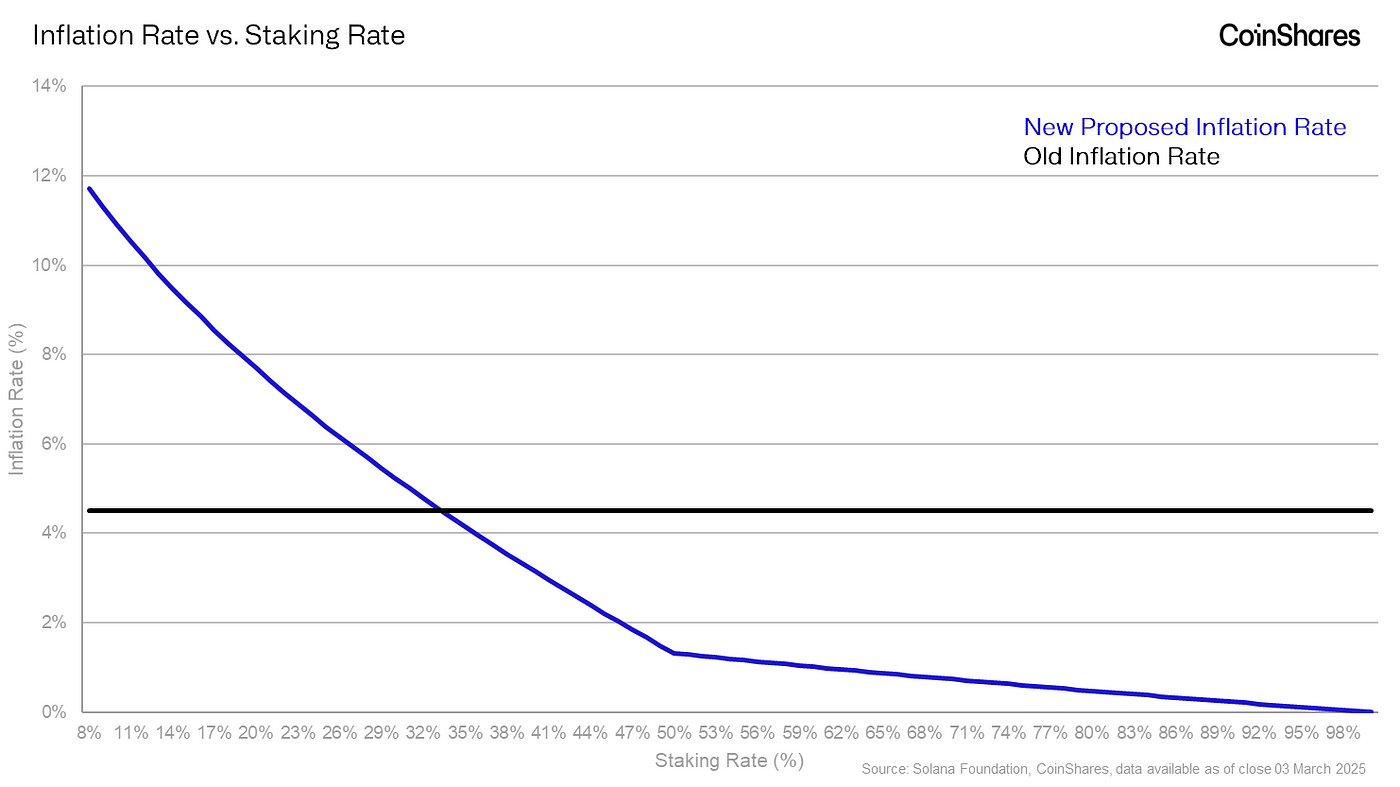
SIMD-228 is a proposal designed to have a dynamic inflation rate, set by the percentage of the circulating supply that is staked, as opposed to having a static inflation rate.

Understanding the Proposed Inflation Adjustments

It is based on the premise that the current inflation model — 4.5% and decreasing by 15% annually until reaching 1.5% — remains too high and requires adjustment. The proposal seeks to make the inflation rate more adaptive, using a target staking ratio as a key determinant.
Voting Timeline and Implementation

The vote is scheduled for 7th March; however, if the vote passes, implementation may take around 100 days (50 Epochs) due to a careful rollout of a change of this magnitude.

Arguments in Favour of SIMD-228

Supporters of SIMD-228 argue that the potential drawbacks — such as greater centralisation due to reduced staking profitability and heightened security risks during bear markets — are outweighed by its benefits. These advantages include increased DeFi activity driven by a lower ecosystem risk-free rate (staking yield), which reduces the hurdle rate for applications like lending and borrowing to generate returns. Additionally, lower daily token emissions decrease selling pressure, thereby enhancing the asset’s attractiveness.

The prevailing sentiment among proponents is that while the proposal is not perfect, it represents a step in the right direction and can be refined over time. Many concerns have been addressed with the argument that perfection should not hinder progress — incremental improvements are preferable to maintaining the status quo.

Furthermore, the recent implementation of SIMD-96, which sent 100% of all priority fees to validators (instead of 50% burned) reduced Solana’s burn rate to approximately 1%, has led to an increase in inflation. This makes SIMD-228 even more appealing as a mechanism to counterbalance this effect.

Arguments Against SIMD-228

Opponents of SIMD-228 are primarily smaller stakers who may experience a reduction in their staking rewards. Based on total revenues, the proportion of revenues derived from emissions, and voting costs, it is highly probable that at least 100 smaller validators could exit the network, according to sources in the industry. Institutional staking service providers, which generate the highest revenues under the current staking model, are also likely to oppose the proposal due to concerns over reduced staking profitability and its potential impact on network decentralisation.

Key Takeaways

  • What? SIMD-228 proposes a dynamic inflation model for SOL, adjusting the rate based on market conditions.
  • Why? The current inflation trajectory is considered too high and insufficiently responsive to market dynamics.
  • Who favours? DeFi community and investors seeking reduced token emissions.
  • Who opposes? Solo stakers and large institutional validators reliant on high staking revenues.
  • When? Voting occurs on 7th March, though implementation could take months.
(written by Luke Nolan and Max Shannon)


Comments

All Comments

Recommended for you

  • ETH breaks $3,000

     the market shows ETH breaking through $3000, currently at $3000.08, with a 24-hour decline of 0.38%. The market is highly volatile, please manage your risk accordingly.

  • Binance Wallet launches "secure auto-signature" service

     according to the official announcement, Binance Wallet has launched the "Secure Auto Sign" (SAS) service: it now supports mnemonic/private key wallets to trade on Binance Wallet (web version).

  • Circle minted 500 million USDC on the Solana network.

    according to Onchain Lens monitoring, Circle has minted 500 million USDC on the Solana network. Since October 11, Circle has issued a total of 18 billion USDC on the Solana network.

  • Sources familiar with the matter: JPMorgan Chase is considering offering cryptocurrency trading services to institutional clients.

    according to Bloomberg, as major global banks deepen their involvement in the cryptocurrency asset class, JPMorgan Chase is considering offering cryptocurrency trading services to its institutional clients. A knowledgeable source revealed that JPMorgan is evaluating what products and services its market division can offer to expand its business in the cryptocurrency field. The source stated that these products and services may include spot and derivatives trading.

  • Federal Reserve Governor Milan: We believe that the policy rate will eventually be lowered.

    Federal Reserve Board member Mylan stated that due to the US government shutdown, there were some anomalies in last week's inflation data; he believes that the US will not experience an economic recession in the near term, but if policies are not adjusted, the US will face an increasing risk of economic recession. We believe that policy interest rates will eventually be lowered.

  • BlackRock deposited 819.39 BTC, worth approximately $73.72 million, into Coinbase.

     according to Onchain Lens monitoring, BlackRock deposited 819.39 BTC into Coinbase, worth approximately 73.72 million USD.

  • Ghana passes law legalizing the use of cryptocurrency

    according to Bloomberg, the Ghanaian Parliament has approved a cryptocurrency legalization bill aimed at addressing the expanding use of cryptocurrencies in the country but the lack of regulation. According to Johnson Asiamah, Governor of the Bank of Ghana, the newly passed Virtual Asset Service Providers Act will facilitate the licensing of crypto platforms and the regulation of related activities.

  • CryptoQuant: Bitcoin network activity cools, market shows clear bearish signs.

    CryptoQuant published an analysis stating that the Bitcoin market continues to be in a bear market state, with multiple network indicators showing a significant cooling of activity. Data shows that the 30-day moving average of Bitcoin is below the 365-day moving average (-0.52%), and the bull-bear cycle indicator confirms the current bear market pattern. The number of network transactions has dropped from about 460,000 to about 438,000, fees have decreased from $233,000 to $230,000, and highly active addresses have reduced from 43.3K to 41.5K, all indicating reduced speculative activity and that the market is in a defensive phase.

  • ETH falls below $3,000

    the market shows that ETH has fallen below $3000, currently at $2999.5, with a 24-hour increase of 0.86%. The market is highly volatile, please manage your risks accordingly.