

Cointime

Download App
iOS & Android

Sending Bitcoin to Mars is now theoretically possible: Researchers

There is apparently a way to get Bitcoin from Earth to Mars in as little as three minutes using already-available technology. We just need someone, or something, to receive it. 

Late last month, tech entrepreneur Jose E. Puente and his colleague, Carlos Puente, published a white paper unveiling Proof-of-Transit Timestamping — a concept he told Cointelegraph is the missing piece needed to make Bitcoin interplanetary. 

The concept suggests that when a Bitcoin user wants to send a payment to Mars in the future, the transaction could hop from the user through different stations, such as ground antennas, satellites, or even a relay around the Moon. 

At each stop, the transaction is “stamped” before continuing until it reaches its destination. 

Speaking to Cointelegraph, Puente said PoTT serves as the “receipt layer” on Bitcoin and the Lightning Network while leveraging optical links built by the National Aeronautics and Space Administration, Elon Musk’s Starlink, or another satellite provider.

“The technology is essentially ready. The moment there’s a stable Earth–Mars link, PoTT can ride on top, making Bitcoin the first currency to operate cleanly across planets,” he said. 

“By simulating Mars-level delays, we could run a convincing end-to-end demo right now.”
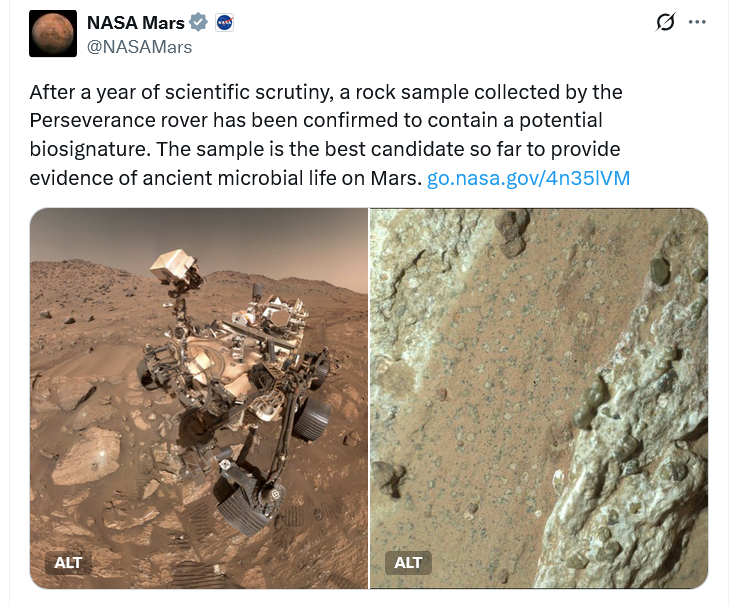
  A NASA rover recently came across some rocks on Mars that might be evidence of past life. Source: NASA Mars


When up and running, Puente said Bitcoin Lightning transfers could reach Mars in as little as three minutes, or as long as 22 minutes in a worst-case scenario. 

Addressing the two-week blackout period on Mars that occurs every 26 or so months, Puente said a solution could “deliberately route around the Sun with relay satellites” to avoid the blackout.

PoTT is like ordinary Bitcoin timestamping except that it can extend to outer space and beyond, Puente explained.

“Imagine it’s 2050 and you’re sending money from Earth to your friend on Mars to help pay for their rent. Because the planets are so far apart, the message has to hop through different stations.”

“At each stop, that station stamps the message with the time it arrived and the time it left, like a passport getting stamped at every border crossing. By the time the message gets to Mars, you can look at all the stamps and see the exact path it took and when it moved.”

Puente said PoTT could be tested today.

Bitcoin has already made it to outer space

The concept builds on Blockstream’s work in December 2018, when it connected Bitcoin to five satellites to make outer space Bitcoin transactions possible. Then, in August 2020, Spacechain completed what it said was the first Bitcoin transaction from the International Space Station, showcasing that Bitcoin ,090can be received away from Earth.

Of course, for a Bitcoin transaction to occur on Mars, a human — or an AI — would need to be there, and that hasn’t happened yet. Only landers, orbiters and rovers from NASA and other space agencies have explored Mars thus far.

There would need to be someone there willing to accept Bitcoin, too. The Jeff Bezos-founded Blue Origin started accepting crypto — including Bitcoin, Ether , Solana, and stablecoins Tether and USDC — last month, but so far they’ve only made it past the Kármán line, about 100 kilometers from Earth.

Musk also agrees that a standard money is needed

Musk’s SpaceX is looking to reach Mars by the end of 2026 with a long-term ambition to build a self-sustaining city there.

Like Puente, Musk agrees that a standard money is needed to transact between Earth and Mars. He previously expressed concern over Bitcoin’s 10-minute block times, but that’s where the Lightning Network comes into play, Puente said.

“PoTT plus Lightning provide the practicality Musk asked for: local speed with global settlement that works across planets.”

After initially dismissing Bitcoin as a solution last January, he eventually agreed that interplanetary payments could be more feasible through the Lightning Network.
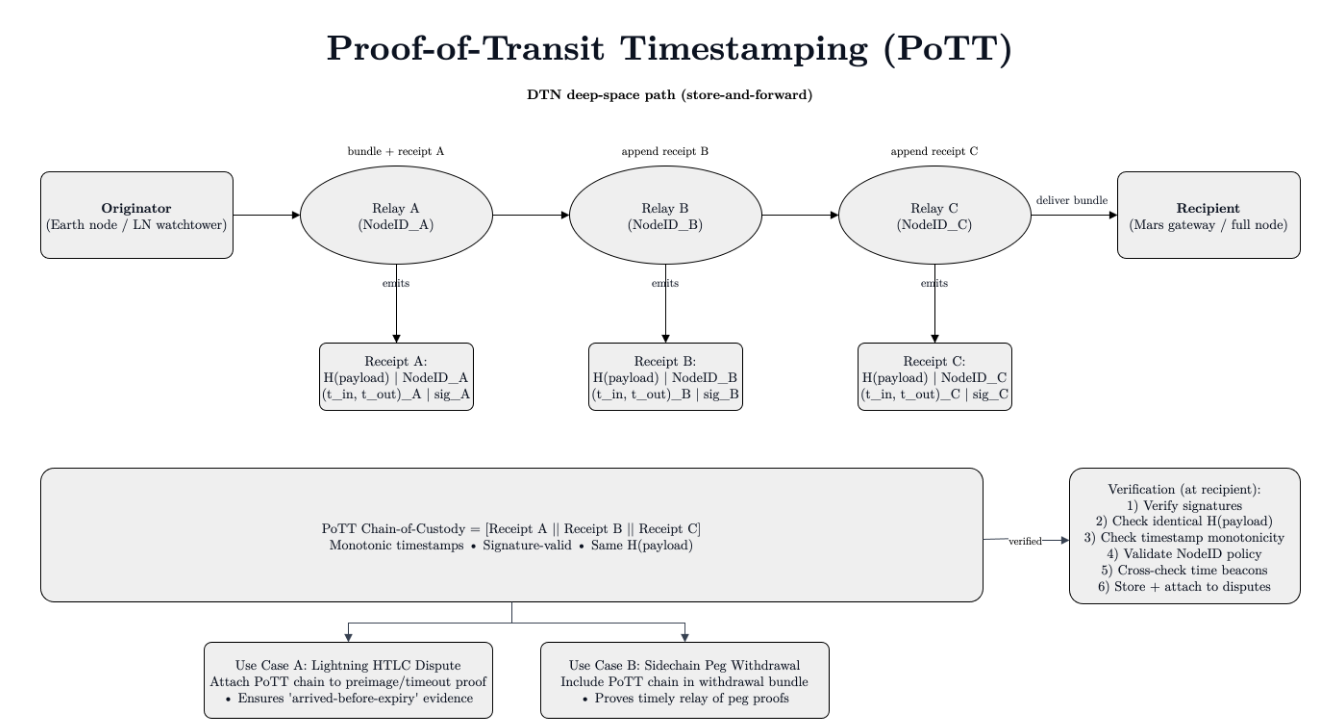
  Diagram showing how PoTT would facilitate a Bitcoin transaction sent from Earth to Mars. Source: arXiv


“If we’re serious about a multi-planet civilization, we need an open, neutral monetary base that doesn’t depend on any single company, government, or ground station,” Puente said, making his case for Bitcoin as the most appropriate interplanetary currency.

“That’s why we focused on Bitcoin as the shared standard and designed PoTT as a practical way to move value across vast distances while preserving accountability and individual agency.”

PoTT is built for all planets

Puente noted that PoTT was built to be planet-agnostic across a star’s habitable zone, meaning the “travel receipts” it generates could be reached from transactions sent to the Moon or any other planet.

He said the research  just focused on Earth and Mars as it is the “cleanest near-time case study.”

Comments

All Comments

Recommended for you

  • American Bitcoin's Bitcoin reserves have increased by approximately 623 BTC in the past 7 days, bringing its current holdings to 4941 BTC.

    Emmett Gallic, a blockchain analyst who previously disclosed and analyzed the "1011 insider whale," posted on the X platform revealing updated data on the Bitcoin reserves of American Bitcoin, a crypto mining company supported by the Trump family. In the past seven days, they increased their holdings by about 623 BTC, of which approximately 80 BTC came from mining income and 542 BTC from strategic acquisitions in the open market. Currently, their total Bitcoin holdings have risen to 4,941 BTC, with a current market value of about 450 million USD.

  • The US spot Ethereum ETF saw a net outflow of $19.4 million yesterday.

    according to TraderT monitoring, the US spot Ethereum ETF had a net outflow of 19.4 million USD yesterday.

  • Listed companies, governments, ETFs, and exchanges collectively hold 5.94 million Bitcoins, representing 29.8% of the circulating supply.

    Glassnode analyzed the holdings of major types of Bitcoin holders as follows: Listed companies: about 1.07 million bitcoins, government agencies: about 620,000 bitcoins, US spot ETFs: about 1.31 million bitcoins, exchanges: about 2.94 million bitcoins. These institutions collectively hold about 5.94 million bitcoins, accounting for approximately 29.8% of the circulating supply, highlighting the trend of liquidity increasingly concentrating in institutions and custodians.

  • The Bank of Japan is reportedly planning further interest rate hikes; some officials believe the neutral interest rate will be higher than 1%.

    according to insiders, Bank of Japan officials believe that before the current rate hike cycle ends, interest rates are likely to rise above 0.75%, indicating that there may be more rate hikes after next week's increase. These insiders said that officials believe that even if rates rise to 0.75%, the Bank of Japan has not yet reached the neutral interest rate level. Some officials already consider 1% to still be below the neutral interest rate level. Insiders stated that even if the Bank of Japan updates its neutral rate estimates based on the latest data, it currently does not believe that this range will significantly narrow. Currently, the Bank of Japan's estimate for the nominal neutral interest rate range is about 1% to 2.5%. Insiders said that Bank of Japan officials also believe there may be errors in the upper and lower limits of this range itself. (Golden Ten)

  • OKX: Platform users can earn up to 4.10% annualized return by holding USDG.

    According to the official announcement, from 00:00 on December 11, 2025 to 00:00 on January 11, 2026 (UTC+8), users holding USDG in their OKX funding, trading, and lending accounts can automatically earn an annualized yield of up to 4.10% provided by the OKX platform, with the ability to withdraw or use it at any time, allowing both trading and wealth management simultaneously. Users can check their earnings anytime through the OKX APP (version 6.136.10 and above) - Assets - by clicking on USDG. Moving forward, the platform will continue to expand the application of USDG in more trading and wealth management scenarios.

  • The Federal Reserve will begin its Reserve Management Purchase (RMP) program today, purchasing $40 billion in Treasury bonds per month.

     according to the Federal Reserve Open Market Committee's decision on December 10, the Federal Reserve will start implementing the Reserve Management Purchase (RMP) program from December 12, purchasing a total of $40 billion in short-term Treasury securities in the secondary market.

  • Bitcoin treasury company Strategy's daily transaction volume has now surpassed that of payment giant Visa.

    according to market sources: the daily trading volume of Bitcoin treasury company Strategy (MSTR) has now surpassed the payment giant Visa.

  • The US spot Bitcoin ETF saw a net outflow of $78.35 million yesterday.

    according to Trader T's monitoring, the US spot Bitcoin ETF had a net outflow of $78.35 million yesterday.

  • JPMorgan Chase issues Galaxy short-term bonds on Solana network

     JPMorgan arranged and created, distributed, and settled a short-term bond on the Solana blockchain for Galaxy Digital Holdings LP, as part of efforts to enhance financial market efficiency using underlying cryptocurrency technology.

  • HSBC expects the Federal Reserve to refrain from cutting interest rates for the next two years.

    HSBC Securities predicts the Federal Reserve will maintain interest rates stable at the 3.5%-3.75% range set on Wednesday for the next two years. Previously, Federal Reserve policymakers lowered rates by 25 basis points with a split vote. The institution's U.S. economist Ryan Wang pointed out in a report on December 10 that Federal Reserve Chairman Jerome Powell was "open to the question of whether and when to further cut rates at next year's FOMC press conference." "We believe the FOMC will keep the federal funds rate target range unchanged at 3.50%-3.75% throughout 2026 and 2027, but as the economy evolves, as in the past, it is always necessary to pay close attention to the significant two-way risks facing this outlook."
