

From Safe by Safe 0x3F62
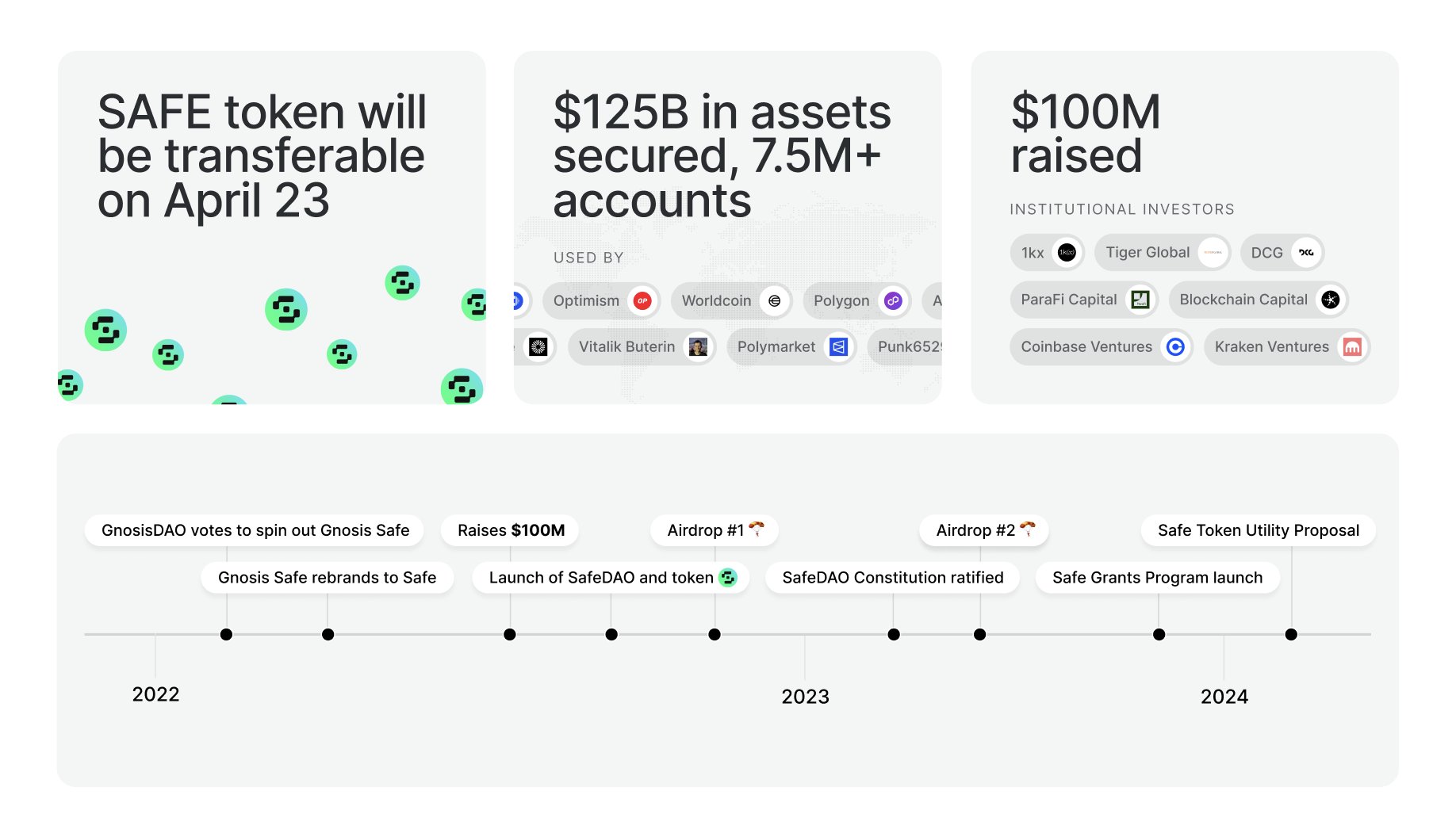
TL;DR: If the token transferability proposal reaches a successful vote by April 15, 2024, SAFE token transferability could be enabled on April 23, 2024. View the proposal here.
Background
From @danftz: https://x.com/danftz/status/1772262229485781183
ICYMI, Safe spun out of Gnosis in July 2022 following a vote of GIP-29. Safe proceeded to raise USD 100M in a funding round, and both SafeDAO and its governing token, the Safe Token (SAFE), was born.
From the outset, the SafeDAO, along with extensive community dialogue, have shaped SAFE’s journey. SAFE was made non-transferable from the outset, with the community still able to participate in governance and submit and vote on proposals. The DAO voted on the requirement that several milestones had to be met before transferability could be enabled (SEP #3). Prior to this, (SEP #2) was voted on to delay transferability, to allow for the project to be developed securely while protecting the interests of all ecosystem participants.
The decision on whether to enable token transferability or not has always been driven by this community-envisioned roadmap, fulfilling specific milestones that were decided on through the transparent SafeDAO governance process.
As of Monday March 18, 2024, the last milestone E has been fully ratified!
Milestones before Transferability
To recap, these were the milestones that needed to be fulfilled before token transferability could be enabled:
- Milestone A: The claim period has passed (completed)
- Milestone B: An SEP on a constitution has been ratified (completed with SEP #4)
- Milestone C: An SEP on a governance framework has been ratified (completed with SEP #7)
- Milestone D: An SEP on a resource allocation framework has been ratified (completed with SEP #8)
- Milestone E: An SEP on token utility has been ratified (completed with SEP #21)
It’s Voting Szn
Now that the milestones have been met. The road ahead is clear. The next dates in governance Sprint 2 are:
- March 25 - April 1: Review phase requiring three delegates/Guardians to signal approval
- April 2, 23:59 UTC: Deadline for proposal submission to Snapshot
- April 3 - April 15: Snapshot voting to unpause SAFE Token Contract
A variety of Safe Ecosystem members: token holders, delegates, and Guardians came together to collaborate on and co-author a one-of-a-kind DAO Proposal to move the DAO to the next phase.
Safe is Everywhere: Leading the transition to smart accounts
The Safe Ecosystem has been heads down shipping Safe{Core} and Safe{Wallet} that are now best-loved throughout Ethereum/EVM. Safe is pioneering the transition to smart accounts, and our account abstraction infrastructure is now securing over $100B in assets.
Safe’s mission remains to make smart accounts the default means of onchain interaction. World-class teams such as Worldcoin, Rabby, Reddit and Gnosis Pay are building on Safe’s modular smart account infrastructure, across multiple use cases such as decentralized identity, asset custody and management, and payments.
Safety in Numbers
- Total value of assets secured: $100 Billion or 4% of the combined cryptocurrency market cap
- Safe accounts created: 7.5m (approx. 4x YoY, or 290% YoY growth)
- Safe transactions: 40m (approx 4.5x YoY, or 350% YoY growth)
- Safe ecosystem projects: >210
- Networks supported: 15+
- Source: https://dune.com/safe/all
Safe looks forward to seeing how the future of Safe and onchain ownership will be steered and shaped by both current and new community members!
Governance and Safe{DAO}
SAFE Token holders become stakeholders in the Safe{DAO} governance process by being granted the rights to:
- Submit proposals
- Vote on proposals
- Delegate their voting power to others
Voting power is proportional to the number of tokens held. Anyone can submit proposals, and participation in proposal creation is not contingent on token ownership or transferability. Token holders can furthermore delegate their voting power to others, allowing non-token holders to actively shape SafeDAO governance. To date, token holders have exercised their votes on proposals such as:
Find out more about the SafeDAO governance process and delegation.
Shape the Future of Ownership
This is an important moment for Safe and the entire smart accounts community, and Safe is here for it. Ultimately, the decision to enable token transferability as well as all following decisions governing the future Safe lies in the hands of SafeDAO.
All decisions are made through a fully open and transparent voting process enabled by the SAFE token and exercised by its holders. Enabling token transferability will unlock the ability for new participants to join governance as well as increase votable supply.
The time is coming for everyone to be able to join the (smartest) smart account community and take it to the next level.
Stake your vote in Safe governance and come shape the future of ownership with us! 💚
FAQ
What is SAFE?
- Safe builds secure smart account infrastructure. It is the leader in smart account abstraction on Ethereum and the EVM, and recently surpassed $100 billion in value of digital assets secured and has over 7 million active accounts, larger than all of DeFI and comparable to countries GDP.
- Previously called Gnosis Safe, Safe’s contracts are battle-tested and have passed the highest industry standards. The SafeDAO governs the future of Safe and is committed to accelerating the transition of blockchains to smart accounts
What is Token Transferability?
- Token transferability refers to the ability of SafeDAO's governance tokens to be transferred freely. This means calling the unpause method of the token contract (using the SafeSnap module), which would result in the SAFE token becoming transferable. This feature plays a role in enhancing liquidity and governance participation within the ecosystem.
Why was the SAFE token initially non-transferable? Why has token transferability not already been enabled?
- The DAO has chosen a milestone-based approach to ensure careful planning and implementation of key governance events, including transferability. The decision of SEP #2 is well-documented in its thread (here).
- Prioritizing Safe as Critical Infrastructure: Delaying transferability prioritized the development and security of Safe as essential infrastructure for managing digital assets.
- Ensuring DAO Maturity (DAO-product / DAO-market-fit): A non-transferable token helped the DAO establish robust governance processes and focus on building a strong foundation before introducing market dynamics.
- Fostering Ecosystem Growth: The focus was on long-term ecosystem development, rather than short-term price speculation that could distract from core objectives. (see SafeDAO Constitution) “Foster a vibrant ecosystem”
- Maintaining Focus: Preventing immediate token transfers allowed the team and community to prioritize Safe's core mission without distraction.
What do we need token utility for?
- To ensure the token has a defined role and value within the ecosystem, enhancing governance and participation. More info on day-1 utility and a lively discussion on future uses can be found in the token utility thread (here).
How does the market sentiment influence the timeline for SAFE token transferability?
- The decision to make the SAFE token transferable is based on achieving specific milestones and is driven by community consensus through SafeDAO governance, rather than market trends or past industry events. The focus remains on building a sustainable and secure project for the long term, with token transferability being a carefully considered step in this process.
What is SafeDAO's response to members concerned about the pace of achieving token transferability?
- We understand some community members are eager to see token transferability implemented already. However, SafeDAO’s members acting through its Safe governance, have chosen to implement a milestone-based approach to ensure careful planning and implementation of key governance events before token transferability can be enabled through a DAO vote. The milestones set and achieved thus far reflect the DAO’s commitment to this vision and the remarkable growth within the Safe ecosystem, even during challenging market conditions, shows signs of validating this approach. The decision of SEP #2 is well-documented in its thread (here).
What does the vote on token utility mean for the future of SAFE token transferability? Is this the final step?
- The vote on token utility is a crucial step in the process towards making SAFE tokens transferable, but it is not the final action. Following the completion of Milestone 5 - [SEP #21] SAFE Token Utility (here), DAO members will have the opportunity to propose and vote on the specific matter of token transferability.
How does the non-transferability of SAFE tokens affect their ability to publish proposals or vote in governance polls?
- The SafeDAO's governance structure allows for a range of participation mechanisms, even within the current non-transferable token model.Specifically, as outlined in Section B.IV of our Governance Framework, the following is true:
- Anyone can submit proposals: Participation in proposal creation is not contingent on token ownership or transferability.
- Delegation enables voting power: Token holders can delegate their voting power to others, allowing non-token holders to actively shape SafeDAO governance.
Stay in the loop with all our latest insights and updates. Click Subscribe and never miss a beat from our team.


All Comments