

Cointime

Download App
iOS & Android

Preventing Arithmetic Overflow and Underflow in Solidity: Best Practices and Solutions

Validated Individual Expert

Solidity is a high-level programming language that is used for developing smart contracts on the Ethereum blockchain. It is a statically typed language, which means that the type of a variable is known at compile-time. One of the most common errors that developers encounter when working with Solidity is arithmetic overflow and underflow.

Arithmetic overflow occurs when the result of a mathematical operation exceeds the maximum value that can be stored in a variable. For example, consider a uint256 variable that can store values between 0 and 2²⁵⁶ — 1. If we add 1 to the maximum value that can be stored in a uint256, the result will be 0, which is called an overflow.

Arithmetic underflow, on the other hand, occurs when the result of a mathematical operation is below the minimum value that can be stored in a variable. For example, if we subtract 1 from 0, the result will be the maximum value that can be stored in a uint256, which is called an underflow.

Both overflow and underflow can have serious consequences for smart contracts. For instance, if a smart contract is programmed to transfer tokens from one account to another and an overflow or underflow occurs, the tokens may be transferred to an unintended recipient. This can result in security vulnerabilities and financial losses.
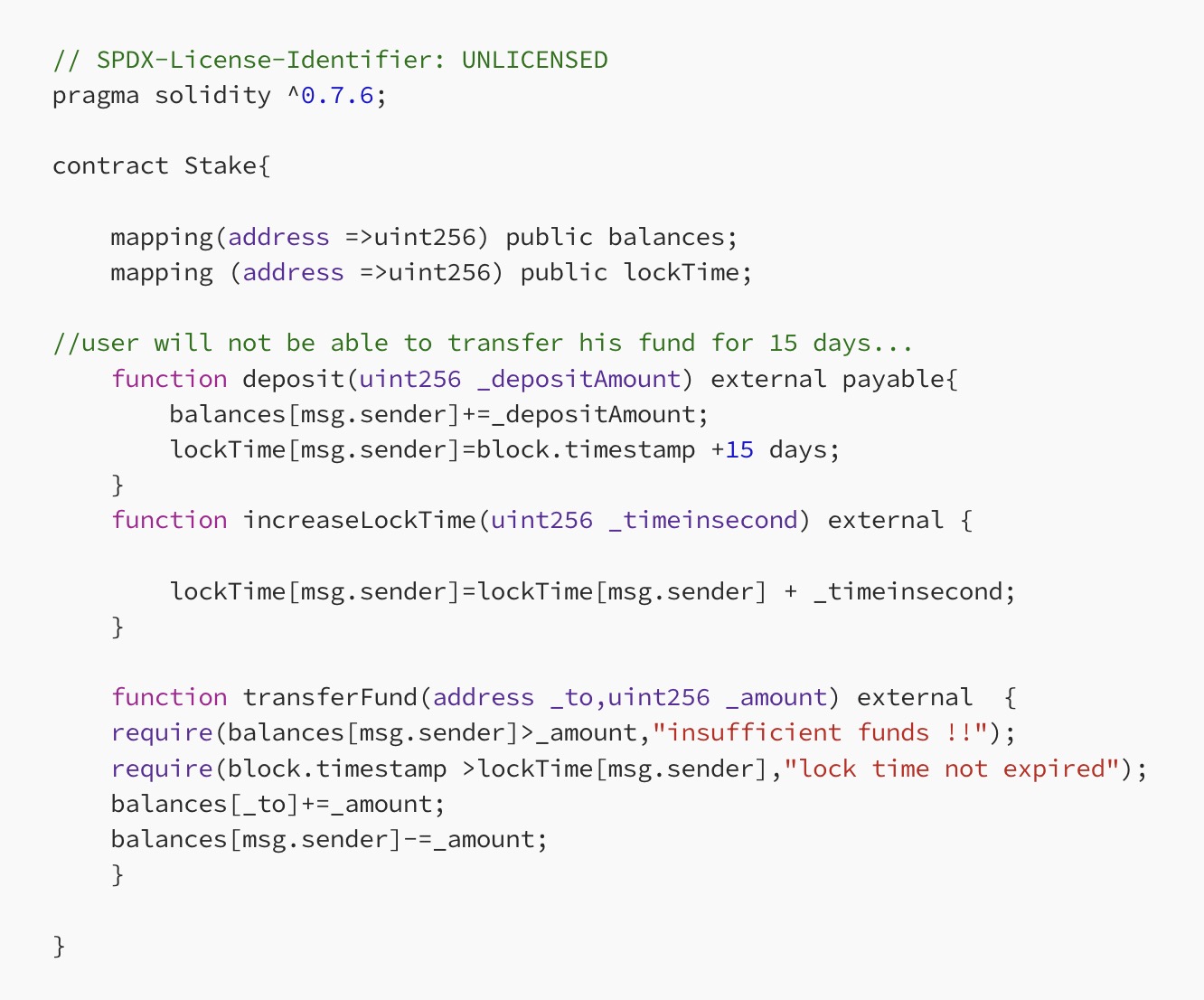
Here, in the above code we can manipulate the locktime to make it Zero by calling increaseLockTime function with a such value which can overflow that Arithmetic value and make it zero.

You can deploy AttackStake Contract so that user will be able to transfer his fund before his locking period ends.Here is the code :-
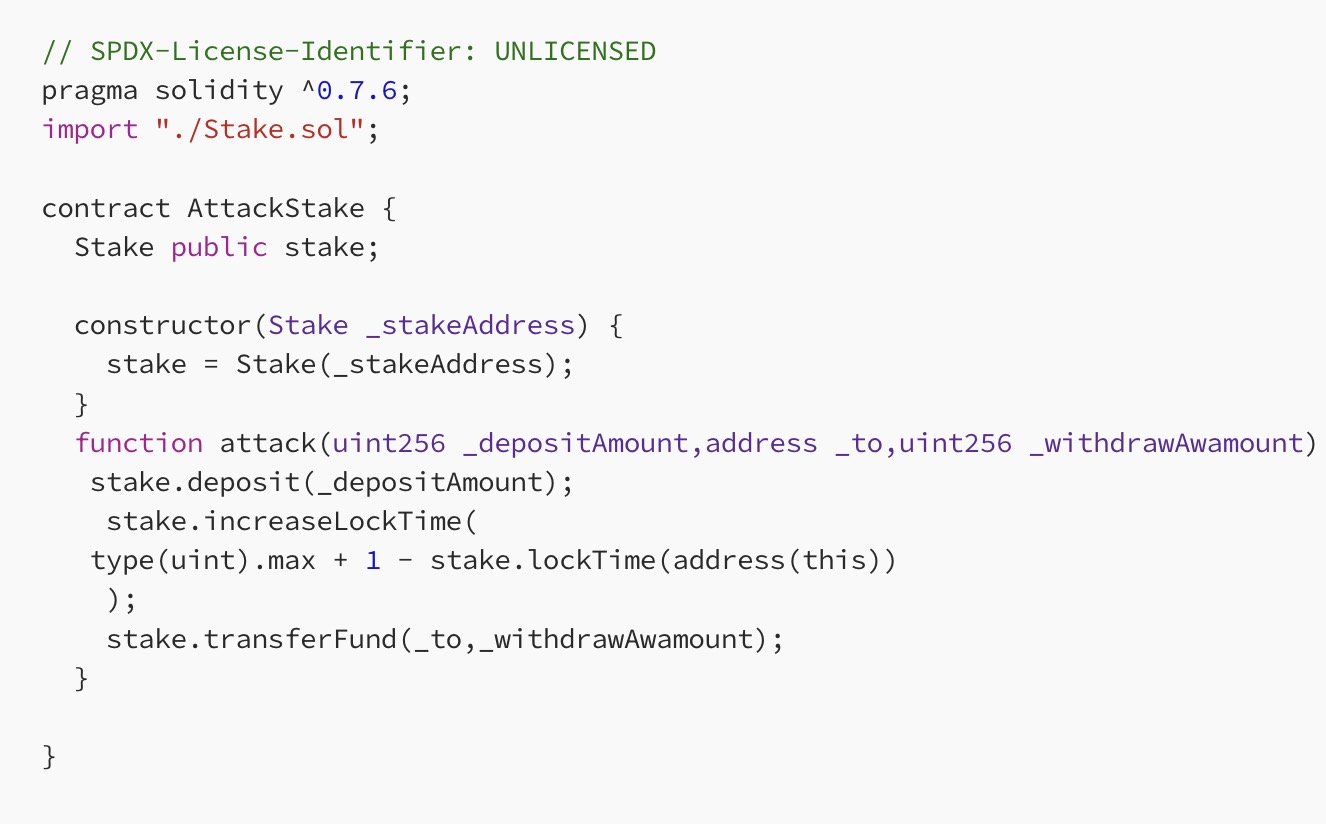
Solution :

To avoid arithmetic overflow and underflow in Solidity, it is important to use the appropriate data types and to write code that checks for overflow and underflow before performing any arithmetic operations.

We can use SafeMath library, which is a collection of functions that perform arithmetic operations and check for overflow and underflow. The SafeMath library is widely used by Solidity developers and is considered to be a best practice for avoiding arithmetic errors in smart contracts.

It does this by providing a set of functions that perform arithmetic operations, such as addition, subtraction, multiplication, and division, and automatically check for overflow and underflow before the operation is performed.

For example, when using the SafeMath library, if an addition operation would result in an overflow, the function will throw an exception and stop the transaction from executing. This helps to ensure that the intended arithmetic operation is performed correctly and that the results are within the expected range.

To use SafeMath,you can import it in your contract, like this :

and use this for your datatype, like this :

  • Solidity 0.8 defaults to throwing an error for overflow / underflow but if you are working with old solidity version, consider Using SafeMath library .

In conclusion, arithmetic overflow and underflow can have serious consequences for smart contracts and it is important to take steps to prevent them. Developers should use appropriate data types and perform checks for overflow and underflow before performing any arithmetic operations. Additionally, the use of libraries such as SafeMath can help to ensure that arithmetic errors are avoided. By following these best practices, developers can help to ensure that their smart contracts are secure and operate as intended.


Comments

All Comments

Recommended for you

  • The Bank of Japan is reportedly planning further interest rate hikes; some officials believe the neutral interest rate will be higher than 1%.

    according to insiders, Bank of Japan officials believe that before the current rate hike cycle ends, interest rates are likely to rise above 0.75%, indicating that there may be more rate hikes after next week's increase. These insiders said that officials believe that even if rates rise to 0.75%, the Bank of Japan has not yet reached the neutral interest rate level. Some officials already consider 1% to still be below the neutral interest rate level. Insiders stated that even if the Bank of Japan updates its neutral rate estimates based on the latest data, it currently does not believe that this range will significantly narrow. Currently, the Bank of Japan's estimate for the nominal neutral interest rate range is about 1% to 2.5%. Insiders said that Bank of Japan officials also believe there may be errors in the upper and lower limits of this range itself. (Golden Ten)

  • OKX: Platform users can earn up to 4.10% annualized return by holding USDG.

    According to the official announcement, from 00:00 on December 11, 2025 to 00:00 on January 11, 2026 (UTC+8), users holding USDG in their OKX funding, trading, and lending accounts can automatically earn an annualized yield of up to 4.10% provided by the OKX platform, with the ability to withdraw or use it at any time, allowing both trading and wealth management simultaneously. Users can check their earnings anytime through the OKX APP (version 6.136.10 and above) - Assets - by clicking on USDG. Moving forward, the platform will continue to expand the application of USDG in more trading and wealth management scenarios.

  • The Federal Reserve will begin its Reserve Management Purchase (RMP) program today, purchasing $40 billion in Treasury bonds per month.

     according to the Federal Reserve Open Market Committee's decision on December 10, the Federal Reserve will start implementing the Reserve Management Purchase (RMP) program from December 12, purchasing a total of $40 billion in short-term Treasury securities in the secondary market.

  • Bitcoin treasury company Strategy's daily transaction volume has now surpassed that of payment giant Visa.

    according to market sources: the daily trading volume of Bitcoin treasury company Strategy (MSTR) has now surpassed the payment giant Visa.

  • The US spot Bitcoin ETF saw a net outflow of $78.35 million yesterday.

    according to Trader T's monitoring, the US spot Bitcoin ETF had a net outflow of $78.35 million yesterday.

  • JPMorgan Chase issues Galaxy short-term bonds on Solana network

     JPMorgan arranged and created, distributed, and settled a short-term bond on the Solana blockchain for Galaxy Digital Holdings LP, as part of efforts to enhance financial market efficiency using underlying cryptocurrency technology.

  • HSBC expects the Federal Reserve to refrain from cutting interest rates for the next two years.

    HSBC Securities predicts the Federal Reserve will maintain interest rates stable at the 3.5%-3.75% range set on Wednesday for the next two years. Previously, Federal Reserve policymakers lowered rates by 25 basis points with a split vote. The institution's U.S. economist Ryan Wang pointed out in a report on December 10 that Federal Reserve Chairman Jerome Powell was "open to the question of whether and when to further cut rates at next year's FOMC press conference." "We believe the FOMC will keep the federal funds rate target range unchanged at 3.50%-3.75% throughout 2026 and 2027, but as the economy evolves, as in the past, it is always necessary to pay close attention to the significant two-way risks facing this outlook."

  • Institution: US AI companies face power pressures that will drive up operating costs.

    Benjamin Melman, Chief Investment Officer of asset management company Edmond de Rothschild, pointed out that American artificial intelligence companies are facing intense competition in terms of electricity costs. He stated that the current power capacity in the U.S. is insufficient to meet the growing demand of AI companies, and electricity prices are significantly higher compared to other countries. "The U.S. faces intense competition in electricity costs, which will drive up the operating costs of AI."

  • Institutions: The US dollar may face further pressure next year, with AI bubble and interest rate outlook being key risks.

    Benjamin Melman, CEO of asset management company Edmond de Rothschild, stated that the US dollar may face downside risks again next year. "If the market worries again about US interest rates or if the artificial intelligence bubble suddenly bursts, the US dollar will be at risk." With the Federal Reserve cutting interest rates, the US dollar has continued to weaken this year. The US Dollar Index (DXY) recently fell 0.05% to 98.59. In mid-September, the index hit a three-and-a-half-year low of 96.218.