

Cointime

Download App
iOS & Android

PFDEX Delivers a Powerful Keynote at the PopChain Global Ecosystem Conference in Hong Kong

Validated Individual Expert

 Building a High-Performance Future for Decentralized Finance

On November 8, 2025, the PopChain Global Ecosystem Conference, hosted by PopChain, successfully concluded in Hong Kong. The conference brought together leading projects and institutional representatives from across the blockchain, DeFi, AI, and digital asset trading sectors to explore “The Power of Connection” and the evolution of next-generation financial infrastructure in the Web3 era.

Among the event’s many highlights, Mr. Mi, PFDEX’s ecosystem representative, delivered a keynote speech titled “PFDEX: The High-Performance Future of Decentralized Finance.” His insightful analysis and systematic technical vision sparked wide attention and in-depth discussions among attendees.

DeFi at a Turning Point: From “Yield-Driven” to “Efficiency-Driven”

At the beginning of his speech, Mr. Mi noted that after years of rapid growth, the DeFi market is undergoing a structural shift from yield-driven speculation to efficiency-driven finance.

“In the past, DeFi was like a high-yield experimental playground. Today, it’s returning to the essence of finance — efficiency, transparency, and trust.”

According to industry data, decentralized exchanges (DEXs) have already captured over 25% of the spot trading market, while derivatives DEXs account for less than 10%, leaving significant untapped potential. This indicates that the DeFi derivatives market remains a blue ocean, where high performance and full-chain transparency are becoming the new competitive frontiers.

PFDEX: The Intersection of Performance Revolution and Capital Efficiency
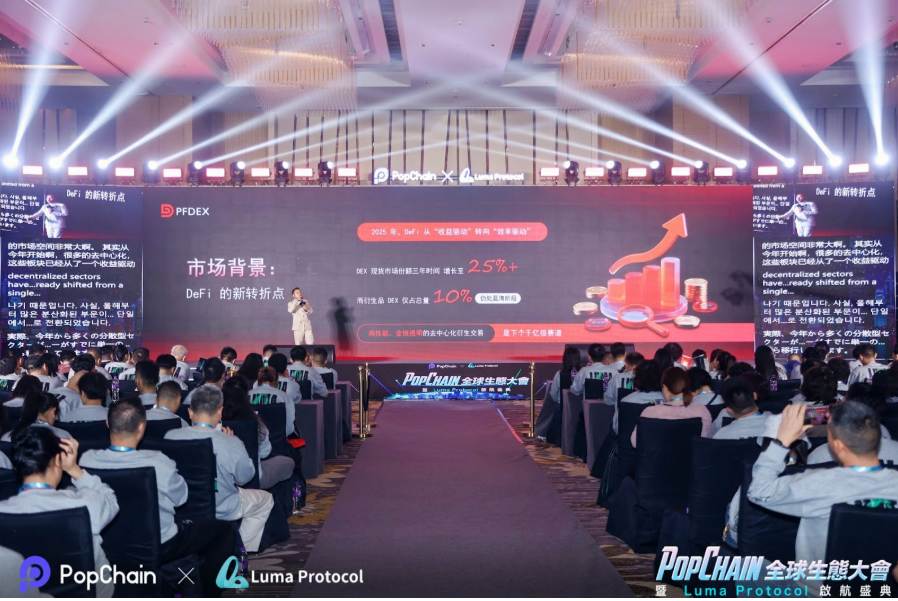
Addressing current market pain points, Mr. Mi introduced PFDEX’s core vision:“To give DeFi the speed of CEX — and bring trust back on-chain.”

Built on the financial-grade Layer-1 architecture of PopChain, PFDEX employs an on-chain order book, parallel matching engine, and intelligent clearing system to achieve full coverage of derivatives trading — from spot and perpetuals to high-low futures and binary options.

Thanks to its hierarchical matching architecture, portfolio margin system, and modular risk control, PFDEX achieves:

  • Matching latency as low as 200 milliseconds, comparable to centralized exchanges;
  • 40%–60% improvement in capital efficiency, unlocking greater liquidity performance;
  • 100% user self-custody and fully verifiable on-chain clearing, ensuring transparency and security.

“PFDEX is not just a trading platform,” Mr. Mi emphasized. “It’s a structural financial engine — redefining the balance between performance and trust.”

Ecosystem Synergy: Powered by PopChain, Driven by PenFolds

PFDEX’s rapid growth is inseparable from PopChain’s ecosystem empowerment. As the financial core of the PopChain ecosystem, PFDEX leverages the chain’s high-performance mainnet and cross-ecosystem interoperability to secure both trading performance and asset safety.

Meanwhile, ecosystem partner PenFolds provides long-term liquidity and user growth momentum, forming a synergistic ecosystem loop from infrastructure to application. This deep integration makes PFDEX not only a key financial module on PopChain, but also the engine of the entire Pop financial system.

Technical Expansion: PFDEX SaaS and Multi-Chain Compatibility

PFDEX has also launched its Decentralized Derivatives SaaS System, designed for exchanges, market makers, and project teams. This system enables one-click deployment, modular activation of matching, clearing, and risk control components, and multi-chain compatibility.

Through this SaaS-based approach, PFDEX transforms its internal technology into industry-wide infrastructure, empowering partners to build their own branded DEXs with self-custody and full risk control — providing engine-level support for the next generation of decentralized trading ecosystems.

Development Roadmap: Global Expansion and DAO Governance

According to Mr. Mi’s presentation, PFDEX’s roadmap outlines a clear multi-phase development plan:

  • 2025 Q4: Mainnet launch; spot and perpetual trading go live.
  • 2026 Q1: Launch of high-low futures and binary options; API and SaaS deployment open.
  • 2026 Q2–Q4: Integration of multi-chain assets; initiation of DAO governance and global market expansion.

PFDEX’s ultimate vision is to become the “Global Engine for Decentralized Derivatives”, driving the evolution of next-generation financial systems through open, verifiable, and scalable architecture.
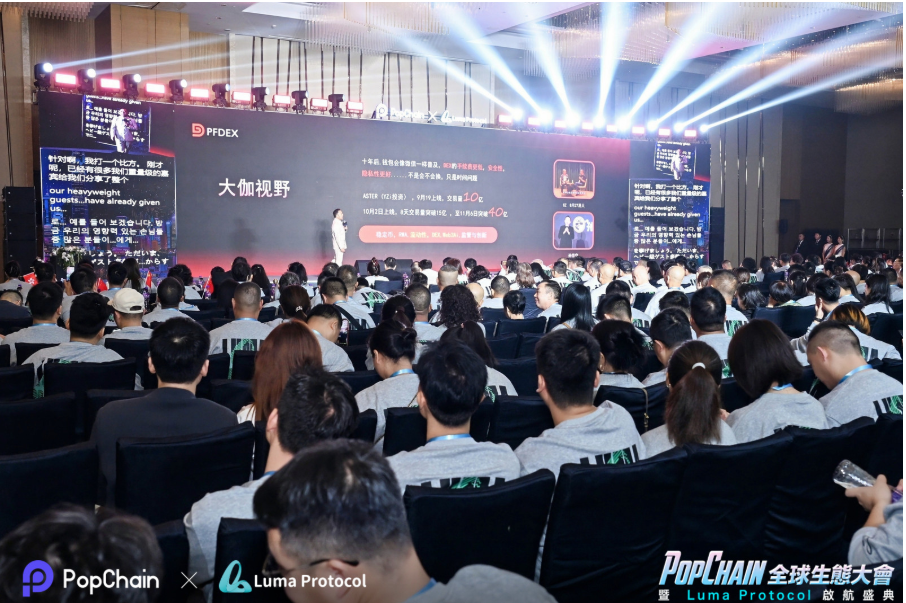
Where Speed Meets Trust

In closing, Mr. Mi summed up PFDEX’s mission in a single line:“The future of decentralized finance is not only about rebuilding trust — it’s about revolutionizing efficiency. PFDEX aims to make every trade verifiable and every unit of value flow freely.”

With the successful conclusion of the PopChain Global Ecosystem Conference, PFDEX’s debut marks a milestone step for the Pop ecosystem in DeFi, heralding the dawn of a new era of high-performance and high-transparency decentralized derivatives.

About PFDEX

PFDEX is a next-generation decentralized derivatives exchange built on the PopChain architecture, integrating on-chain order books, intelligent clearing systems, and portfolio margin models. Supporting spot, perpetual, high-low futures, and binary options, PFDEX operates under the core philosophy:“Fast as CEX, Real as DeFi.”

It is committed to building a global and inclusive decentralized financial infrastructure through high-performance and high-transparency structural innovation.


Comments

All Comments

Recommended for you

  • American Bitcoin's Bitcoin reserves have increased by approximately 623 BTC in the past 7 days, bringing its current holdings to 4941 BTC.

    Emmett Gallic, a blockchain analyst who previously disclosed and analyzed the "1011 insider whale," posted on the X platform revealing updated data on the Bitcoin reserves of American Bitcoin, a crypto mining company supported by the Trump family. In the past seven days, they increased their holdings by about 623 BTC, of which approximately 80 BTC came from mining income and 542 BTC from strategic acquisitions in the open market. Currently, their total Bitcoin holdings have risen to 4,941 BTC, with a current market value of about 450 million USD.

  • The US spot Ethereum ETF saw a net outflow of $19.4 million yesterday.

    according to TraderT monitoring, the US spot Ethereum ETF had a net outflow of 19.4 million USD yesterday.

  • Listed companies, governments, ETFs, and exchanges collectively hold 5.94 million Bitcoins, representing 29.8% of the circulating supply.

    Glassnode analyzed the holdings of major types of Bitcoin holders as follows: Listed companies: about 1.07 million bitcoins, government agencies: about 620,000 bitcoins, US spot ETFs: about 1.31 million bitcoins, exchanges: about 2.94 million bitcoins. These institutions collectively hold about 5.94 million bitcoins, accounting for approximately 29.8% of the circulating supply, highlighting the trend of liquidity increasingly concentrating in institutions and custodians.

  • The Bank of Japan is reportedly planning further interest rate hikes; some officials believe the neutral interest rate will be higher than 1%.

    according to insiders, Bank of Japan officials believe that before the current rate hike cycle ends, interest rates are likely to rise above 0.75%, indicating that there may be more rate hikes after next week's increase. These insiders said that officials believe that even if rates rise to 0.75%, the Bank of Japan has not yet reached the neutral interest rate level. Some officials already consider 1% to still be below the neutral interest rate level. Insiders stated that even if the Bank of Japan updates its neutral rate estimates based on the latest data, it currently does not believe that this range will significantly narrow. Currently, the Bank of Japan's estimate for the nominal neutral interest rate range is about 1% to 2.5%. Insiders said that Bank of Japan officials also believe there may be errors in the upper and lower limits of this range itself. (Golden Ten)

  • OKX: Platform users can earn up to 4.10% annualized return by holding USDG.

    According to the official announcement, from 00:00 on December 11, 2025 to 00:00 on January 11, 2026 (UTC+8), users holding USDG in their OKX funding, trading, and lending accounts can automatically earn an annualized yield of up to 4.10% provided by the OKX platform, with the ability to withdraw or use it at any time, allowing both trading and wealth management simultaneously. Users can check their earnings anytime through the OKX APP (version 6.136.10 and above) - Assets - by clicking on USDG. Moving forward, the platform will continue to expand the application of USDG in more trading and wealth management scenarios.

  • The Federal Reserve will begin its Reserve Management Purchase (RMP) program today, purchasing $40 billion in Treasury bonds per month.

     according to the Federal Reserve Open Market Committee's decision on December 10, the Federal Reserve will start implementing the Reserve Management Purchase (RMP) program from December 12, purchasing a total of $40 billion in short-term Treasury securities in the secondary market.

  • Bitcoin treasury company Strategy's daily transaction volume has now surpassed that of payment giant Visa.

    according to market sources: the daily trading volume of Bitcoin treasury company Strategy (MSTR) has now surpassed the payment giant Visa.

  • The US spot Bitcoin ETF saw a net outflow of $78.35 million yesterday.

    according to Trader T's monitoring, the US spot Bitcoin ETF had a net outflow of $78.35 million yesterday.

  • JPMorgan Chase issues Galaxy short-term bonds on Solana network

     JPMorgan arranged and created, distributed, and settled a short-term bond on the Solana blockchain for Galaxy Digital Holdings LP, as part of efforts to enhance financial market efficiency using underlying cryptocurrency technology.

  • HSBC expects the Federal Reserve to refrain from cutting interest rates for the next two years.

    HSBC Securities predicts the Federal Reserve will maintain interest rates stable at the 3.5%-3.75% range set on Wednesday for the next two years. Previously, Federal Reserve policymakers lowered rates by 25 basis points with a split vote. The institution's U.S. economist Ryan Wang pointed out in a report on December 10 that Federal Reserve Chairman Jerome Powell was "open to the question of whether and when to further cut rates at next year's FOMC press conference." "We believe the FOMC will keep the federal funds rate target range unchanged at 3.50%-3.75% throughout 2026 and 2027, but as the economy evolves, as in the past, it is always necessary to pay close attention to the significant two-way risks facing this outlook."