
Cointime

Download App
iOS & Android

Pakistan creates Digital Asset Authority to regulate crypto

Pakistan’s Ministry of Finance has reportedly endorsed the creation of a dedicated body to regulate blockchain-based financial infrastructure in the country.

The Pakistan Digital Assets Authority (PDAA) will serve as a regulatory body to oversee licensing, regulate exchanges, custodians, wallets, tokenized platforms, stablecoins and decentralized finance applications, according to a May 21 report from the state-owned broadcaster, PTV.

Muhammad Aurangzeb, federal minister for finance and revenue, told the broadcaster, “Pakistan must regulate not just to catch up, but to lead” in the industry.

“With the PDAA, we are creating a future-ready framework that protects consumers, invites global investment, and puts Pakistan at the forefront of financial innovation,” he said.

  Muhammad Aurangzeb, Pakistan’s Federal Minister for Finance and Revenue. Source: Pakistan Ministry of Finance

The PDAA will also be tasked with tokenizing national assets and government debt, facilitating monetization of Pakistan’s surplus electricity through regulated Bitcoin mining, and helping startups build blockchain-based solutions at scale.

The new regulatory body was part of a recommendation from the Pak­istan advisory body, the Cryptocurrency Cou­ncil, which was launched on March 14 and has former Binance CEO Changpeng Zhao as an adviser.

“This is not just about crypto — it’s about rewriting our financial future, expanding access, and creating new export channels through tokenization, digital finance and Web3 innovation,” said Bilal Bin Saqib, CEO of Pakistan's Crypto Council.

Pakistan’s Federal Investigation Agency previously proposed a regulatory framework for digital assets designed to address terrorism financing, money laundering provisions, and Know Your Customer concerns, according to am April 10 report from local newspaper, The Express Tribune.

Pakistan crypto market rises despite early skepticism  

In May 2023, former Minister of State for Finance and Revenue Aisha Ghaus Pasha said that Pakistan would never legalize cryptocurrencies due to the potential for digital assets to circumvent regulations created by the Financial Action Task Force, the supranational organization that polices finance for money laundering. 

However, the following year, Pakistan ranked highly in Chainalysis’ 2024 crypto adoption index, coming in ninth, mainly due to strong retail adoption and transactions at centralized services.
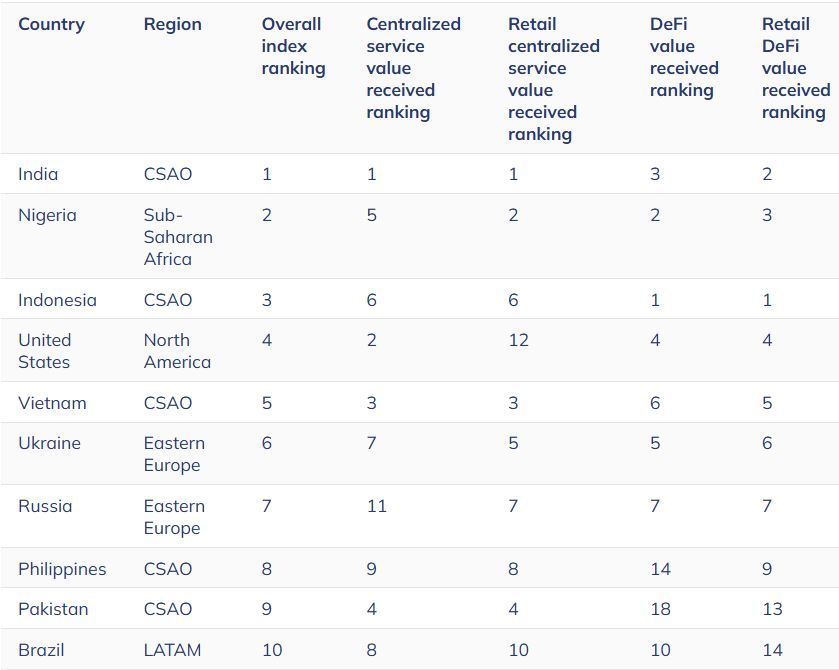
  Pakistan ranked highly in Chainalysis’ 2024 crypto adoption index, coming in 9th. Source: Chainalysis

Meanwhile, the online data platform Statista shows Pakistan’s crypto market is “experiencing rapid growth” and estimates the number of crypto users is expected to amount to over 27 million by 2025, out of a population of 247 million.

At the same time, revenue in the Pakistan crypto market is projected to reach $1.6 billion in 2025. The United States still leads the pack, with its crypto market generated an estimated revenue of over $9.4 billion, according to Statista data. 

Comments

All Comments

Recommended for you

  • Ministry of Commerce Seeks Public Opinion on Draft Regulations for Protecting Chinese Trade Secrets

    The Ministry of Commerce is seeking public opinion on the "Draft Regulations for Protecting Chinese Trade Secrets." The draft states that if foreign entities engage in behaviors specified in Article 2 of these regulations, the Ministry of Commerce may decide to take one or more of the following measures against the relevant foreign entities: (1) Restrict or prohibit their involvement in import and export activities related to goods, technology, and international service trade concerning China, and prohibit the export of related items to them; (2) Restrict or prohibit their new investments within China; (3) Restrict or prohibit the entry of their relevant personnel and transportation means; (4) Restrict or revoke work permits, stay, or residence qualifications for their relevant personnel in China; (5) Impose fines according to the severity of the circumstances; (6) Other necessary measures.

  • Tokenized Stock DeFi Deposits Exceed $300 Million, Growing Approximately 25-Fold in One Year

    On October 26, Cryptopolitan reported, citing data from Token Terminal, that the deposits of tokenized stocks in DeFi protocols have surpassed $300 million, up from $262 million last month, and have increased by 2,451.5% compared to approximately $11.8 million a year ago, distributed across 20 issuers and 10 blockchains. The growth was concentrated in the third quarter: starting at $80.1 million at the beginning of the quarter, it rose to $265 million by September 30, marking a quarterly increase of about 230%. This timing coincides with Binance's launch of bStocks in June and Robinhood Chain's launch in July. In terms of on-chain distribution, Solana leads with $102.6 million, accounting for 34.2% of the total, followed by Robinhood Chain and Ethereum in second and third place, respectively. BNB Chain has $42.8 million, and Base has $24.3 million, with the top five chains collectively accounting for approximately 96%. Regarding issuers, xStocks holds over 39%, with Robinhood at $70.8 million, Binance bStocks at $38.4 million, and Ondo Finance at $3.4 million.

  • Ethereum Foundation Sells 2,785 ETH Worth Approximately $6.42 Million

    On October 26, according to monitoring by Onchain Lens, the Ethereum Foundation sold 2,785 ETH through CoW Swap for approximately $6.42 million in exchange for USDS.

  • Qatari Mediators Arrive in Tehran to Alleviate Regional Tensions

    According to an official familiar with the situation, Qatari mediators arrived in Tehran on Sunday with the aim of easing regional tensions. Qatar's mediation efforts are being conducted in coordination with the United States.

  • Musk: Future Phones Will Have No Apps or Operating Systems, Just AI Generation

    On October 25, Musk predicted that in the next 5 to 6 years, smartphones may undergo a complete transformation: traditional operating systems and apps will gradually disappear, and phones will become dedicated terminals for running AI. At that time, users will no longer need to download applications or open software; instead, they will simply tell the AI what they want, and the phone's AI will collaborate with cloud AI to generate videos, images, and various interactive content in real-time.

  • Iran: Tehran's Stance Unchanged Despite Potential New U.S. Strikes

    On October 25, Iranian Foreign Minister Zarif stated on Sunday that Iran's position will not change even if a new round of conflict erupts between Israel and the United States. This comes amid escalating tensions between Tehran and Washington. U.S. President Trump had mentioned on Friday that Washington "might come back for another small-scale 'epic fury'" military operation. Zarif remarked, "Recently, some have talked about the possibility of a new war, but I am already considering the post-war situation. Our policies will not change whether or not war occurs. They have tried twice before and have seen the results. If they want to try again, they should understand that the final outcome will be no different from the past." (Golden Ten)

  • Russia Ready to Supply Any Amount of Diesel to the U.S.

    On October 25, Russian Deputy Prime Minister Novak stated that Russia is prepared to supply any amount of diesel to the United States.

  • Egypt's Benchmark Stock Index Declines by 5%

    Egypt's benchmark stock index has expanded its decline to 5%.

  • Yemen Conflict Escalates, Saudi and Egyptian Stock Markets Decline

    On October 25, Sunday, the stock markets in Saudi Arabia and Egypt experienced declines. This followed a statement from the Saudi-led coalition indicating that, amid escalating conflicts with the Yemeni Houthi forces, the coalition intercepted several drones and missiles over Riyadh and southern Saudi Arabia. Under pressure from widespread sell-offs, the Saudi benchmark index (TASI) fell by 2.6%, marking its worst intraday performance since April 2025, with major stock Saudi Aramco dropping by 1.1%. Outside the Gulf region, the Egyptian blue-chip index (EGX30) plummeted by 2.5%, nearing its lowest level in about seven months, with all constituent stocks declining. The Egyptian parliament is expected to vote on October 26 to decide whether to authorize the armed forces to provide support for Saudi Arabia in its conflict with the Houthi forces upon request.

  • SemiAnalysis CEO: Substrates are the 'Biggest Bottleneck'

    On October 25, the CEO of SemiAnalysis stated: 'I believe that in the semiconductor industry, the biggest limiting factor, aside from memory, is substrates. Substrates, PCB materials, and substrate materials are all severely under-invested. Many companies in the supply chain that produce these materials in Japan are relatively conservative and unwilling to make significant investments in capacity. As a result, there is a huge bottleneck. In terms of what can be produced in the next two years, whether it’s accelerators, CPUs, or any other component in the supply chain, I believe substrates are the biggest bottleneck.'
