


I. Introduction: The Financial Evolution from Centralized Trust to Algorithmic Credibility
Over the past decade, the digital asset industry has undergone a profound transformation—from experimental systems to a global financial network. From early peer-to-peer value transfer ledgers to today’s comprehensive financial systems supporting complex derivatives trading, structured asset management, and cross-chain liquidity, crypto infrastructure is steadily carrying an increasing volume of real capital activity.
Yet throughout this evolution, trading infrastructure has remained caught in a structural contradiction.
On one hand, centralized exchanges (CEXs) leverage high-performance matching engines and mature risk control systems to deliver a trading experience comparable to traditional financial markets, becoming the primary venue for digital asset derivatives trading. However, their fundamental architecture still relies on centralized trust. User asset custody, order execution processes, and risk management logic all operate within opaque internal systems.
On the other hand, decentralized exchanges (DEXs), through on-chain execution logic, have for the first time technically unified asset sovereignty and transaction transparency. Users directly retain control over their assets and can verify execution processes. However, due to inherent performance constraints of on-chain synchronous execution, most DEXs still struggle to meet professional trading requirements in terms of throughput, latency, and liquidity depth.
This contradiction represents an unavoidable structural phase in the transition of financial systems from “intermediary-based credit” to “algorithm-based credibility.”
It is against this backdrop that Nivex, a globally leading digital asset service provider, officially announces the launch of its core ecosystem strategic protocol—NxDex—a decentralized derivatives trading infrastructure centered on high-performance algorithmic architecture. NxDex is designed to fundamentally reshape the execution paradigm of on-chain trading and build an algorithmic financial system capable of supporting capital at global scale.
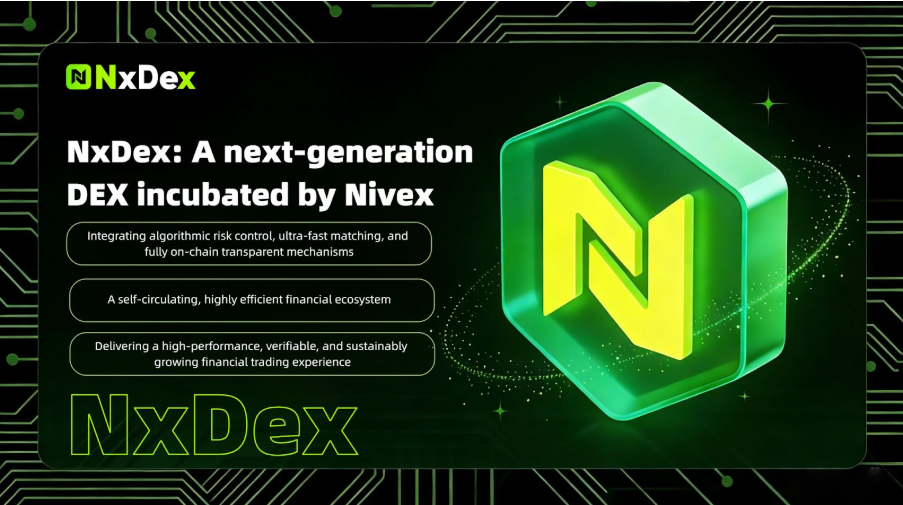
NxDex does not aim to merely replicate the functions of traditional exchanges. Instead, through algorithmic, structured, and verifiable execution systems, it seeks to construct a financial operating system where code itself forms the foundation of trust.
II. The Structural Dilemma of Trading Infrastructure: The Long-Term Separation of Performance and Sovereignty
In traditional centralized exchange systems, all trading activities rely on internal matching engines. Once users submit orders, execution sequence, fill prices, and risk control logic are determined entirely by exchange servers. While this structure enables extremely high execution efficiency, it also requires users to fully trust the exchange’s internal systems.
Historical experience has repeatedly demonstrated that centralized trust structures carry significant systemic risks under extreme market conditions.
Issues such as asset misappropriation, liquidity mismatches, opaque internal liquidation processes, and unverifiable real-time risk exposure all stem from the non-verifiability of execution logic. These problems are not isolated incidents of individual institutions, but inherent characteristics of centralized financial structures.
By contrast, decentralized trading protocols embed matching and fund management logic into smart contracts, ensuring that all trading behavior is executed within a publicly verifiable code framework. This structure fundamentally eliminates the possibility of human intervention in trade execution, providing for the first time a fully transparent execution environment for financial activity.
However, most existing DEXs still rely on synchronous on-chain execution, resulting in significantly higher latency than centralized systems and limiting their ability to support high-frequency derivatives trading.
The industry therefore faces a core question:
How can execution performance comparable to centralized systems be achieved without sacrificing asset sovereignty?
The emergence of NxDex is a systematic answer to this question.
III. NxDex Core Positioning: The Algorithmic Operating System for On-Chain Derivatives Trading
NxDex is not a traditional trading platform, but a comprehensive on-chain derivatives trading protocol. Its core positioning is to build a financial infrastructure characterized by:
- High-performance matching capabilities
- Fully verifiable execution logic
- Decentralized asset custody structure
- Autonomous risk management system
- Scalable multi-chain financial execution environment
Through its proprietary high-performance asynchronous sequencing engine, NxDex achieves millisecond-level transaction responsiveness within a decentralized environment for the first time, enabling on-chain derivatives trading to approach the execution efficiency of centralized systems.
Within NxDex’s architecture, trade execution logic operates automatically through algorithms rather than centralized institutional control. Every order, every liquidation event, and every risk adjustment is completed through auditable execution processes.
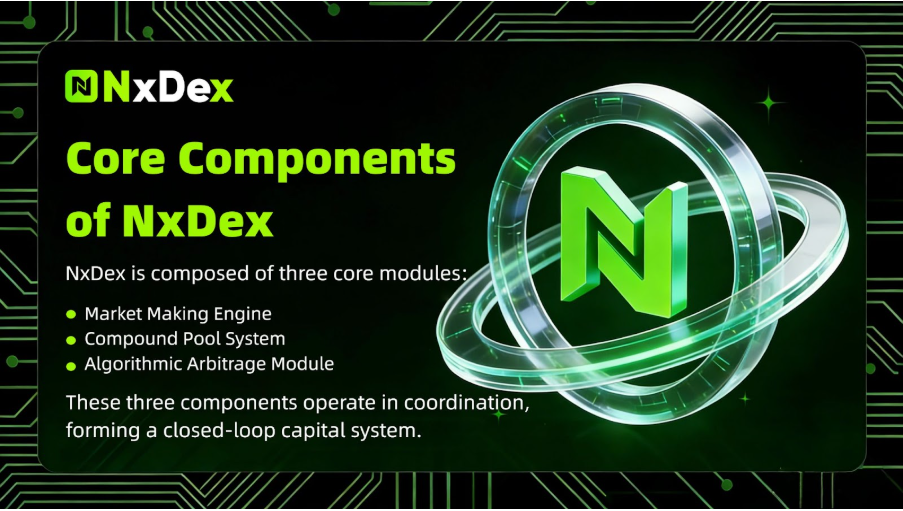
This structure makes NxDex a truly algorithm-driven financial system, rather than a trading environment dependent on institutional credibility.
IV. Core Technical Architecture: A Three-Layer Execution Engine Building a High-Performance Financial System
NxDex’s technical system is built upon a three-layer core architecture. Each layer assumes distinct financial execution responsibilities, collectively forming a complete on-chain trading infrastructure.
1. Trade Execution Layer: Asynchronous Sequencing Matching Engine
Traditional on-chain trading systems rely on synchronous execution logic, requiring each transaction to wait for block confirmation before completion. This structure significantly limits system throughput.
By introducing an asynchronous sequencing mechanism, NxDex separates transaction ordering from on-chain settlement, thereby achieving:
- Millisecond-level order response
- High-concurrency transaction support
- Low-latency matching execution
This architecture enables NxDex to support high-frequency trading demands of professional institutions.
2. Risk Management Layer: Real-Time Actuarial Calculation and Automated Liquidation System
NxDex incorporates a fully automated risk control model that monitors all accounts in real time.
The system continuously calculates:
- Margin ratio
- Unrealized profit and loss
- Liquidation thresholds
- Overall system risk exposure
When risk conditions are triggered, the liquidation process executes automatically without human intervention.
This mechanism ensures the protocol maintains solvency even under extreme market conditions.
3. Capital Liquidity Layer: Engineered Liquidity Structure
NxDex constructs a structured liquidity system to maintain stable trading depth and execution efficiency.
Through algorithmic dynamic allocation of liquidity resources, the capital layer achieves:
- Optimal capital utilization
- Reduced slippage
- Enhanced system stability
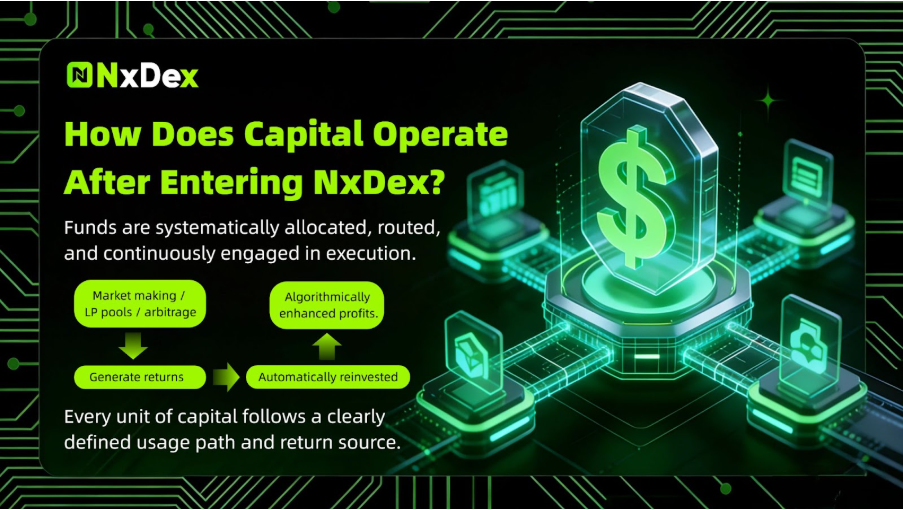
This structure enables NxDex to maintain institutional-grade trading performance within a decentralized environment.
V. Tokenomics Model: A Scarcity-Driven Value Concentration Mechanism
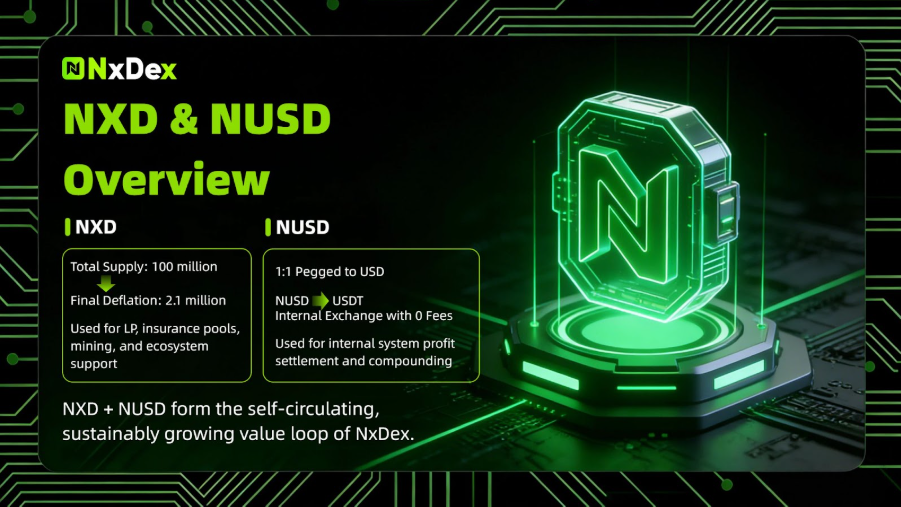
NxDex introduces its native protocol token, NXD, as the core component of its economic cycle.
NXD serves multiple critical functions, including:
- Settlement of trading fees
- Governance participation
- Node operation
- System incentives
To ensure long-term value stability, NxDex implements a dynamic supply adjustment mechanism, burning a portion of tokens daily to gradually reduce total supply.
Under the current model, NXD’s total supply is projected to decrease to approximately 2.1% of its initial issuance.
This mechanism ensures that token value progressively concentrates alongside system growth.
VI. Decentralized Governance Framework: An Algorithm-Driven Autonomous Structure
NxDex introduces a distributed governance framework designed to progressively achieve full decentralization while ensuring the protocol maintains the capacity for continuous evolution and adaptive optimization over the long term. Within this structure, critical operational rules are no longer controlled by a single centralized entity. Instead, they are governed through an on-chain governance mechanism, jointly maintained and decided by protocol participants. This ensures that the system operates on a foundation of transparency, verifiability, and rule-based execution.
Governance nodes serve as a core component of the protocol’s governance architecture, participating in the decision-making and adjustment of key operational parameters. These parameters directly influence protocol efficiency, risk management capability, and overall system stability, and include the following:
- Fee Structure: Governance nodes may participate in adjusting the trading fee model, including base fee rates and their allocation ratios. This enables the protocol to dynamically optimize its revenue structure and liquidity incentive balance in response to evolving market liquidity conditions and trading volume, ensuring sustainable and healthy protocol growth across different stages of development.
- Liquidation Parameters: Governance nodes may participate in defining and adjusting key risk management parameters, including margin thresholds and liquidation trigger conditions. This allows the protocol to continuously refine its risk control model in response to market volatility, preserving overall solvency and operational stability while mitigating systemic risks during extreme market events.
- Liquidity Configuration: Governance nodes may participate in determining liquidity-related parameters, including liquidity allocation structures and incentive distribution ratios. This enables more efficient utilization of protocol liquidity resources, enhances market depth, and improves execution stability, providing participants with a more reliable and efficient trading environmen
All governance decisions are executed through on-chain mechanisms, ensuring full transparency and verifiability. Approved parameter changes are automatically enforced by smart contracts, without reliance on centralized operational intervention. This ensures that protocol rule adjustments remain deterministic, transparent, and resistant to human manipulation.
By implementing this distributed governance framework, NxDex progressively decentralizes both operational execution and protocol control. This enables the protocol to operate and evolve under the collective stewardship of its participants. As the governance system continues to mature, NxDex will transition toward a fully autonomous financial system driven by protocol-level rules, establishing itself as a long-term, sustainable execution infrastructure for on-chain derivatives trading.
VII. Global Development Roadmap: Building an Independent Financial Execution Network
NxDex’s development will proceed in three stages.
Phase One: BSC Deployment and System Validation
The protocol will complete initial deployment on BSC and validate core system performance.
Phase Two: Multi-Chain Expansion
The protocol will expand to support multi-chain operations and integrate cross-chain liquidity.
Phase Three: Application-Chain Evolution
NxDex will evolve into a dedicated financial application chain, achieving fully independent operation.
VIII. Strategic Significance: From Trading Platform to Financial Infrastructure
The significance of NxDex lies not merely in building a new trading protocol, but in establishing a new financial operating paradigm.
Within the NxDex framework:
Trust no longer relies on institutions, but on algorithms. Execution no longer depends on human discretion, but on code. Financial order no longer depends on intermediaries, but on mathematical rules.
IX. Future Outlook: Constructing the Global On-Chain Financial Execution Layer
With the launch of NxDex, Nivex is building a comprehensive decentralized financial infrastructure system.
NxDex will serve as the execution core of this ecosystem, supporting future on-chain financial transactions.
Its long-term objective is to become the foundational execution standard for global on-chain derivatives trading.
X. Conclusion: Returning Finance to Algorithms
The essence of finance lies in the flow and allocation of value.
Algorithms are the only mechanism capable of ensuring that this process remains fair, transparent, and verifiable.
The emergence of NxDex marks the entry of financial systems into a new algorithm-driven era.
In this system:
Speed belongs to everyone. Rules apply equally to all. Trust no longer depends on individuals, but on code.
What NxDex is building is not merely a trading protocol.
It is the foundational infrastructure of future finance.




All Comments