

Cointime

Download App
iOS & Android

Native Markets officially claims Hyperliquid's USDH stablecoin ticker

Native Markets, one of the teams that submitted a proposal to issue and manage the Hyperliquid crypto exchange’s US dollar stablecoin (USDH), officially claimed the USDH ticker on Sunday, following a community vote.

The project will deploy the inaugural Hyperliquid Improvement Proposal (HIP) for USDH and an ERC-20 token, the token standard for the Ethereum network, in the coming days, Max Fiege, founder of Native Markets, said in an X post. He also outlined the next steps:

“We will then start with a testing phase for mints and redeems of up to $800 per transaction with an initial group, to be followed by the opening of the USDH/USDC spot order book, as well as uncapped mints and redeems.”

Native Markets’ odds of winning the ticker spiked to over 99% on Saturday, on prediction market Polymarket, following synthetic stablecoin issuer Ethena’s withdrawal from the race on Thursday. 
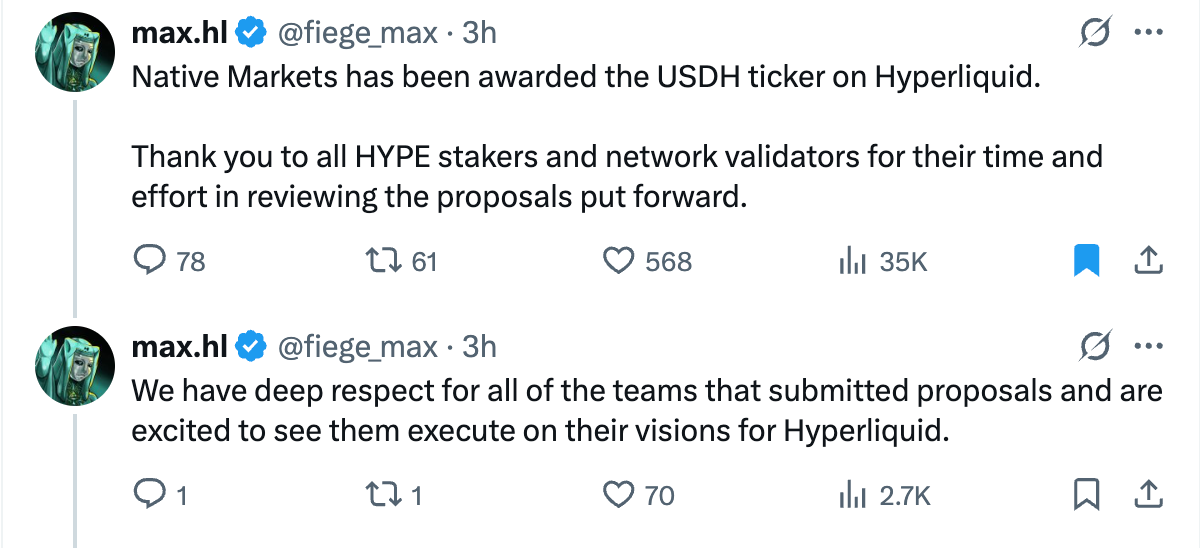
  Source: Max Fiege


The USDH bidding war was closely followed by the crypto community and industry executives, leading to accusations of a rigged selection process and reflections on the future of the stablecoin sector as a whole.

Hyperliquid’s USDH bidding war draws criticism and sparks debate

Crypto industry executives voiced mixed reactions to the USDH bidding process and the outcome of the vote, which saw established stablecoin, crypto, and payment firms lose out to a newcomer. 

“Starting to feel like the USDH RFP was a bit of a farce,” Haseeb Qureshi, managing partner of venture capital firm Dragonfly, said on Tuesday.

“Hearing from multiple bidders that none of the validators are interested in considering anyone besides Native Markets. It's not even a serious discussion, as though there was a backroom deal already done,” Quershi added.

Mert Mumtaz, the CEO of remote procedure call (RPC) node provider Helius, said that the bidding war revealed that stablecoins have become commoditized.

Mumtaz speculated that US dollar stablecoin tickers will be abstracted away in the future, and exchanges will only display a generic “USD” to front-end users.

These exchanges will do all the work of swapping the differently denominated stablecoins behind the scenes, in a backend process that the user never sees or interacts with, Mumtaz concluded.


Comments

All Comments

Recommended for you

  • AI Startup Ineffable Intelligence Secures $1.1 Billion Seed Funding, Valued at $5.1 Billion

    On April 28, AI startup Ineffable Intelligence, founded by former Google DeepMind core researcher David Silver, announced it has completed a seed funding round of up to $1.1 billion, setting a record for the largest seed investment in European history. Founded at the end of 2025, the company achieved this funding within just a few months of its establishment, with a valuation of $5.1 billion. The funding round was co-led by Sequoia Capital and Lightspeed, with participation from investors including NVIDIA, DST Global, Index Ventures, as well as Google and the UK Sovereign AI Fund. Ineffable Intelligence will focus on reinforcement learning technology, allowing AI to learn from its own experiences rather than relying on human-provided training data. This approach contrasts with the majority of mainstream AI models that are based on training with web text and is seen as an important direction towards achieving higher-level artificial intelligence. (Dongxin News Agency)

  • China Halts Meta's Acquisition of Manus, Meta Responds

    On April 28, Chinese authorities announced the halt of U.S. tech giant Meta's acquisition of the artificial intelligence startup Manus, requiring the parties involved to withdraw the acquisition deal. The National Development and Reform Commission of China stated on its official website on April 27 that the Office of the Foreign Investment Security Review Mechanism 'legally and in accordance with regulations made a decision to prohibit investment in the foreign acquisition of the Manus project, requiring the parties to withdraw the acquisition transaction.' On the same day, Meta issued a statement asserting that the deal complies with applicable laws and expressed hope that the issues raised by the Chinese side would be resolved appropriately, but did not provide further details. Meta announced the $2 billion acquisition of Manus at the end of December last year, and China confirmed its investigation into the matter in January of this year. (Dongxin News Agency)

  • Trump Expresses Discontent with Iran's Proposal to Reopen Strait of Hormuz

    On April 28, several individuals familiar with the internal discussions in the White House Situation Room revealed that President Trump has informed his aides that he does not accept Iran's latest proposal to reopen the Strait of Hormuz and end hostilities. According to officials from both the U.S. and Iran familiar with the negotiation details, the proposal also demands that the U.S. lift its maritime blockade while deliberately sidelining issues related to Iran's nuclear program. Iran has repeatedly rejected U.S. demands to suspend its nuclear program and surrender its stockpile of highly enriched uranium. The specific reasons for Trump's dissatisfaction with the proposal remain unclear, but he has consistently taken a hardline stance, stating that he will never allow Iran to develop nuclear weapons. A U.S. official admitted that accepting the proposal could prevent Trump from achieving a political victory. (Dongxin News Agency)

  • U.S. Senate Has Approximately 9 to 10 Working Weeks Left to Advance the Clarity Act as August Deadline Approaches

    On April 28, as revisions to the Clarity Act are expected to take place in May, the cryptocurrency industry is calculating how much time is left to pass comprehensive market structure legislation through a shrinking legislative window. "We have about 13 weeks left in the Senate, and we need to get some things done," said Ji Kim, CEO of the Crypto Council for Innovation, in an interview with Crypto In America, emphasizing what many in Washington see as the real deadline: getting the bill to President Trump’s desk before the August recess, when lawmakers will shift their focus to the midterm elections. Although Kim mentioned there are about 13 weeks remaining, the actual time window is tighter. Once the recess is factored in, the Senate effectively has only 9 to 10 working weeks to advance the bill, as legislators also have to deal with a busy agenda that includes the upcoming Foreign Intelligence Surveillance Act (FISA) deadline, initiating budget resolution mediation, and passing the Department of Homeland Security funding bill. However, first, the bill must pass through the Senate Banking Committee, where it has been stalled since January due to the failure to secure key industry support, delaying the initial revisions. The hoped-for April revisions are now out of reach, as Senator Thom Tillis (R-NC) requested more time from Committee Chairman Tim Scott (R-SC) to propose a compromise on stablecoin yields and incentives to the banking industry. "For me, the most important thing is not to rush the process, to hear from everyone, and to provide a rational basis for what we accept and do not accept," Tillis told reporters last week.

  • White House Cryptocurrency Advisor Hints at Major Announcement on Trump's Strategic Bitcoin Reserve in Coming Weeks

    On April 28, Patrick Witt, Executive Director of the White House Presidential Advisory Council on Digital Assets, previewed a significant announcement regarding Trump's strategic Bitcoin reserve in the coming weeks at the Bitcoin 2026 conference. Witt stated that since Trump signed the executive order to establish a strategic Bitcoin reserve last year, the team has been researching relevant mechanisms and legal interpretations to ensure that digital assets (especially Bitcoin) on the government's balance sheet are properly protected and consolidated. Meanwhile, lawmakers are pushing to codify Trump's executive action. The BITCOIN Act, reintroduced by Senator Cynthia Lummis and Congressman Nick Begich, has been renamed the 'U.S. Reserve Modernization Act,' which includes provisions to acquire one million Bitcoins over five years through a 'budget-neutral strategy.'

  • ETH Falls Below $2300

    Market data shows that ETH has fallen below $2300, currently priced at $2280.99, with a 24-hour increase of 2.89%. The market is experiencing significant fluctuations, so please ensure proper risk management.

  • BTC Falls Below $77,000

    Market data shows that BTC has fallen below $77,000, currently priced at $76,900.26, with a 24-hour decline of 1.54%. The market is experiencing significant volatility, so please ensure proper risk management.

  • MiCA-licensed Banking Circle joins bank stablecoin settlement race in Europe

    Banking Circle's stablecoin settlement launch follows its CASP approval, entering a crowded market with SocGen, Sygnum and a 12-bank euro stablecoin consortium.

  • Ethereum’s EEZ could pull other blockchains into its orbit

    The Ethereum Economic Zone aims to unify fragmented rollups, but its broader goal is to extend interoperability to other blockchains, says Ernst.

  • Bitcoin leads $1.2B weekly inflows into crypto investment products

    Crypto ETPs see $1.2 billion inflows in fourth straight week as Bitcoin leads gains and blockchain equity ETFs hit record demand, CoinShares reported.