

Cointime

Download App
iOS & Android

Luma Protocol Debuts at Hong Kong Summit|Officially Launching the Global Era of Compute-Based Finance

Validated Individual Expert

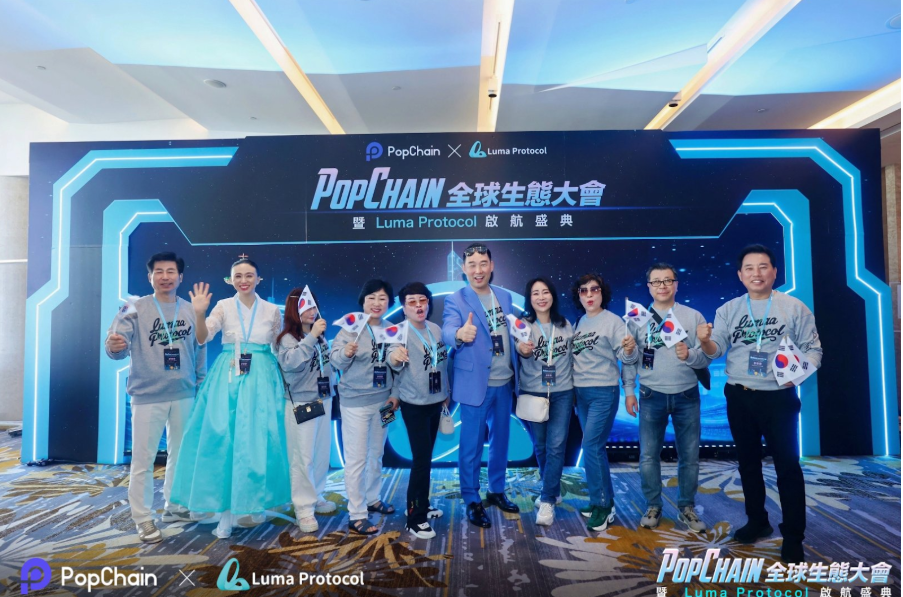
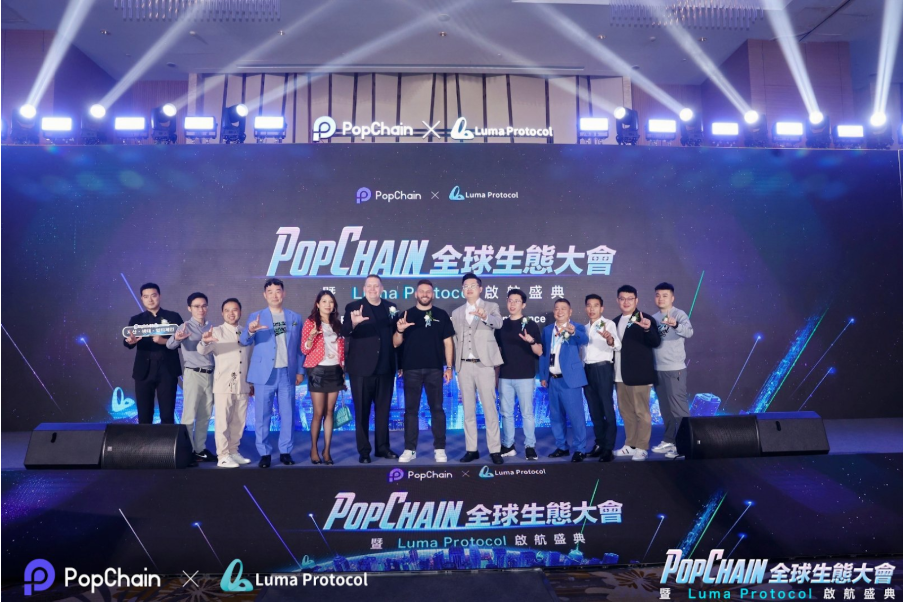
On November 8, 2025, the “Pop Chain Global Ecosystem Summit & Luma Protocol Launch Ceremony,” co-hosted by PopChain and Luma Protocol, was grandly held in Hong Kong. The conference brought together global leaders from blockchain, AI infrastructure, digital finance, and the wider Web3 economy, centering on one core theme — the arrival of the Compute-Finance era. During the event, Ben, Vice Dean of the Luma Academy, delivered the keynote speech titled “Compute is the New Yield,” formally announcing to the global ecosystem that Luma is redefining the fundamental logic of DeFi by transforming compute power from a cost center into a verifiable, priceable, tradable, and compounding financial asset — laying a new value foundation for the deep convergence of AI and Web3.
In his speech, Ben emphasized that over the past five years, “liquidity” has been the central competitive driver of DeFi. Yet with the exponential acceleration of AI, compute power has become the world’s scarcest and most structurally growing resource. Its importance is rapidly overtaking liquidity, positioning compute as the new value anchor for the next financial cycle. At this critical turning point, however, the global market still lacks a unified framework capable of standardizing, financializing, and tokenizing compute. Luma’s arrival, Ben said, is not a minor technical upgrade but a restructuring of the economic base layer. By recording compute contributions on-chain and converting computation into yield through transparent and verifiable mechanisms, Luma is establishing the world’s first sustainable Compute-Fi standard system.
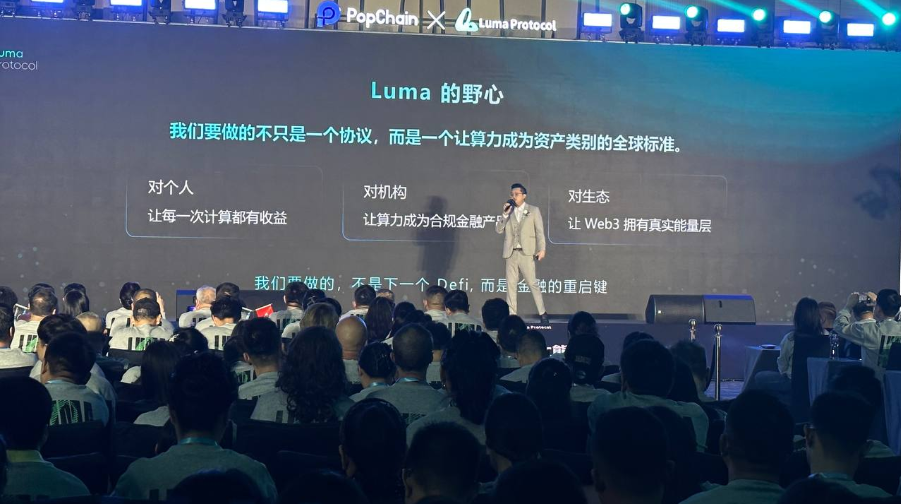
As the first protocol globally dedicated to compute-based financialization, Luma’s mission is simple yet transformative — to turn compute into an asset and computation into yield. Unlike traditional liquidity-mining models, Luma introduces compute-contribution mining, compute-yield financialization, and multi-ecosystem value circulation. It enables everyday users to generate real returns through compute participation, while giving AI training, inference, and on-chain computation clear financial attributes. Ben highlighted: “Compute will be the new Liquidity, and Luma will be the new Engine.” This shift signals the beginning of the Compute-Fi era and will fundamentally reshape the structures of Web3, AI, and the global digital asset market over the coming decade.

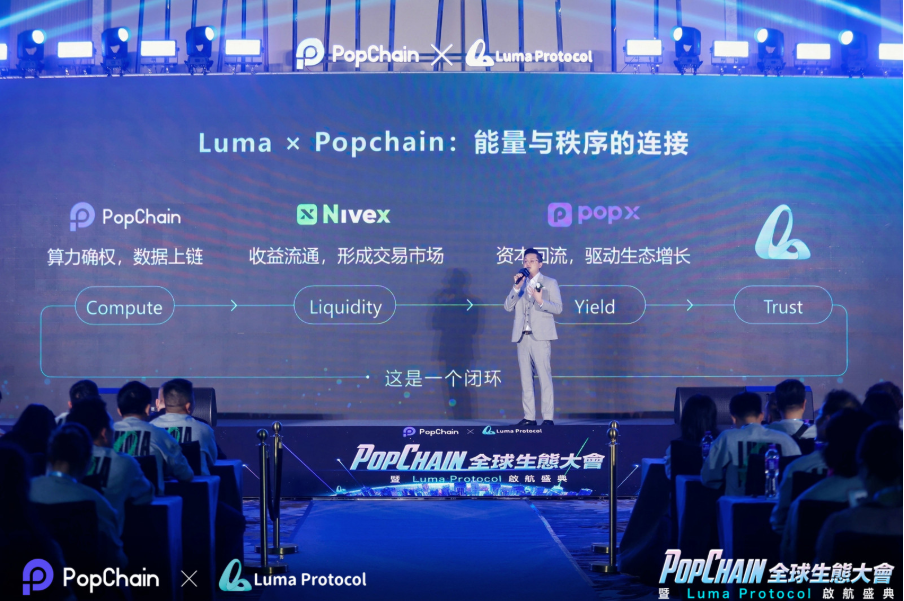
Within the broader ecosystem, Luma functions not as an isolated protocol but as the “financial engine layer” of the PopChain economy. On PopChain, Luma enables compute ownership and on-chain assetization; within the Nivex trading ecosystem, compute yield gains pricing, liquidity, and market flow; through PopX Fund, compute assets receive capital acceleration and compounding growth; and across applications such as PenFolds, Probly, and Pop Game, Luma’s data and yields feed back into the PopChain economic model, driving the ecosystem’s flywheel. Together, these interactions form a closed loop of Compute → Liquidity → Yield → Trust, making PopChain a sovereign chain with fully integrated energy, financial, and application layers. In Ben’s words: if PopChain is the body, then Luma is undoubtedly its economic heart.
Importantly, Luma’s progress has already moved well beyond narrative. The Luma mainnet test environment has demonstrated stable performance with yields exceeding those of traditional DeFi products; the protocol has passed full security audits by CertiK; partnerships with multiple AI infrastructure and GPU networks have been established, supplying real compute resources to Luma’s financial model; and the governance community now spans more than 20 countries, forming a global contributor network. These developments signal that Compute-Fi is no longer a concept but an emerging global trend.

Ben concluded his keynote by stating: “The past decade was defined by capital driving financial growth. The next decade will be defined by compute driving capital growth. Luma is not just a protocol — it is a reconstruction of value, energy, and trust. As AI and Web3 converge globally, compute will become the new benchmark for financial value, and Luma will stand at the starting point of the global compute economy.”

With the official debut of Luma Protocol, the PopChain ecosystem now stands on six strategic pillars — sovereign L1 infrastructure, compute finance, decentralized trading, entertainment applications, social content, and capital systems. This summit marks both the launch of Luma’s Compute-Fi standard and the beginning of a new phase of global, energy-driven expansion for the PopChain ConnectFi ecosystem. Looking forward, Luma will continue advancing compute ownership, financialization, and global liquidity, transforming computation into the foundational value source of the next financial era.
Comments

All Comments

Recommended for you

  • American Bitcoin's Bitcoin reserves have increased by approximately 623 BTC in the past 7 days, bringing its current holdings to 4941 BTC.

    Emmett Gallic, a blockchain analyst who previously disclosed and analyzed the "1011 insider whale," posted on the X platform revealing updated data on the Bitcoin reserves of American Bitcoin, a crypto mining company supported by the Trump family. In the past seven days, they increased their holdings by about 623 BTC, of which approximately 80 BTC came from mining income and 542 BTC from strategic acquisitions in the open market. Currently, their total Bitcoin holdings have risen to 4,941 BTC, with a current market value of about 450 million USD.

  • The US spot Ethereum ETF saw a net outflow of $19.4 million yesterday.

    according to TraderT monitoring, the US spot Ethereum ETF had a net outflow of 19.4 million USD yesterday.

  • Listed companies, governments, ETFs, and exchanges collectively hold 5.94 million Bitcoins, representing 29.8% of the circulating supply.

    Glassnode analyzed the holdings of major types of Bitcoin holders as follows: Listed companies: about 1.07 million bitcoins, government agencies: about 620,000 bitcoins, US spot ETFs: about 1.31 million bitcoins, exchanges: about 2.94 million bitcoins. These institutions collectively hold about 5.94 million bitcoins, accounting for approximately 29.8% of the circulating supply, highlighting the trend of liquidity increasingly concentrating in institutions and custodians.

  • The Bank of Japan is reportedly planning further interest rate hikes; some officials believe the neutral interest rate will be higher than 1%.

    according to insiders, Bank of Japan officials believe that before the current rate hike cycle ends, interest rates are likely to rise above 0.75%, indicating that there may be more rate hikes after next week's increase. These insiders said that officials believe that even if rates rise to 0.75%, the Bank of Japan has not yet reached the neutral interest rate level. Some officials already consider 1% to still be below the neutral interest rate level. Insiders stated that even if the Bank of Japan updates its neutral rate estimates based on the latest data, it currently does not believe that this range will significantly narrow. Currently, the Bank of Japan's estimate for the nominal neutral interest rate range is about 1% to 2.5%. Insiders said that Bank of Japan officials also believe there may be errors in the upper and lower limits of this range itself. (Golden Ten)

  • OKX: Platform users can earn up to 4.10% annualized return by holding USDG.

    According to the official announcement, from 00:00 on December 11, 2025 to 00:00 on January 11, 2026 (UTC+8), users holding USDG in their OKX funding, trading, and lending accounts can automatically earn an annualized yield of up to 4.10% provided by the OKX platform, with the ability to withdraw or use it at any time, allowing both trading and wealth management simultaneously. Users can check their earnings anytime through the OKX APP (version 6.136.10 and above) - Assets - by clicking on USDG. Moving forward, the platform will continue to expand the application of USDG in more trading and wealth management scenarios.

  • The Federal Reserve will begin its Reserve Management Purchase (RMP) program today, purchasing $40 billion in Treasury bonds per month.

     according to the Federal Reserve Open Market Committee's decision on December 10, the Federal Reserve will start implementing the Reserve Management Purchase (RMP) program from December 12, purchasing a total of $40 billion in short-term Treasury securities in the secondary market.

  • Bitcoin treasury company Strategy's daily transaction volume has now surpassed that of payment giant Visa.

    according to market sources: the daily trading volume of Bitcoin treasury company Strategy (MSTR) has now surpassed the payment giant Visa.

  • The US spot Bitcoin ETF saw a net outflow of $78.35 million yesterday.

    according to Trader T's monitoring, the US spot Bitcoin ETF had a net outflow of $78.35 million yesterday.

  • JPMorgan Chase issues Galaxy short-term bonds on Solana network

     JPMorgan arranged and created, distributed, and settled a short-term bond on the Solana blockchain for Galaxy Digital Holdings LP, as part of efforts to enhance financial market efficiency using underlying cryptocurrency technology.

  • HSBC expects the Federal Reserve to refrain from cutting interest rates for the next two years.

    HSBC Securities predicts the Federal Reserve will maintain interest rates stable at the 3.5%-3.75% range set on Wednesday for the next two years. Previously, Federal Reserve policymakers lowered rates by 25 basis points with a split vote. The institution's U.S. economist Ryan Wang pointed out in a report on December 10 that Federal Reserve Chairman Jerome Powell was "open to the question of whether and when to further cut rates at next year's FOMC press conference." "We believe the FOMC will keep the federal funds rate target range unchanged at 3.50%-3.75% throughout 2026 and 2027, but as the economy evolves, as in the past, it is always necessary to pay close attention to the significant two-way risks facing this outlook."
