

Cointime

Download App
iOS & Android

Is another Bitcoin bull run underway? This analyst thinks so

Bitcoin [BTC] may be gearing up for another surge despite a recent pullback from its 2023 high of $44,000, pseudonymous CryptoQuant analyst Tarekonchain noted in a new report.

These indicators hint at another bullish rally

Tarekonchain assessed three key on-chain indicators and found that their values have gradually increased recently.

Based on these readings, the analyst concluded that

“the bear market for Bitcoin may be subsiding, making way for the early stages of a bull cycle.”

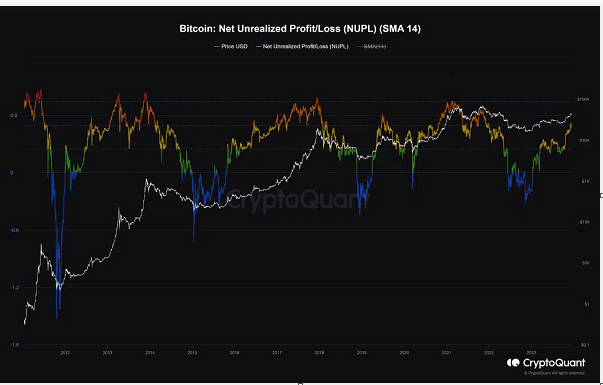
The first metric the analyst considered was BTC’s Net Unrealized Profit/Loss (NUPL). The NUPL metric determines whether BTC holders are currently experiencing unrealized gains or losses.

It compares the average purchase price of all BTCs investors hold to the current market price. When it rises above zero and remains in an uptrend, it means that BTC holders are in profit.

According to Tarekonchain a rising NUPL indicates an increasingly profitable market, often correlating with a bullish sentiment.

At 0.48, and in an uptrend, the analyst opined:

“The current trajectory of NUPL suggests an uplift in market optimism, which is a typical precursor to a bull market
Source: CryptoQuant

What the MVRV ratio says

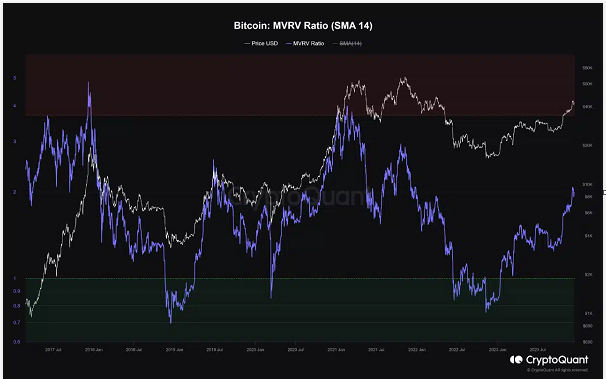
Another metric assessed by the CryptoQuant analyst was BTC’s Market Value to Realized Value (MVRV) ratio.

An asset’s MVRV ratio tracks the ratio between the asset’s current market price and the average price of every coin or token of that asset acquired.

A positive MVRV ratio above one signals an asset is overvalued, while a negative MVRV value shows that the asset is undervalued. Assessed on a 30-day small moving average, BTC’s MVRV has risen by 11% in the last 30 days.

According to Tarekonchain:

“The recent upward movement in the MVRV ratio from these lower levels may signal that the market is transitioning from undervaluation to a phase where growth is anticipated, hinting at the start of a bull cycle.”
Source: CryptoQuant

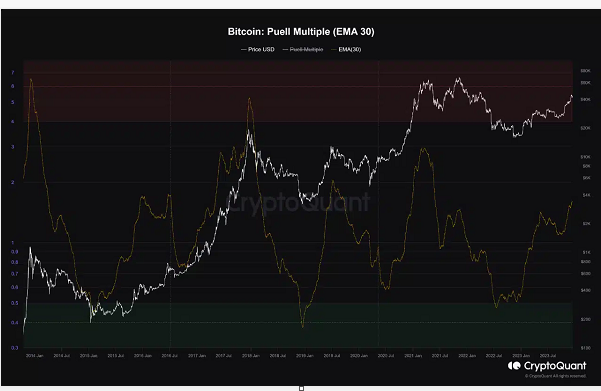
Lastly, the analyst considered BTC’s Puell Multiple. This indicator provides insights into the profitability of mining operations on the BTC network.

When the value of the metric rises, mining revenue is relatively high compared to the long-term average. On the other hand, a low Puell Multiple indicates that mining revenue is relatively low compared to the historical average.

Taking a cue from BTC’s historical performance, Tarekonchain noted that a low Puell Multiple often marks market bottoms, and many view it as an opportunity to accumulate the leading coin.

Read Bitcoin’s [BTC] Price Prediction 2023-24

With this indicator in an uptrend in recent times, the analyst concluded:

“A gradual increase in this multiple from its lower levels can be interpreted as a reduction in selling pressure and increased profitability for miners, aligning with the potential onset of a bull cycle.”
Source: CryptoQuant
Comments

All Comments

Recommended for you

  • Whale Transfers 1,133 BTC to Coinbase Prime, Valued at $71.48 Million

    According to Onchain Lens monitoring, a whale transferred 1,133 BTC from Coinbase to Coinbase Prime through an intermediary wallet, valued at $71.48 million.

  • U.S. AI Chip Stocks Decline Before Market Open, Intel Falls Over 3%

    On July 7, U.S. AI chip stocks experienced widespread declines before the market opened. Intel dropped over 3%, while AMD, Qualcomm, and NXP fell more than 2%. TSMC, Broadcom, and Tesla decreased by over 1%, and NVIDIA declined by 0.7%.

  • China's Central Bank Increases Gold Reserves for the 20th Consecutive Month

    As of the end of June, China's gold reserves stood at 75.44 million ounces (approximately 2,346.446 tons), an increase of 480,000 ounces (about 14.93 tons) from the end of May, which reported 74.96 million ounces (approximately 2,331.52 tons). This marks the 20th consecutive month of gold accumulation.

  • China's Foreign Exchange Reserves in June at $341.6262 Billion

    On July 7, China's foreign exchange reserves for June stood at $341.6262 billion, a decrease of $26 billion from the end of May, representing a decline of 0.75%, with expectations set at $343.2 billion.

  • U.S. Storage Stocks Drop Pre-Market, SanDisk and Micron Down Over 4%

    On July 7, U.S. storage concept stocks collectively fell in pre-market trading. Western Digital dropped over 5%, SanDisk and Micron Technology fell over 4%, Seagate Technology declined over 3%, Rambus fell over 2%, and SMI fell over 1%.

  • U.S. Stocks in Optical Communication Sector Drop Pre-Market

    On July 7, stocks in the optical communication sector of the U.S. market collectively fell pre-market. Astera Labs dropped over 4%, while Marvell Technology, Credo Technology, and AXT Inc. fell more than 3%. Tower Semiconductor, MaxLinear, Corning, Applied Optoelectronics, GlobalFoundries, Lumentum, and Qorvo all declined by more than 2%. Coherent, Nokia, Amphenol, and Broadcom dropped over 1%.

  • Pre-market Decline in U.S. Storage Stocks

    In pre-market trading, U.S. storage concept stocks experienced a widespread decline, with Micron Technology falling by 4.8%, SanDisk dropping over 4%, Corning down more than 2%, and Intel decreasing by over 3%.

  • Two Departments: Support for Reinsurance Institutions to Increase Capital and Issue Supplementary Capital Tools

    On July 7, the National Financial Supervision and Administration Bureau and the Shanghai Municipal Government released several measures to accelerate the construction of the Shanghai International Reinsurance Center. Among these measures, they proposed to enhance the quality and efficiency of the reinsurance industry, support reinsurance institutions in increasing capital and expanding shares, and issuing supplementary capital tools to improve the capacity for internal capital accumulation and external capital supplementation, thereby strengthening the reinsurance industry's capabilities. The initiative aims to guide the insurance industry to focus on major national projects, strategic emerging industries, and livelihood security, consolidating insurance and reinsurance underwriting capabilities to enhance risk protection levels. It also supports reinsurance institutions in leveraging their professional technical advantages to assist the insurance industry in reducing risk.

  • Sources: Saudi Arabia Plans to Expand Oil Pipeline to Red Sea, Increasing Capacity by 2 Million Barrels Daily to Bypass Strait of Hormuz

    On July 7, five informed sources revealed that Saudi Arabia is considering expanding the crude oil pipeline capacity to its western coast on the Red Sea, allowing Saudi Arabia and its neighbors to transport more oil without passing through the Strait of Hormuz. This east-west pipeline, built in the early 1980s, has gained strategic importance since the outbreak of the Iran war in February and the disruption of shipping in the Strait of Hormuz. The pipeline can deliver up to 7 million barrels of crude oil per day to the Red Sea port. The CEO of Saudi Aramco stated in May that approximately 2 million barrels are supplied to west coast refineries, while about 5 million barrels are for export. Sources indicate that Saudi Arabia is in preliminary discussions with some neighboring countries regarding the pipeline expansion, aiming to add about 2 million barrels of pipeline capacity per day. It remains unclear whether Aramco's planned expansion involves upgrading existing infrastructure or constructing new pipelines. One source mentioned that the expansion plan also includes a smaller refined oil pipeline. Two sources indicated that the expansion scale could range from 1 million to 2 million barrels per day, with refined oil also being considered. Another source stated that the project would take several years and cost billions of dollars, requiring adjustments to Saudi crude pricing mechanisms.

  • Citi: Tencent's WorkBuddy Gains Momentum, Maintains 'Buy' Rating

    On July 7, Citi released a research report stating that, according to the latest industry data, Tencent's AI agent product WorkBuddy has reached 20 million monthly active users (MAU) and over 13 million daily active users (DAU), with a DAU/MAU ratio between 65% and 75%. Considering the product has only been launched for a few months, user stickiness and daily engagement are performing strongly. Citi quoted Tencent's management as saying that in terms of daily active users, Tencent is leading its Chinese peers in the deployment of AI agents. Early user data reflects strong natural growth for both CodeBuddy and WorkBuddy, with high retention rates. Early users are interacting with the AI agents for long durations and with high frequency, creating a positive feedback loop. It is expected that AI products will become a key revenue source for Tencent Cloud. The firm believes that WorkBuddy's success demonstrates the strength of Tencent's ecosystem, the synergy between various productivity tools, and users' trust in Tencent's products and security. Citi maintains a 'Buy' rating on Tencent with a target price of HKD 763 unchanged.
