

Cointime

Download App
iOS & Android

Investment advisers ’dominating’ with $18.3B in Bitcoin, Ether ETFs

Investment advisers are the largest trackable cohort outside of retail that are buying Bitcoin and Ether exchange-traded funds, according to new data from Bloomberg Intelligence. 

Bloomberg ETF analyst James Seyffart said in an X post on Wednesday that investment advisers are “dominating the known holders” of Ether ETFs, investing over $1.3 billion or 539,000 Ether 

ETH$4,552in Q2 — an increase of 68% from the previous quarter.

  Source: James Seyffart


The same was observed in US spot Bitcoin ETFs. Seyffart said on Monday that “advisers are by far the biggest holders now,” with over $17 billion of exposure in 161,000 Bitcoin . 

In both cases, the exposure from investment advisers was nearly twice that from hedge fund managers. 

However, Seyffart said this was based on data filed with the SEC, which represents only a fraction of all the spot Bitcoin ETF holders. 

“This data is mostly 13F data. It only accounts for about 25% of the Bitcoin ETF shares. The other 75% are owned by non-filers, which is largely going to be retail,” he added. 

Crypto ETF data tells a story, analysts say

Vincent Liu, the chief investment officer at Kronos Research, said the data signals a shift from speculative flows to long-term, portfolio-driven allocations.

“As the top holders, their strategic positioning provides deeper liquidity and a lasting foundation for crypto’s integration into global markets,” he told Cointelegraph.

Liu said that as more advisers adopt Bitcoin and Ether ETFs, crypto will be recommended and recognized as a long-term diversification tool within traditional portfolios, complementing equities, bonds, and other mainstream assets.

“As more altcoins join the ETF space and yield-bearing assets like staked Ether gain approval, advisers can use crypto not just to diversify portfolios but also to generate returns, driving broader and longer-term adoption.” 

Room for advisers to lean further into crypto ETFs

Some have speculated that the number of financial advisers in crypto ETFs could explode as regulations come into force. In July, Fox News Business predicted that trillions of dollars could flood the market through financial advisers. 

  Source: Daniel Batten


Pav Hundal, lead market analyst at Australian crypto broker Swyftx, told Cointelegraph that investment adviser holdings in Bitcoin ETFs have grown by about 70% since June, triggered by softening in the US regulatory context, coupled with an almost unprecedented demand for risk-on assets.

“We’re likely still only in the early chapter of growth. Like with any investment that starts to build momentum, you get two types of participants: those who arrive early and those who come later out of fear of missing out,” he said. 

“That dynamic plays out across both institutions and retail investors. With Ethereum pressing into new all-time highs, and US policymakers hinting at a softer monetary stance as the labor market shows cracks, the setup is there for advisers to lean in further.” 

Regulation to play a role in crypto ETF growth 

Meanwhile, Kadan Stadelmann, chief technology officer of the blockchain-based Komodo Platform, told Cointelegraph the data makes it clear “Main Street, through their financial advisers, is seeking access to crypto markets through Wall Street.” 

“Ether ETFs are experiencing the success of Bitcoin ETFs, but on a smaller scale, representing a shift from early to institutional adoption. And we’re not talking about smaller Wall Street firms, but the biggest names, such as BlackRock and Fidelity,” he added. 
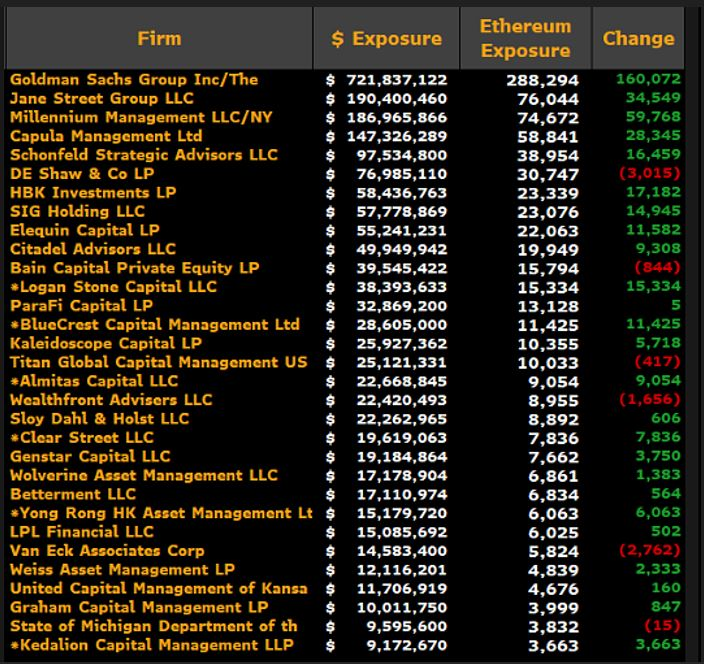
  The top holders of the Ether ETFs according to 13F data as of Q2. Source: James Seyffart


However, in the long run, Stadelmann thinks “regulatory realities” will play a role in the growth of financial advisers in the crypto market. 

The US Securities and Exchange Commission launched Project Crypto in July to foster blockchain innovation, and the US House passed the Genius Act in the same month, which represented regulatory clarity long called for by crypto lobbyists. 

“In lower Manhattan, crypto is definitely more seen as an equity than a revolution, and the move by these big players has merely been followed by financial advisers, who now have the confidence of regulatory clarity,” Stadelmann said.  

However, Stadelmann thinks that if a less crypto-friendly government were to be voted in at the next election, it could throw a spanner in the works, 

“The approach to crypto could include crackdowns, which could put a freeze over the institutional crypto market, and strike fear into the hearts of financial advisers that they could lose their licenses if they offer the products,” he said. 

“That is yet to be seen, and Democrats could leave the new status quo due to market demands.” 

Comments

All Comments

Recommended for you

  • Alphabet, Google's Parent, Plans to Raise Up to $25 Billion via Bond Issuance

    On August 6, Alphabet, Google's parent company, plans to raise up to $25 billion through bond issuance.

  • Warsh sticks to cautious market guidance, may consider September rate hike if inflation is strong

    August 6 - According to the Financial Times, Federal Reserve Chairman Warsh has maintained his typically concise communication style, even after triggering a significant sell-off in Treasuries by declining to reveal too many details about interest rate strategy. People close to Warsh said he acknowledged making some mistakes during his first 10 weeks at the helm of the world's most important central bank, including failing to reinforce his key message on price stability and causing confusion over whether his long-term plans to reform the Fed would affect near-term policy decisions. However, they insisted these errors were not enough to derail Warsh's plans for reforming the Fed. Insiders also revealed that if inflation data released in the coming weeks prove strong and market expectations for higher borrowing costs rise accordingly, Warsh is prepared to raise interest rates at the September meeting. Insiders added that although the Fed chairman has raised the possibility of shrinking the central bank's $6.7 trillion balance sheet to tighten monetary policy, interest rates remain the primary tool—and would be used at the upcoming meeting if needed.

  • SanDisk Tumbles Over 10% Pre-Market as Citigroup, Wells Fargo Cut Price Targets

    On August 6, SanDisk (SNDK.US) fell over 10% in pre-market trading. On the news front, Citigroup lowered its price target on SanDisk from $2,500 to $2,100. Meanwhile, on June 25, a month and a half earlier, Citigroup had raised its target from $2,025 to $2,500, citing improving NAND flash memory price outlook and initiating a 90-day short-term upside watch. Additionally, Wells Fargo cut its target from $1,620 to $1,400. However, just half a month earlier, on July 22, Wells Fargo had raised its target from $1,250 to $1,620.

  • Unitree Technology: Offering Price Set at RMB 150.80/Share, Online Subscription Date August 10

    On August 6, Unitree Technology (688836.SH) announced that its initial public offering of shares on the STAR Market has been priced at RMB 150.80 per share. The offering consists of 40,446,434 shares, representing 10% of the total post-offering share capital. The offering price-to-earnings ratio is 219.23 times, higher than the industry average P/E ratio of 38.56 times. The total funds expected to be raised are approximately RMB 6.099 billion, with net proceeds of approximately RMB 5.917 billion. Strategic placement subscribers were allocated 8,089,286 shares, including the Social Security Fund, DeepSeek, and China National Petroleum Corporation. The online subscription date is August 10, and the payment date is August 12.

  • Amazon Shares Surge 15.2%, Biggest Gain Since 2012

    On July 31, Amazon shares surged 15.2% to $271.255 per share, marking their biggest gain since 2012, with a total market value of $2.92 trillion.

  • US Treasury Secretary Bessent Vows to Track Down Iranian Assets Globally for Terror Victims

    US Treasury Secretary Bessent said the US will actively track down Iranian assets worldwide to ensure compensation funds for victims of Iran-backed terrorist activities. Bessent stated that the US government's military and economic blockade measures against the Iranian regime will continue and will not be relaxed. (Jinshi)

  • Apple Plunges Nearly 10%, Q4 Revenue Guidance Misses Expectations

    On July 31, Apple (AAPL.US) plunged nearly 10% to $300.33, marking its biggest drop since April 2025. In terms of fundamentals, Apple's third-fiscal-quarter revenue rose approximately 16% year-over-year to $109.42 billion, slightly above analyst expectations. Among the details, product revenue came in at $78.68 billion, beating the expected $77.25 billion. However, services revenue—a key driver of its valuation re-rating in recent years—totaled $30.74 billion, missing the consensus estimate of $31.36 billion. Additionally, Greater China revenue reached $18.82 billion, with year-over-year growth slowing to 22%, also below analysts' forecast of $19.58 billion. During the earnings call, Apple guided fourth-fiscal-quarter revenue growth in the range of 9% to 11%, overall below the 12.1% analysts had expected. CFO Parekh noted that component supply constraints would impact iPhone, Mac, and iPad businesses in the fourth fiscal quarter, with currency fluctuations also constraining growth.

  • Three Fed Officials Back Rate Hike, Hawkish Pressure Builds

    On July 31, three Federal Reserve policymakers said that dissenting votes in favor of a rate hike this week stemmed from stubborn inflationary pressures, highlighting rising internal pressure on Fed Chair Warsh to act. In statements released Friday morning, Hammack and Kashkari said they worry that although the current round of price increases may stem from short-term factors such as President Trump's tariff policies and the Iran war, the inflation situation already warrants Fed action. Logan also joined in, saying that even if inflation cools, if the Fed does not raise rates, inflation is unlikely to fully fall back to the Fed's 2% target; without any policy constraints, inflation could continue to run above target until an unexpected shock occurs. Kashkari said that if inflation remains persistently stubborn, he might support a series of rate hikes, not just a single increase, to prevent inflation from becoming further entrenched. He said: "A series of small policy adjustments may be preferable to waiting for developments to unfold and ultimately having to take more forceful action." Hammack said that if the Fed does not tighten policy, price increases could continue to accelerate. She said: "Inflation has been stubbornly above 2% for more than five years, and I have no confidence that it will return to our target on its own." (Jin Shi)

  • US 10-Year Treasury Yield Rises to 4.7388%, Highest Since January 2025

    On July 31, the US 10-year Treasury yield rose to 4.7388%, the highest level since January 2025.

  • Spot Gold Intraday Decline Widens to 2%, at $4,021.08 per Ounce

    On July 31, spot gold's intraday decline widened to 2%, reported at $4,021.08 per ounce.
