


Key takeaways:
- Gemini AI serves as a powerful tool for researching day trade strategies but cannot be used to execute trades directly.
- It summarizes fundamentals and compares assets to support daily trade decisions but still requires access to data sets.
- Gemini AI helps manage trading discipline by turning watchlists, catalysts and post-mortems into structured loops that prevent traders from chasing noise.
- Gemini Flash 2.5, the latest version, still lacks real-time data access, so pair it with data from tools like TradingView, Glassnode or Nansen.
Day trading crypto moves fast, order books flip, narratives rotate, and liquidity pockets appear then vanish. Google’s Gemini AI can help you organize information, test ideas and automate routine analysis. It can function as a smart assistant that allows you to filter noise, structure market data and enable you to make insight-driven decisions.
This article shows you a workflow to research, simulate and automate parts of a day-trading stack using Gemini AI without handing it your keys or “letting the AI trade for you.”
It is important to note that all prompts and examples were tested on Gemini Flash 2.5, which doesn’t stream real-time market data. That means you’ll need to cross-check AI-generated insight against live charts and reliable sources before acting on it. Crypto is volatile, so do your own research and trade responsibly.
How AI makes crypto day trading better
Day trading in crypto means opening and closing positions within the same day, often within hours or even minutes. Unlike swing traders who ride trends for days or long-term investors who hold for months, day traders thrive on short-term price moves.
Volatility is their playground, and crypto offers it in overdrive. That overdrive shows up in several ways unique to crypto markets:
- 24/7 markets: There’s no closing bell. BTC can break out at 3 am.
- Narrative-driven pumps: A token upgrade or social media post can flip sentiment instantly.
- Liquidity pockets: Order books thin out, and slippage can wreck an unplanned entry.
- Noise overload: Telegram, X, Discord, onchain alerts and macro news with hundreds of signals compete for attention.
This is where AI tools like Google’s Gemini fit in. They don’t replace the trader but act as a co-pilot. They help by:
- Summarizing order flow and sentiment
- Filtering catalysts that actually move the price from background noise
- Structuring data into sheets or dashboards so you see setups clearly
- Helping you write, test and refine rules (instead of chasing FOMO).
What Gemini can (and can’t) do for crypto day traders
What it can do well
- Reason over large context: Newer Gemini releases (e.g., Gemini 2.5 Pro) focus on long-context reasoning and strong coding ability, ideal for stitching market data and your notes into actionable summaries.
- Live inside your tools: Gemini works across Google Workspace apps, including Docs and Sheets, where it can summarize data, clean it and generate charts, now even through in-cell AI functions in Sheets.
- Developer-friendly: With Google AI Studio and the Gemini API, you can programmatically prompt models, analyze data sets and integrate outputs into your scripts or dashboards.
What it shouldn’t do (directly)
Hold crypto keys or auto-trade unsupervised. Keep Gemini focused on analysis, signal generation, backtesting and alerts. If you do connect to an exchange API, strictly gate permissions.
Did you know? Google’s Gemini can process up to 1 million tokens in a single prompt, meaning traders can feed entire research reports, news flows and charts into one query for faster insights.
Select and set up your Gemini access and workspace
1. Pick your Gemini access level
- Google AI Studio + API key for developers building prompts and scripts.
- Gemini in Workspace (Docs/Sheets) for no-code research and dashboards.
- Google now bundles “Advanced” features under the Google AI Pro subscription for the Gemini app (bigger context windows, deeper research and brainstorming ideas with Gemini). If you need maximum context for multi-asset intraday notes, that can help.
2. Create a trading notebook in Google Sheets
Once you’ve chosen your Gemini access (Sheets, Docs or API for developers), the next step is to create a trading notebook, a structured space where AI helps you organize chaos into clarity.
A simple Google Sheet with six tabs, as follows, can be a start:
- Watchlist: Track the tokens you’re monitoring.
- Catalysts: Note key events (upgrades, unlocks, macro reports).
- Levels: Mark out support, resistance and liquidity pockets.
- Order flow: Capture onchain flows, funding rates or order book imbalance.
- Plan: Write your playbook before the session begins.
- Post-mortem: Log what worked, what failed and what to improve.
Instead of staring at X or 10 chart tabs, you’re creating a repeatable loop: Watchlist → Catalysts → Levels → Plan → Order Flow → Post-Mortem → back to Watchlist. Gemini slots into each step as a reasoning partner.
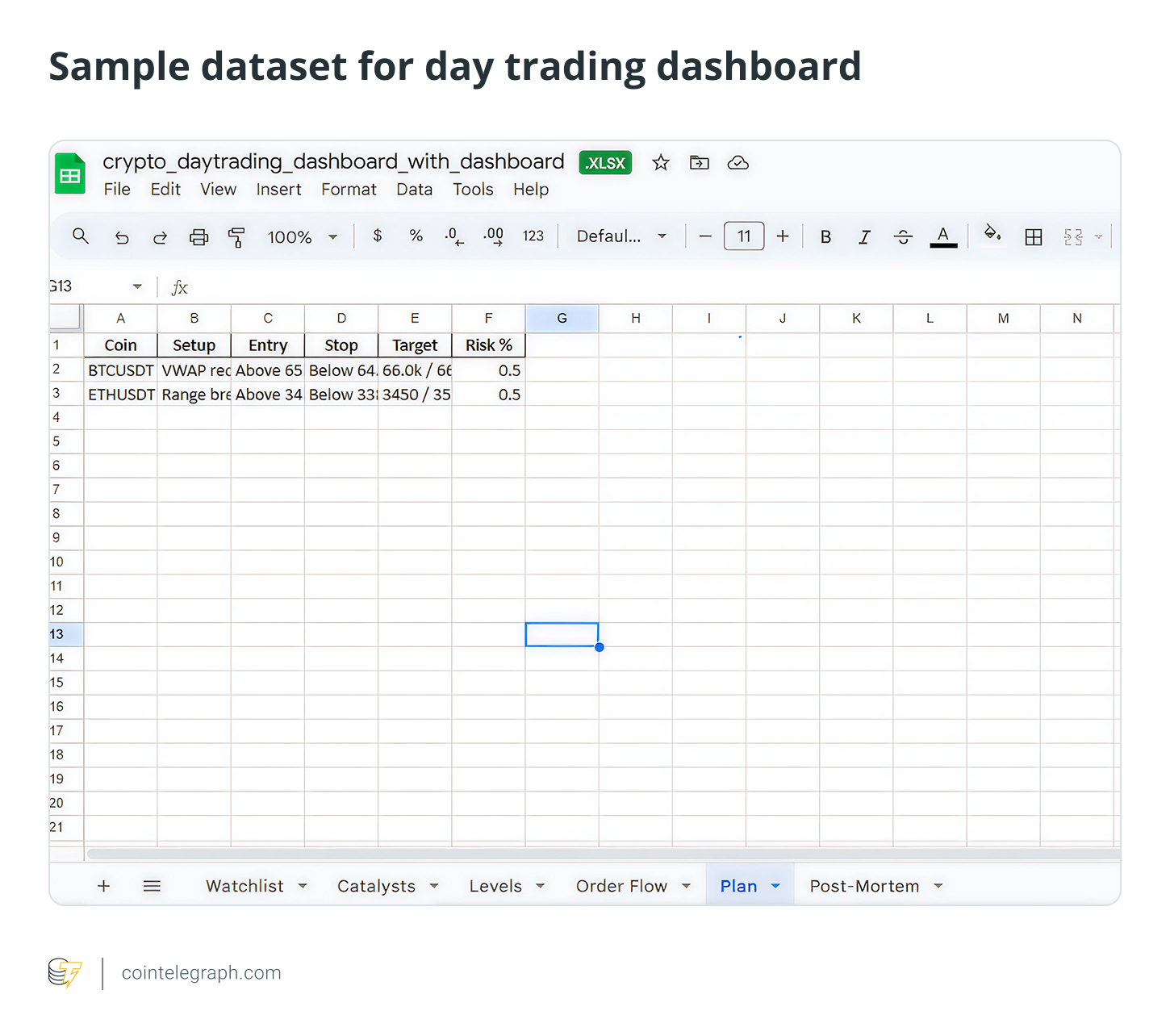
While you can manually create data sets, another way to run a trading loop is via data sets downloaded from analytics providers like Glassnode, TradingView or CryptoQuant.
Did you know? In a 2025 global survey of regulators, IOSCO reported that among broker-dealers, algorithmic trading (63%) was one of the most commonly observed AI use cases, alongside surveillance (53%), client communications (67%) and market analysis/trading insights (40%).
Day trade using Gemini AI
Example: Using Gemini AI to refine a watchlist
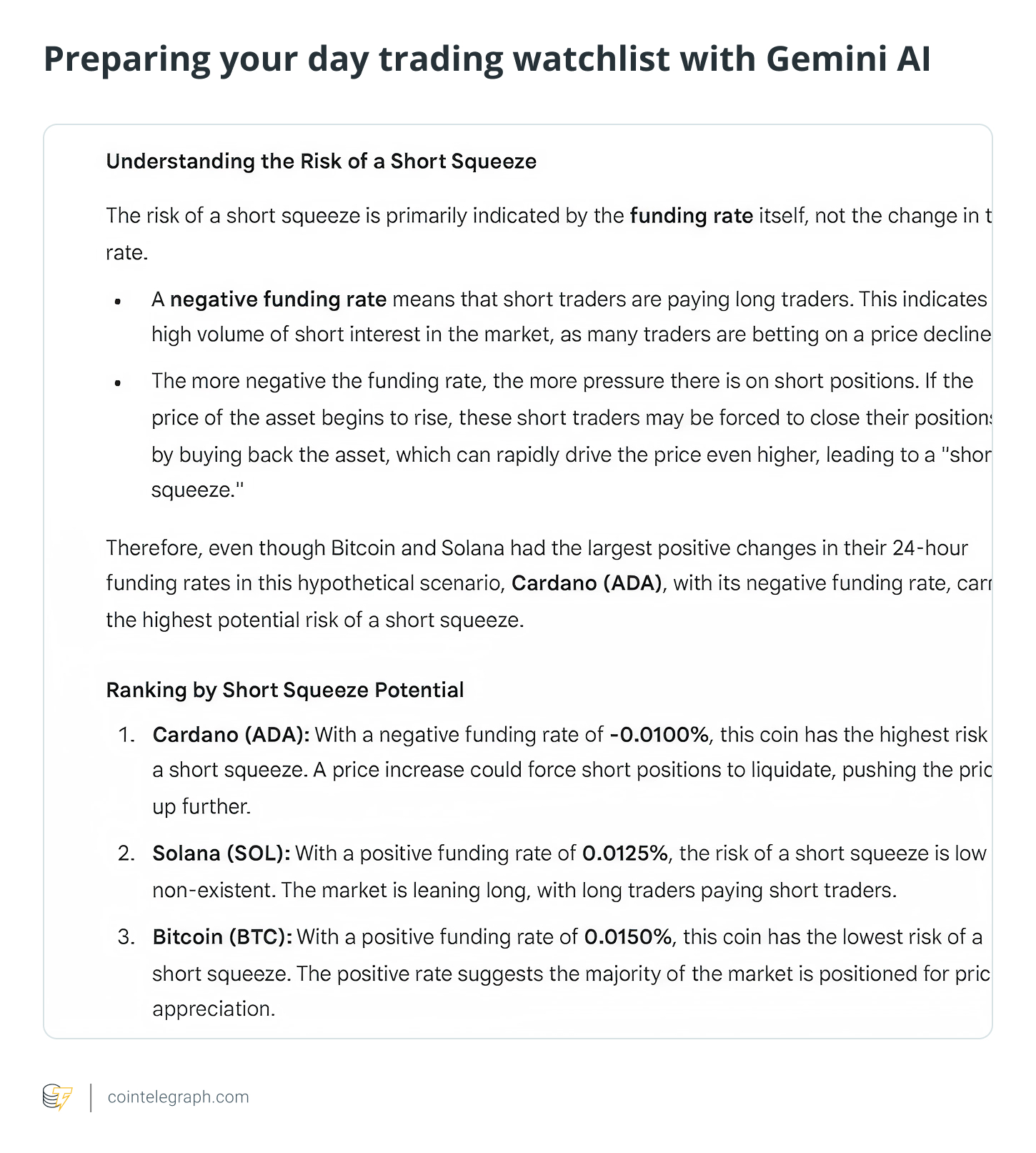
Say your watchlist includes Bitcoin , Cardano and Solana. Instead of scanning 50 tokens, you ask Gemini to highlight which ones had the biggest market swings or the highest percentage changes in the past 24 hours (pulled from your own data feed or an external data platform).
A prompt might look like:“Summarize the top three coins by 24-hour price change from this data set. Rank them by potential risk of shorting.”
Gemini will produce you context and a structured ranking that helps you focus your limited time on the most volatile assets based on the data set you provided.
Example: Using Gemini AI for catalyst filtering
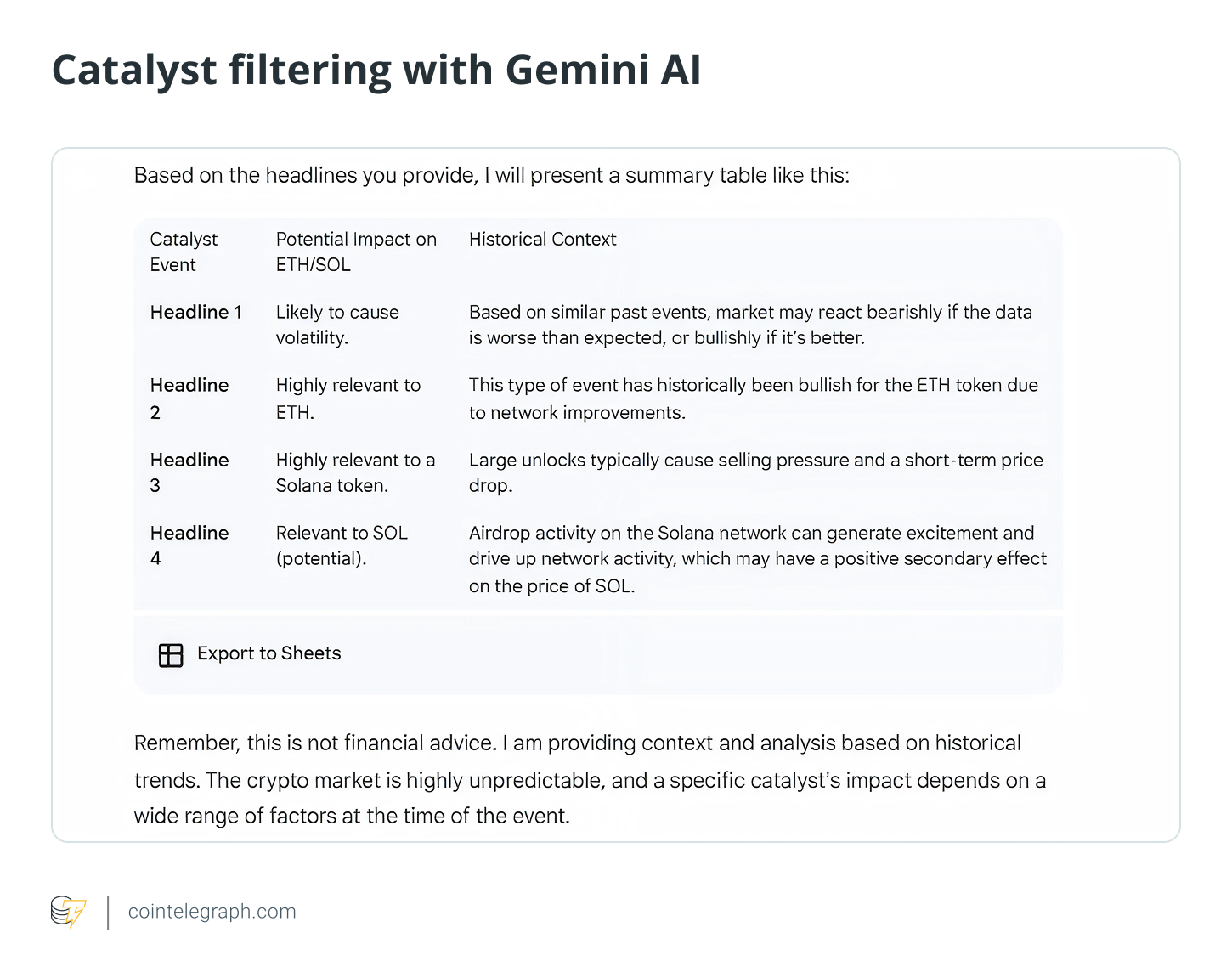
Catalysts drive intraday moves, Consumer Price Index reports, US Federal Reserve minutes, token unlocks, tech upgrades or even airdrop rumors. But there’s more noise than signal. Instead of manually scrolling through X or Discord, paste in the headlines and ask Gemini AI.
A prompt might look like:
“Flag which of these news catalysts are most likely to impact ETH and SOL in the next 12 hours, based on past price reactions.”
Example: Levels and liquidity mapping
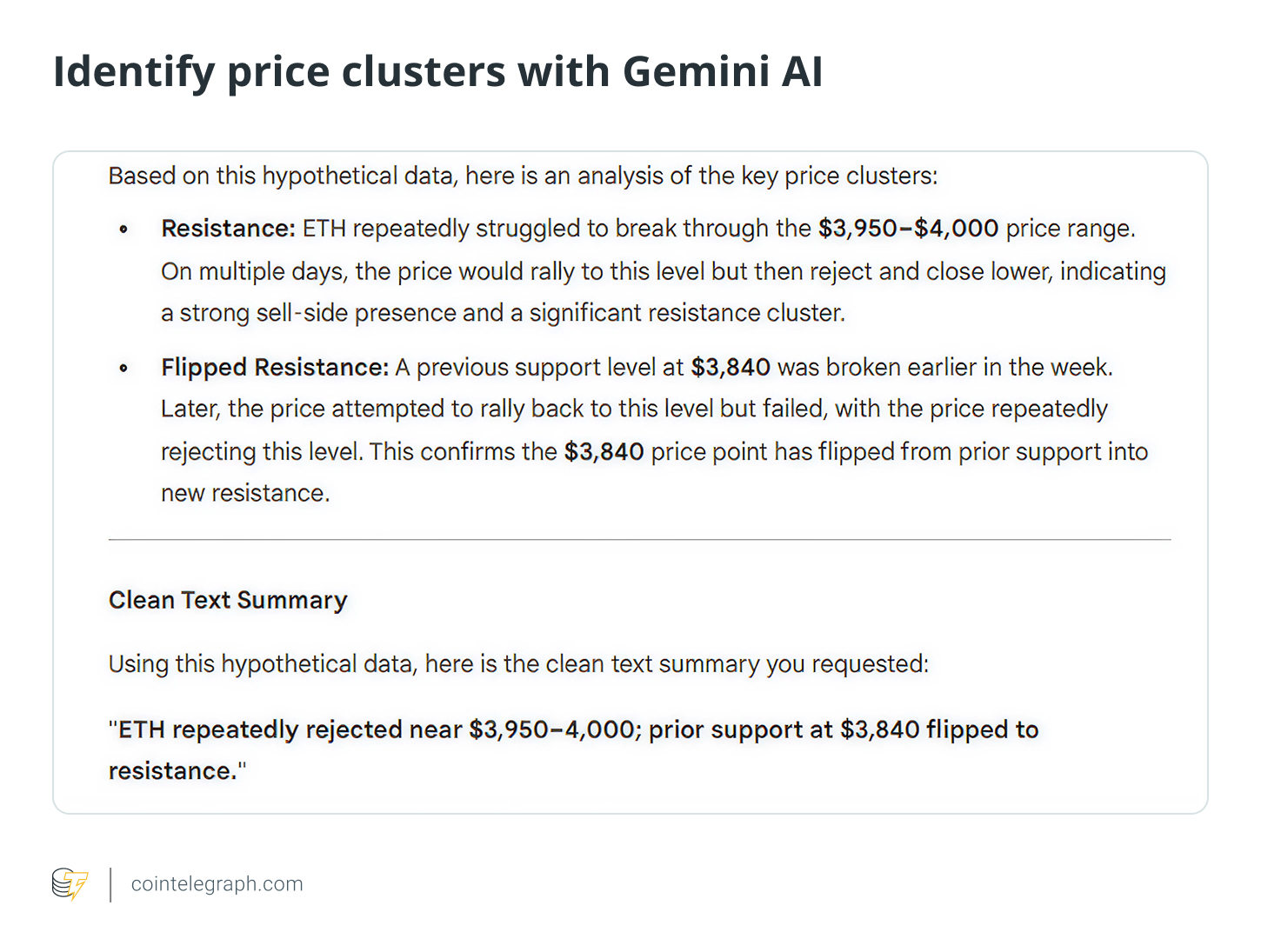
Support and resistance levels are the bread and butter of day trading. Gemini can’t stream live order books, but you can feed it recent OHLCV (open, high, low, close and volume) data or your own notes, then ask:
“Identify the key price clusters where ETH was rejected multiple times this week and summarize as possible resistance.”
Instead of eyeballing, you get a clean text summary: “ETH repeatedly rejected near $3,950-$40,000; prior support at $3,840 flipped resistance.”
Example: Using Gemini AI for order flow sentiment
If you’re tracking open interest, long/short ratios or whale wallet flows, Gemini AI can help make sense of it:
“Summarize whether current BTC futures positioning looks more skewed to longs or shorts.”
You still need the raw BTC data downloaded from your trading portals, but Gemini AI’s summary can help you avoid tunnel vision. Instead of staring at numbers, you can request an interpreted snapshot that tells you whether the crowd is leaning long, short or neutral.
Example: Using Gemini AI for a daily trading plan
The Plan tab is where Gemini helps enforce discipline. A prompt like:
“Take today’s Watchlist, Catalysts and Levels tabs and draft three possible intraday scenarios with triggers and invalidations.”
That might provide an output like:
- Scenario A:Ether breaks above $3,000 on high volume; long scalp with stop at $2,960.
- Scenario B: BTC rejects $105,000 resistance again and fades into $100,000.
- Scenario C: SOL reacts negatively to unlock event; short bounce into $170.
Now you’ve got a structured plan instead of winging it.
Example: Using Gemini AI for a post-mortem review
After the session, you can paste your trades into Gemini AI and ask:
“Analyze my last five trades and identify patterns in mistakes or strengths.”
It might spot that you cut winners too early but let losers run, or that you always overtrade during high volatility. This turns mistakes into structured lessons.
How can Gemini AI support risk management?
Risk is the one variable every day trader must control because surviving bad trades matters more than catching perfect ones. Use Gemini AI for a discipline check:
- Position sizing: Share your account size and maximum risk per trade, and Gemini AI can calculate position sizes under different leverage scenarios.
- Scenario planning: Instead of mapping only bullish setups, prompt Gemini AI to also outline bearish and sideways cases so you’re never locked into one bias.
- Risk-to-reward ratios: Paste your planned setups into Gemini and ask it to rank them by “r/r” ratio. This keeps your focus on the highest-quality trades.
- Capital allocation: Ask Gemini to summarize your exposure across assets (e.g., too much ETH beta) so you can rebalance before it’s too late.
Day trading crypto will always be a high-speed, high-risk game. What Gemini AI offers isn’t shortcuts, but the ability to process more information, stick to your rules and refine strategies faster than you could alone.


All Comments