

Cointime

Download App
iOS & Android

How Polkadot is transforming blockchain technology: Report

Cointime Official

From cointelegraph by John W

Polkadot 2.0: The evolution

Polkadot is preparing for its biggest upgrade yet: Polkadot 2.0. The upgrade is expected to roll out in phases throughout 2024 and introduce key features such as Asynchronous Backing, Agile Coretime and Elastic Scaling.  

Cointelegraph Research’s latest report provides an overview of Polkadot 2.0’s evolution and discusses other key developments for Polkadot, such as its ecosystem growth and adoption by developers.

With the launch of Asynchronous Backing in May, block processing has become more efficient, wait times have been reduced, and overall network performance has been boosted. Agile Coretime, launched in September, opens up new opportunities for developers. It lowers entry barriers and enables on-demand blockspace purchases to cut costs for projects with variable resource demands. 

Lastly, Elastic Scaling, expected in late 2024 or early 2025, will further expand the network’s capacity. This feature lets Polkadot accommodate more blockchains and handle higher transaction volumes without sacrificing security or performance. The report provides more detailed technical descriptions of these updates.

Download a full version of the report for free here

Governance and DAO growth

Polkadot has seen a surge in governance activity and a growing number of decentralized autonomous organizations (DAOs) throughout 2023 and 2024. The number of referenda submitted has increased by 150%, and voter turnout has grown by 40% since 2023. In July alone, over 1,134 unique voters participated in governance activities, illustrating the network’s commitment to community engagement.

Polkadot’s governance mechanism, OpenGov, stands out because it is an onchain system for real-time, transparent and democratic decision-making. Any Polkadot DOT$3.74 holder can submit a proposal through OpenGov, but not all proposals automatically go to a referendum. To move forward, a proposal must acquire enough backing through a deposit of DOT or by receiving support from the community or the council.

One notable example of successful governance in action is Referendum 234, which proposed a 20% increase in the treasury allocation toward ecosystem development projects. With over 75% of participating DOT holders voting in favor, this referendum has already sparked new funding opportunities and development activity on the platform.

Developer ecosystem and adoption metrics

Polkadot’s developer community is among the most active in the blockchain space. The network has attracted nearly 2,500 developers, with almost 800 working full-time on the platform. Polkadot’s software development kit offers developers a modular framework that reduces the complexity involved in building customized blockchains. This flexibility, combined with support for multiple programming languages such as WebAssembly, has made Polkadot a common choice for projects in the recent past. 
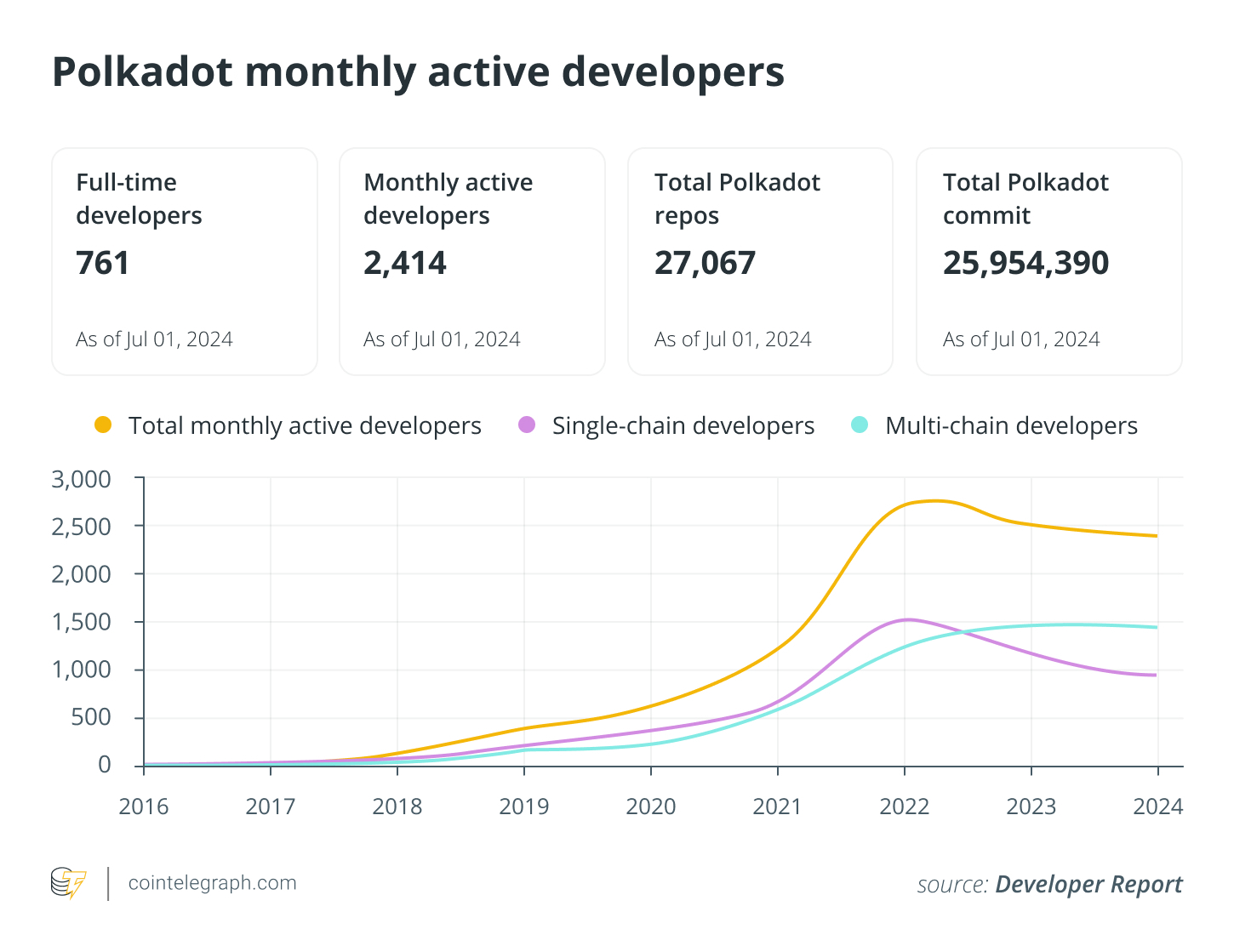
Polkadot has positioned itself as an adaptable and scalable layer-zero blockchain that addresses scalability, interoperability and governance fundamentals. Its parallel processing capabilities, community-driven governance and ambitious roadmap make it a promising platform. As Polkadot continues to evolve, it is expected to play an important role in the future of decentralized applications, Web3 and beyond.

Comments

All Comments

Recommended for you

  • American Bitcoin's Bitcoin reserves have increased by approximately 623 BTC in the past 7 days, bringing its current holdings to 4941 BTC.

    Emmett Gallic, a blockchain analyst who previously disclosed and analyzed the "1011 insider whale," posted on the X platform revealing updated data on the Bitcoin reserves of American Bitcoin, a crypto mining company supported by the Trump family. In the past seven days, they increased their holdings by about 623 BTC, of which approximately 80 BTC came from mining income and 542 BTC from strategic acquisitions in the open market. Currently, their total Bitcoin holdings have risen to 4,941 BTC, with a current market value of about 450 million USD.

  • The US spot Ethereum ETF saw a net outflow of $19.4 million yesterday.

    according to TraderT monitoring, the US spot Ethereum ETF had a net outflow of 19.4 million USD yesterday.

  • Listed companies, governments, ETFs, and exchanges collectively hold 5.94 million Bitcoins, representing 29.8% of the circulating supply.

    Glassnode analyzed the holdings of major types of Bitcoin holders as follows: Listed companies: about 1.07 million bitcoins, government agencies: about 620,000 bitcoins, US spot ETFs: about 1.31 million bitcoins, exchanges: about 2.94 million bitcoins. These institutions collectively hold about 5.94 million bitcoins, accounting for approximately 29.8% of the circulating supply, highlighting the trend of liquidity increasingly concentrating in institutions and custodians.

  • The Bank of Japan is reportedly planning further interest rate hikes; some officials believe the neutral interest rate will be higher than 1%.

    according to insiders, Bank of Japan officials believe that before the current rate hike cycle ends, interest rates are likely to rise above 0.75%, indicating that there may be more rate hikes after next week's increase. These insiders said that officials believe that even if rates rise to 0.75%, the Bank of Japan has not yet reached the neutral interest rate level. Some officials already consider 1% to still be below the neutral interest rate level. Insiders stated that even if the Bank of Japan updates its neutral rate estimates based on the latest data, it currently does not believe that this range will significantly narrow. Currently, the Bank of Japan's estimate for the nominal neutral interest rate range is about 1% to 2.5%. Insiders said that Bank of Japan officials also believe there may be errors in the upper and lower limits of this range itself. (Golden Ten)

  • OKX: Platform users can earn up to 4.10% annualized return by holding USDG.

    According to the official announcement, from 00:00 on December 11, 2025 to 00:00 on January 11, 2026 (UTC+8), users holding USDG in their OKX funding, trading, and lending accounts can automatically earn an annualized yield of up to 4.10% provided by the OKX platform, with the ability to withdraw or use it at any time, allowing both trading and wealth management simultaneously. Users can check their earnings anytime through the OKX APP (version 6.136.10 and above) - Assets - by clicking on USDG. Moving forward, the platform will continue to expand the application of USDG in more trading and wealth management scenarios.

  • The Federal Reserve will begin its Reserve Management Purchase (RMP) program today, purchasing $40 billion in Treasury bonds per month.

     according to the Federal Reserve Open Market Committee's decision on December 10, the Federal Reserve will start implementing the Reserve Management Purchase (RMP) program from December 12, purchasing a total of $40 billion in short-term Treasury securities in the secondary market.

  • Bitcoin treasury company Strategy's daily transaction volume has now surpassed that of payment giant Visa.

    according to market sources: the daily trading volume of Bitcoin treasury company Strategy (MSTR) has now surpassed the payment giant Visa.

  • The US spot Bitcoin ETF saw a net outflow of $78.35 million yesterday.

    according to Trader T's monitoring, the US spot Bitcoin ETF had a net outflow of $78.35 million yesterday.

  • JPMorgan Chase issues Galaxy short-term bonds on Solana network

     JPMorgan arranged and created, distributed, and settled a short-term bond on the Solana blockchain for Galaxy Digital Holdings LP, as part of efforts to enhance financial market efficiency using underlying cryptocurrency technology.

  • HSBC expects the Federal Reserve to refrain from cutting interest rates for the next two years.

    HSBC Securities predicts the Federal Reserve will maintain interest rates stable at the 3.5%-3.75% range set on Wednesday for the next two years. Previously, Federal Reserve policymakers lowered rates by 25 basis points with a split vote. The institution's U.S. economist Ryan Wang pointed out in a report on December 10 that Federal Reserve Chairman Jerome Powell was "open to the question of whether and when to further cut rates at next year's FOMC press conference." "We believe the FOMC will keep the federal funds rate target range unchanged at 3.50%-3.75% throughout 2026 and 2027, but as the economy evolves, as in the past, it is always necessary to pay close attention to the significant two-way risks facing this outlook."
